
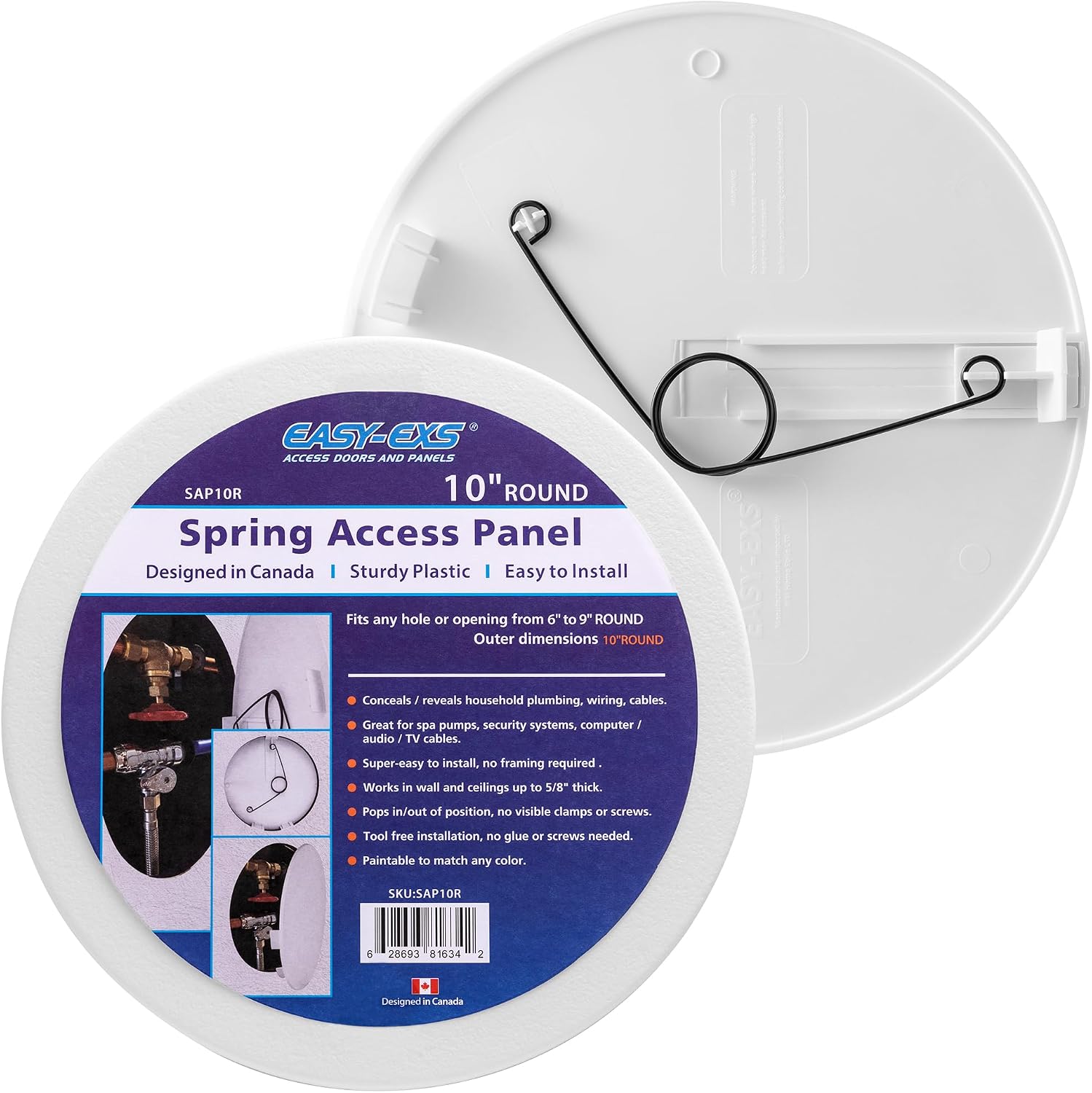
Easy-Exs · SAP10R
10 in Round Spring-Loaded Access Panel for 6–9 in Openings
Rated 4.5 out of 5, 243 ratings online
Fits 6–9 in round openings · Overall 10 in diameter
USD $10.99 each
- 10+ panels: $9.49 each
- 80+ panels: $7.49 each
Access panels and doors for your next project
Pot lights, speakers and cameras
Take out a recessed light (a pot light or can light), a ceiling speaker or a camera and you are left with a round hole, sometimes with wiring above it. A round access panel works as a cover plate: it closes the hole and comes out again when you need to reach above. Measure across the center of the hole and pick the cover whose listed opening includes it.
3 products
Easy-Exs · SAP10R
Rated 4.5 out of 5, 243 ratings online
Fits 6–9 in round openings · Overall 10 in diameter
USD $10.99 each
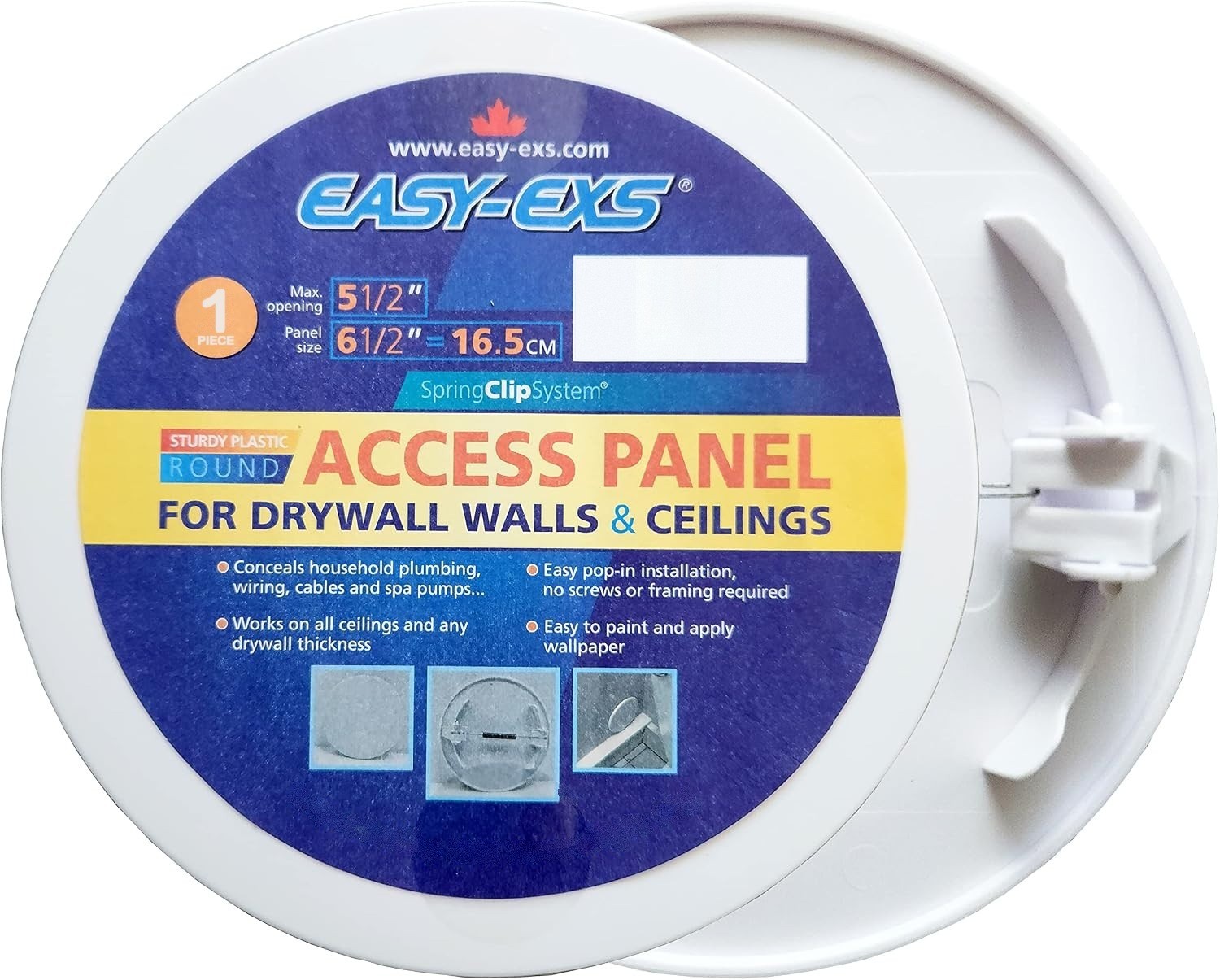
Easy-Exs · PAP65
Fits 5.25–5.5 in round openings (smallest estimated) · Overall 6.5 in diameter
USD $6.49 each
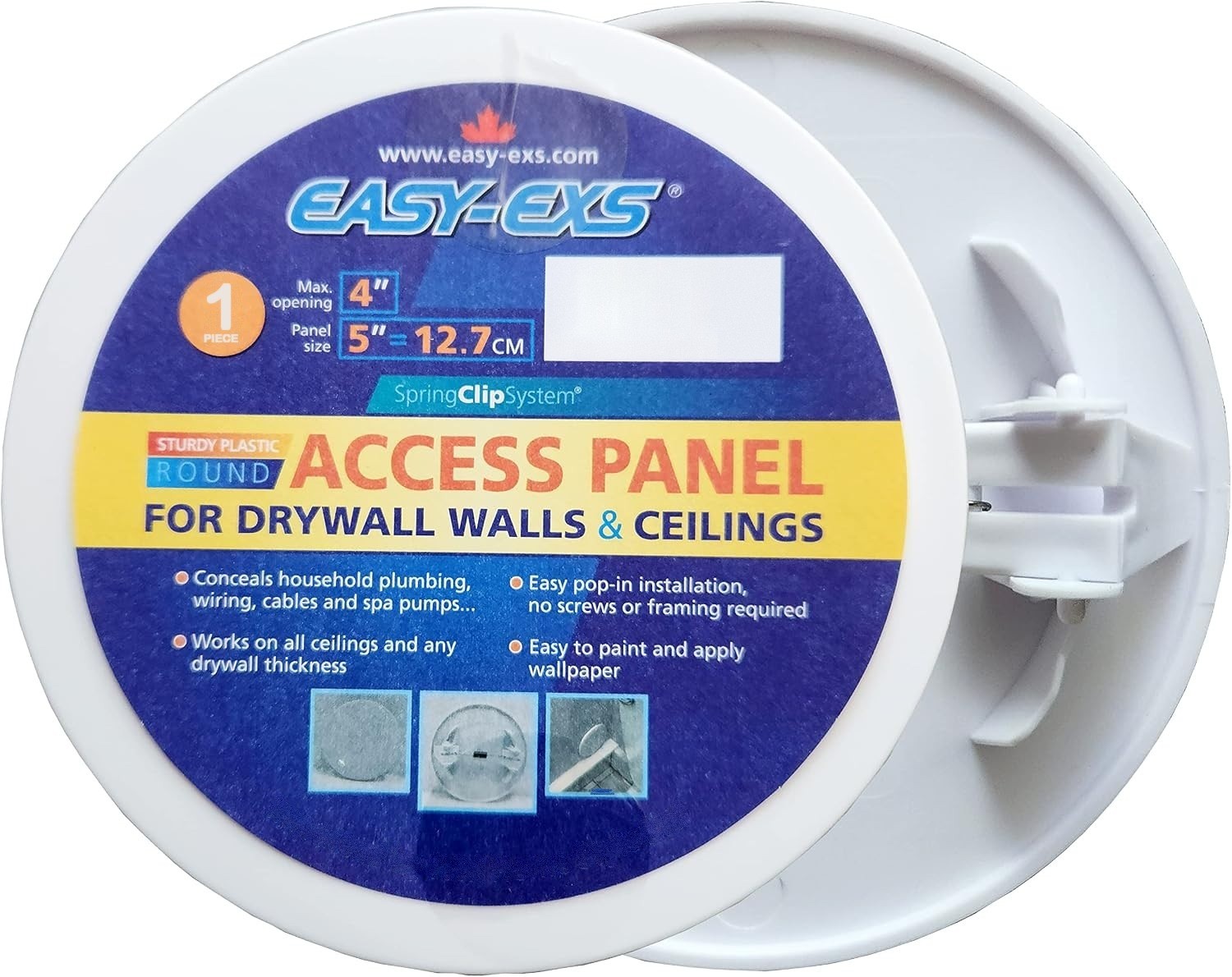
Easy-Exs · SAP50
Fits 3.75–4 in round openings (smallest estimated) · Overall 5 in diameter
USD $5.49 each
Measure straight across the center of the hole, in two directions, and use the larger figure. Then match it to a listed opening:
A hole between 4 and 5.25 in, or between 5.5 and 6 in, fits none of them as it is: enlarge it to at least 5.25 in for the PAP65 or 6 in for the SAP10R. The Click-Fit covers' smallest holes are estimated from their CAD, so if your hole is close to 3.75 in or 5.25 in, ask us before you order.
A hole wider than 9 in is too big for any round cover we sell. Cut it square instead: the SAP1414 panel fits square openings from 10 × 10 to 14 × 14 in under a 16 × 16 in cover. The panel finder runs this check for any diameter you type in.
The same hole has three possible fixes, and they do different jobs:
If the cable that fed the light stays in the ceiling, any box that holds its connections has to stay reachable:
A round cover over the hole keeps the box within reach without opening the ceiling. It is not a box cover, and it is not a way to hide wiring that should be finished properly. Have a licensed electrician terminate the wiring in a box before you close the hole, and turn off the circuit before you work near it.
A hole left by a ceiling speaker, or by the cable behind a camera, is measured the same way. Measure the hole itself, not the speaker grille or the camera base that used to cover it. If the cut-out is wider than 9 in, square it off for a square panel as described above.
Check the surface around the hole before you order. The cover needs a flat, sound edge all the way around: 5 in across for the SAP50, 6.5 in for the PAP65 and 10 in for the SAP10R.
A pot light in a top-floor ceiling may sit right below an unheated attic, so its hole passes through the ceiling's air barrier. The product records for these covers don't list a gasket, weatherstripping or insulation, so ask your building department what it accepts over a hole into an attic. In the US, the energy code your state or city adopts may also set rules for openings into an attic.
All three models are in the round access panels category, and the guide to measuring a round opening covers the measurement step by step.
Measure across the center of the hole itself, not the old trim. The SAP50 fits round openings of about 3.75 to 4 in, the PAP65 about 5.25 to 5.5 in (their smallest estimated) and the SAP10R from 6 to 9 in. A hole over 9 in can be cut square for the SAP1414 panel, which fits square openings from 10 × 10 to 14 × 14 in.
No. A goof ring is a trim ring that hides the gap around a new light fitted in a hole that is too big for its trim. A round access panel is a blank cover plate for a hole with no fixture in it, and it comes out when you need to reach above. We don't sell goof rings.
In the US, section 314.29 of the 2023 National Electrical Code says boxes must be installed so the wiring and devices in them are accessible, and allows removable covers that keep that access. A round cover over the hole keeps the box reachable. In Canada, ask your provincial electrical inspection authority; your inspector decides what counts as accessible.
Yes, if the hole is round and within a listed opening: about 3.75 to 4 in, about 5.25 to 5.5 in (the smallest estimated), or 6 to 9 in across. Measure the hole, not the speaker grille. For a cut-out wider than 9 in, cut the hole square and use a square panel.
No. None of the round covers is fire-rated, and none is listed for a fire-rated ceiling or wall assembly.