
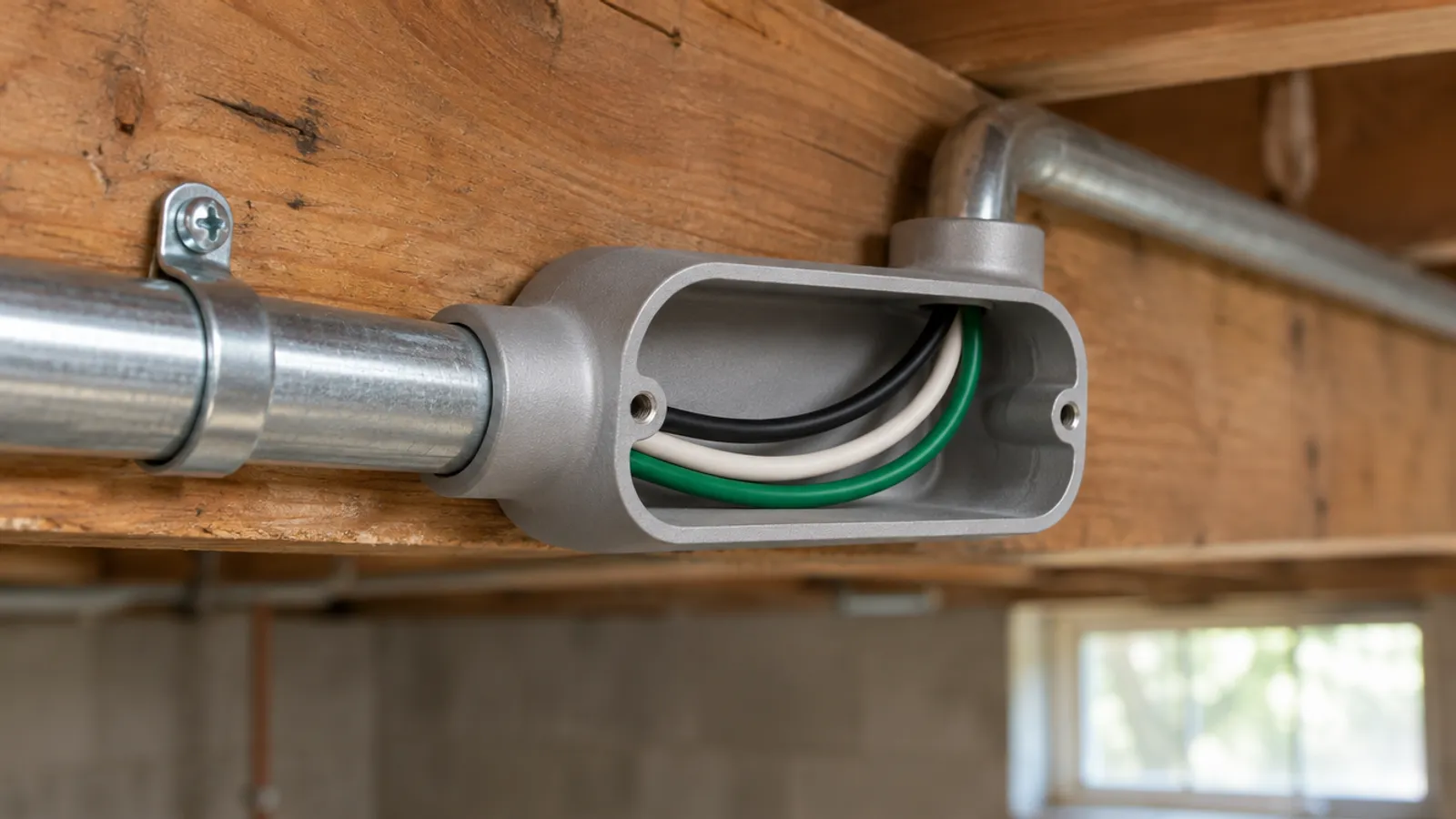
A conduit body is a conduit fitting with a removable cover, placed where a run of conduit changes direction, branches or needs a pull point. Taking off the cover gives an electrician access to the wires inside. Its letter name (LB, LL, LR, T or C) tells you where its hubs point. Like a box, it must stay accessible.
You'll find conduit bodies on basement ceilings, in garages and on the outside of houses, often where conduit feeds outdoor equipment. Below: the conduit body types, what each may hold, and how to keep one reachable.
What is a conduit body?
A conduit body is a hollow fitting with two or more hubs, where conduit threads or clamps in, and an oval cover held by screws. Conduit is the metal or plastic pipe that carries the wire, and the conduit body is part of that raceway, not a separate box: each one is an access point on the run. One maker's catalog page for aluminum conduit outlet bodies lists the uses: a pull point for wire, room for splices and taps, a mount for fixtures and devices, 90-degree bends, and access for maintenance and later changes.
The material follows the conduit. Metal bodies are cast, commonly aluminum, which is light and resists corrosion, with threaded hubs for rigid conduit or set screws for EMT. PVC bodies are molded for PVC conduit and won't rust. Where moisture is a concern, the electrical inspectors' association magazine notes that a body for wet locations must be marked for them and fitted with the cover its maker specifies. The aluminum maker above seals its covers with a neoprene gasket.
What do the letters mean in conduit body types?
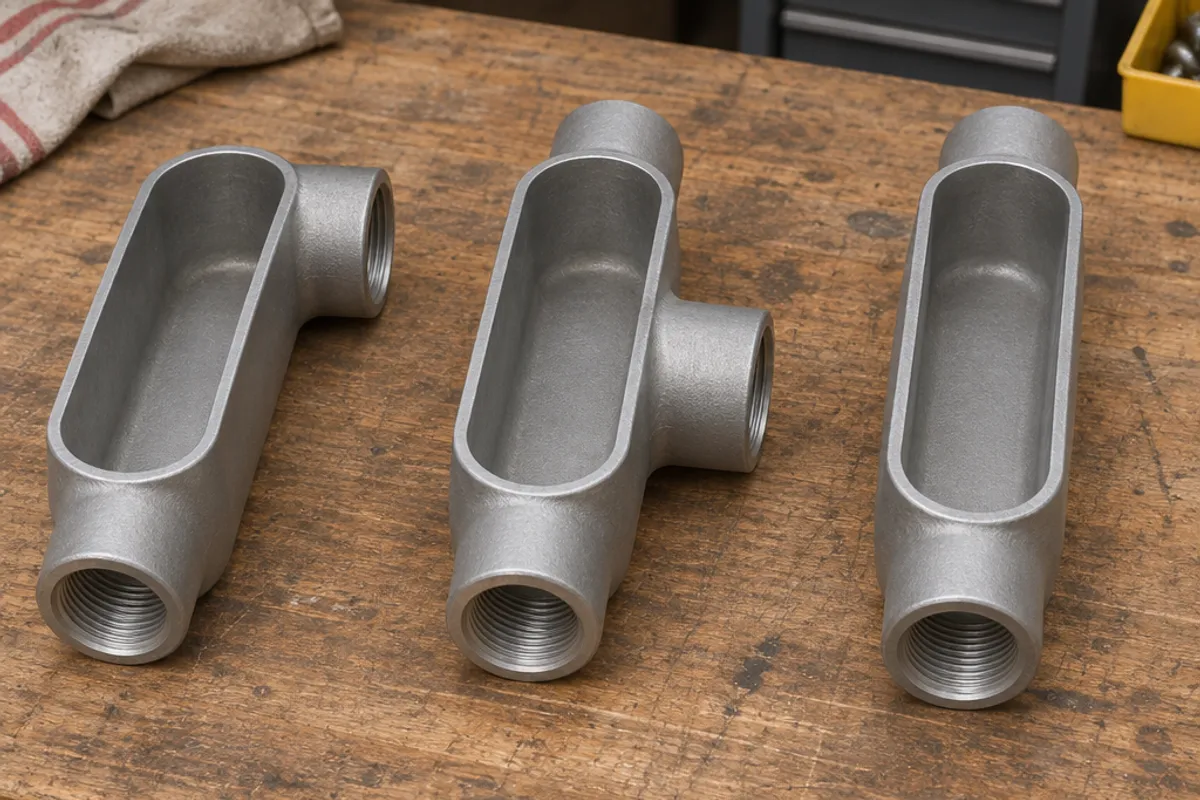
The first letter gives the layout: L-shaped bodies turn the run, a T shape branches it, an X forms a cross, and a C runs straight. On L bodies, the second letter gives the direction of the turn. To tell the type at a glance, hold the body upright, cover facing you, with the straight-through hub on top, the way one maker's Type LB sheet describes it. Then find the other hub:
| Type | Hubs | Where the run goes | Typical use |
|---|---|---|---|
| LB | 2 | Top, then out the back | Passing through siding into a house |
| LL | 2 | Top, then out the left side | Turning left, staying flat |
| LR | 2 | Top, then out the right side | Turning right, staying flat |
| T | 3 | Both ends plus one side | A branch |
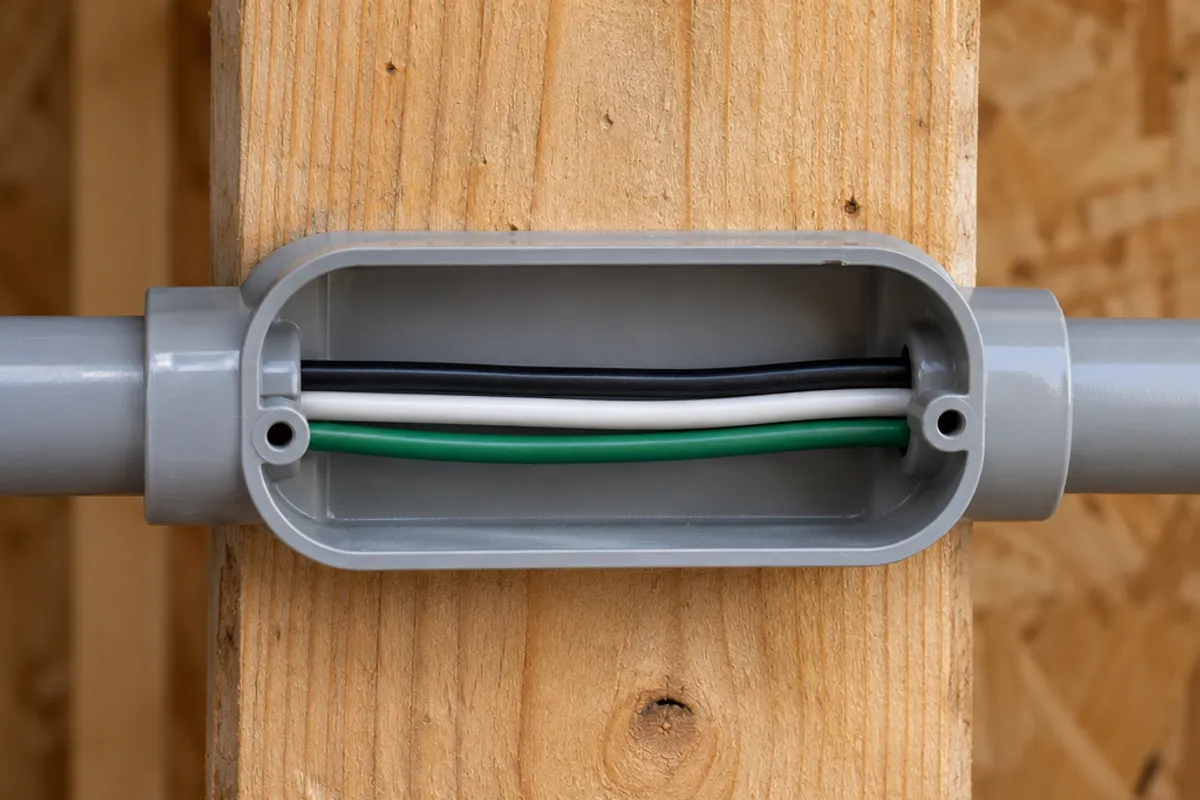
| C | 2 | Straight through | A pull point on a straight run |
| X | 4 | Four ways | Runs that cross |
What is an LB conduit body?
An LB conduit body turns the run 90 degrees out through its back, opposite the cover, so its two hubs form an L. One maker's sheets describe this type as giving "pull, splice, and tap access" along with a change in direction. It is a common fitting where conduit comes down a house and turns in through the siding into the structure, and the cover still faces you after the turn. It isn't a pull box, but it works as a pull point, allowing the wire to come out through the open cover and go on around the corner; what is a pull box covers the bigger boxes on long runs.
How do LL and LR conduit bodies differ?
An LL conduit body and an LR mirror each other, and the second letter gives the side: the second hub exits the left side on an LL and the right side on an LR. LR conduit bodies and LLs keep the raceway flat, around a corner or a beam, instead of turning through it. Choose by the direction of the turn as seen from the cover side, left or right, and set the cover facing the room at installation.
What are T and C conduit bodies?
A T type has three hubs, two in line and one out the side, and joins a branch to a run. A C type has a hub at each end and adds a pull point to a straight run. An X has four hubs.
Can you splice wires in a conduit body?
Only when it is big enough and marked for it. One maker's aluminum bodies list a volume in cubic inches and a maximum number of conductors for each trade size, and the PVC sheets give a volume and wire fill for each type. The inspectors' article says to check that marking before using a conduit body as a box; small capped elbows are designed only for installing the raceway and its wire. If the splices won't fit, use a junction box.
Does a conduit body have to stay accessible?
Yes. Its cover has to come off to pull new wire, replace a damaged conductor or check a splice, so every conduit body has to stay a working access point.
For conduit bodies, the US rule on access is stricter than for small boxes: NEC 314.29(A)(3) (NFPA 70, 2023 edition, as revised by Tentative Interim Amendment 23-10) says the hole in the finished surface over a conduit body can't be smaller than the body's outer walls, and it allows a removable finished cover that keeps that access.
A small hole over an LB won't pass. Your inspector has the final word, since local rules can amend the NEC; in Canada, the provincial electrical inspector does.
What size access panel fits over a conduit body?
- Measure the body from hub to hub, and across its widest point, side hubs included.
- Note the depth behind the drywall or plaster.
- Pick a hole at least that size, centered on the cover, and confirm it with your electrician.
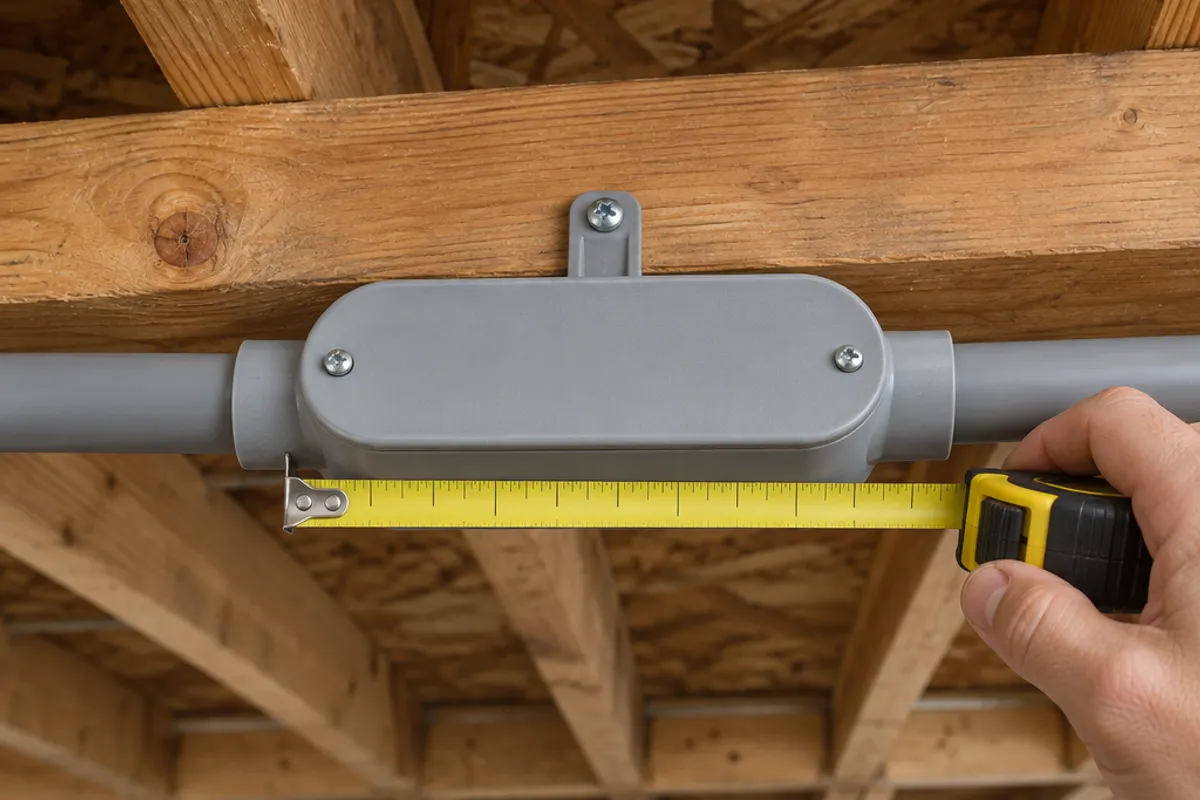
Lengths vary by maker and material, so measure your own. As a guide, one maker's nominal PVC lengths (from its LB, T and C sheets):
| Trade size | LB, hub to hub | T or C, overall | Our panels and doors that clear it |
|---|---|---|---|
| 1/2 in | 4.2 in | 4.6 in | PAD0808 or SAP0808 |
| 3/4 in | 4.9 in | 5.4 in | PAD0808 or SAP0808 |
| 1 in | 5.9 in | 6.6 in | SAP0808; PAD0808 for L bodies only |
| 1-1/4 in | 7.6 in | 8.2 in | SAP1414 or PAD1212; SAP0808 for L bodies only |
| 1-1/2 in | 8.6 in | 9.3 in | SAP1414 or PAD1212 |
| 2 in | 9.8 in | 10.4 in | SAP1414 |
| 2-1/2 in and up | 15 in or more | 19 in or more | Too long for our panels |
| Model | Type | Opening | Overall size |
|---|---|---|---|
| PAD0808 | hinged door | Maximum service opening 6.35 × 6.35 in | 8 × 8 in |
| SAP0808 | spring-loaded panel | Fits 6 × 6 to 8 × 8 in openings | 10 × 10 in |
| PAD1212 | hinged door | Maximum service opening 10.35 × 10.35 in (estimated) | 12 × 12 in |
| SAP1414 | spring-loaded panel | Fits 10 × 10 to 14 × 14 in openings | 16 × 16 in |
A spring-loaded panel's wire spring reaches back through the hole, so it needs clear space behind the drywall; check the depth you noted against the edge view in the product's technical drawing. The PAD1212 cut-out size is an estimate, so hold its 1:1 template against the body first. Keep the conduit body's own cover on behind any panel. Our panels are for dry, indoor ceilings and walls; an LB on the outside of a house stays exposed under its own cover.
Our plastic access panels and doors are not fire-rated, and we publish no water-resistance rating for them, so don't fit one in a fire separation, such as the wall between a house and an attached garage.
Measure before you order: our guide on how to measure for an access panel shows how, and the access panel size chart compares every opening and cover.
Who should open or install a conduit body?
Opening a conduit body, pulling wire or splicing in it is electrical work: use a licensed electrician where your area requires one, and expect a permit and inspection where needed. Turn the power off first.
Your part is the plan. Before a ceiling is closed in, mark every conduit body and box the drywall will cover, and plan a panel over each. How to install a junction box covers the box side, and can you drywall over a junction box? helps find a hidden one. Compare sizes on the access panel size chart or the electrical access panels.