
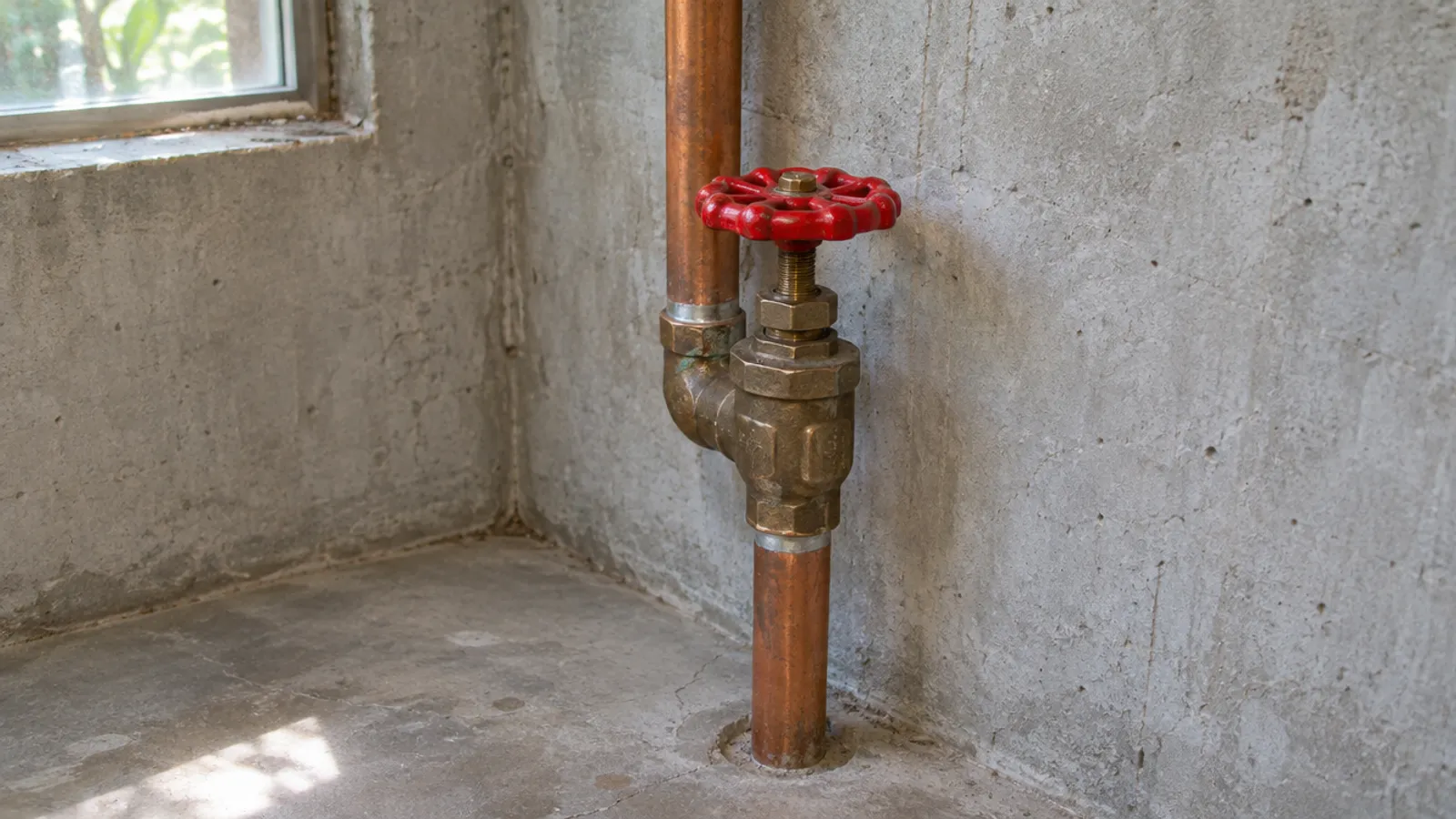
The main water shutoff valve is typically located where the water line enters your house: low on a basement or crawl-space wall, on a pipe coming up through the floor of a utility room or garage, or near the water heater. In warm climates, some homes have it outside, near the water meter. It controls the water supply to the entire home, so find it now, before a burst pipe sends you looking, and make sure nothing stops you reaching it.
This guide covers where to look, what the different valves look like and how to close each one, the valve at the street, the shut-offs for each fixture, and what to do when a valve ends up behind a finished wall.
Where is the main water shutoff valve in your house?
Start by finding where the water enters the house. The service line enters through the foundation wall or comes up through the slab, and the main valve is typically located on it, close to where it enters. If your water meter is indoors, look for the valve close to it.
Where to look:
- Basement. Check the front foundation wall, on the side of the house that faces the street, low down, and look for a line rising out of the concrete. Look behind the furnace, laundry tubs and storage shelves.
- Crawl space. Look near the foundation wall where the line comes in. Take a flashlight, and watch for the meter as well as the valve.
- Utility room or near the water heater. In a house on a slab foundation, the line may come up in a utility room, a mechanical room, a laundry closet or beside the water heater. The valve on the cold supply into the water heater controls only the heater, so trace that line back to where it enters the house.
- Garage. In some houses the service comes in through the garage.
- A private well. If your water comes from a private well, the main shutoff valve is typically located near the pressure tank, where the line from the well pump comes in.
- Outside. In warm climates, the main valve may be outdoors, on an exterior wall, near the meter or by an outdoor faucet. There is more on that below.
If you still haven't located it, check the home inspection report from when you bought the house, which may note the location, or ask the previous owner or the builder. In a condo or apartment, the shut-off for your unit may be in a closet or behind an access panel, or it may be controlled by building management, so ask them.
What does a water shut-off valve look like?
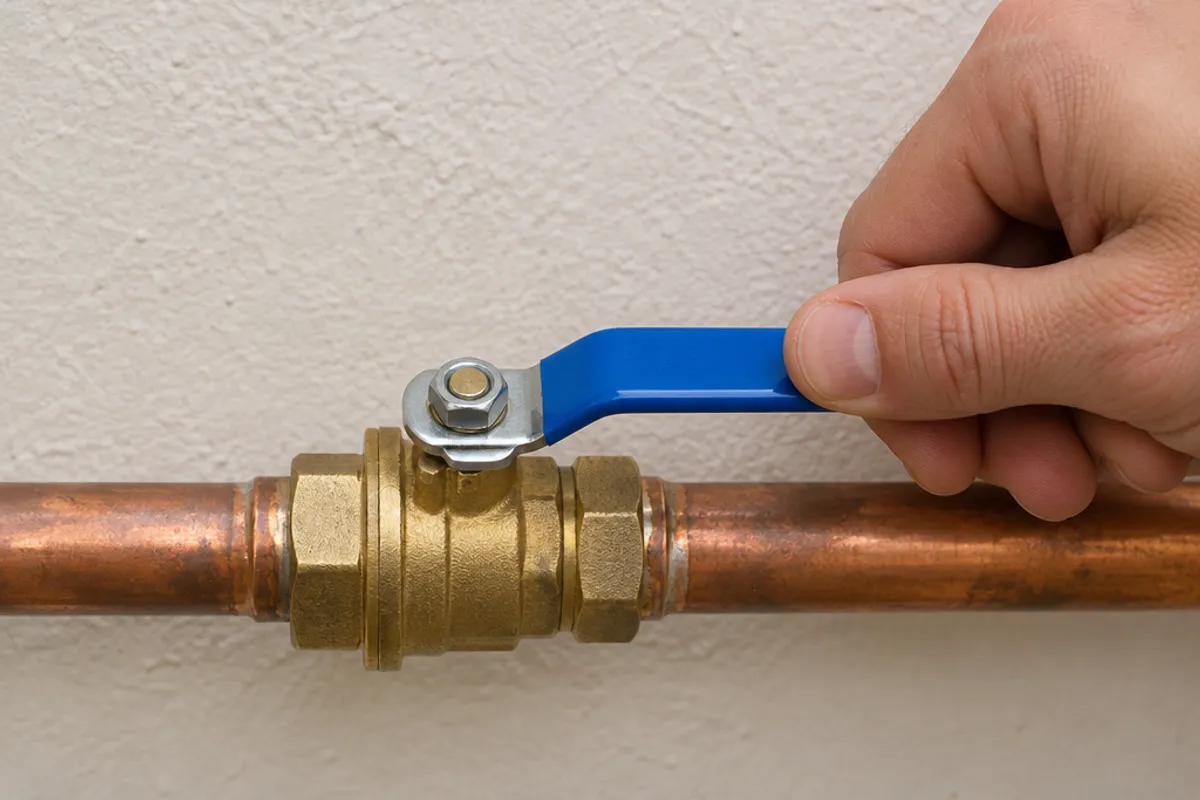
You will meet three kinds of valve on a main line, and you can tell them apart by the handle:
- Ball valve, with a lever handle. A short flat lever, often colored. It turns a quarter turn. When the lever lies along the pipe the valve is open, and when it sits across the pipe (perpendicular to it) it is closed. Ball valves are quick to close, which is what you want in emergencies.
- Gate valve, with a round wheel handle. The handle looks like a small steering wheel: turn the valve clockwise, several full turns, to close it. Gate valves are found in many older houses. After years without use they can stick, or close without stopping the water completely.
- Globe valve, also with a round wheel handle. From the outside it looks much like a gate valve and closes the same way, with several turns.
Some water meters also have a valve on one or both sides. The one on the street side may belong to the water utility, so check with them before you use it.
How do you close the main water shut-off valve?
- Clear anything in front of the main water valve so you can grip the handle with both hands.
- For a lever handle, turn it a quarter turn, until it sits across the pipe. For a wheel handle, turn clockwise until it stops, by hand.
- Open a faucet, ideally on the lowest floor, and check that the water flow stops once the pipes drain.
- To turn the water back on, open the main valve slowly: slowly turn the handle back, so the plumbing refills gently and the water flow returns to normal. Then run each faucet until it stops sputtering air.
If a wheel handle won't turn by hand, don't put a long wrench or a hammer on it. An old valve can snap or start leaking at the stem, and then you have a leak you cannot stop. Call your local water utility company if you need the water off immediately, and have the valve replaced. Replacing a main valve means cutting into the supply line, so hire a licensed plumber where your area requires one.
Where is the main water shut-off valve outside?
Many houses have a second valve outside, at the property end of the water service. It is often called the curb stop or curb valve. It sits in a box near the property line, the sidewalk or the front lawn, under a small round or square lid, and you need a long key to reach it.
In many places the curb stop belongs to the water utility, and only the utility may operate it. Don't open or close it yourself unless your utility says you may. In an emergency, call them: many utilities list an emergency number on the bill or their website. Find that number now and keep it with your house papers.
In some warm-climate homes, the main shut-off itself is outdoors. Look where the water line comes up out of the ground beside the foundation, or in the meter box near the property line. A valve in a ground-level box may be hidden under soil or leaves, so clear the box and check that the handle still turns.
Where are the smaller shut-off valves for each fixture?
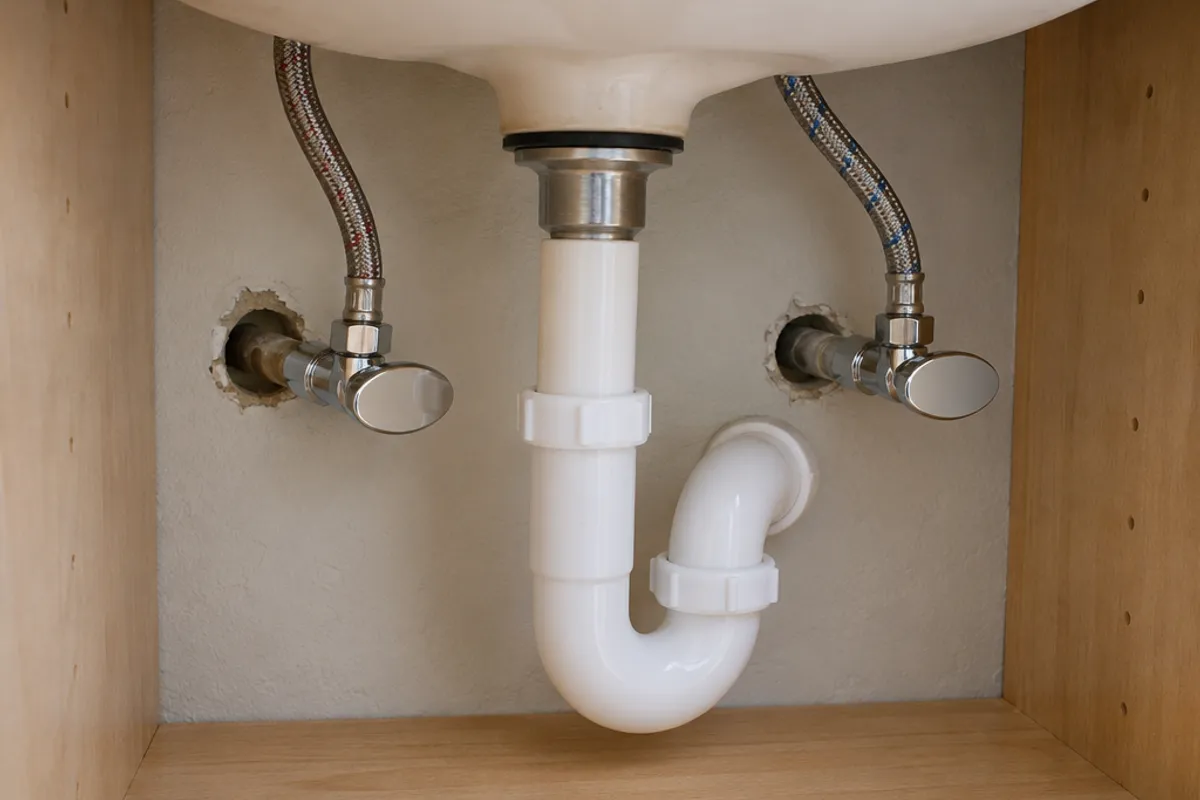
For a leaking faucet or a running toilet, you rarely need the main. Many fixtures have their own shut-offs, often called stops:
- Sinks. Two stops under the sink, hot and cold, with supply hoses up to the faucet.
- Toilets. One stop on the wall or floor behind the toilet.
- Washing machine. Hot and cold valves in a box or on the wall behind it.
- Water heater. A valve on the cold pipe going in.
- Dishwasher and fridge water lines. Often a stop under the kitchen sink or behind the appliance.
- Showers and tubs. Often there are no separate stops. Some shower valves have stops built into the valve body behind the trim, and some installers fit stops behind an access panel.
- PEX manifolds. In a house plumbed with a manifold, each fixture line may have its own valve at the manifold.
Turn each stop now and then. A stop that hasn't moved in years can stick, or start dripping at the stem when you finally turn it. Replace any that do while the main is off.
What if the shut-off valve is behind a wall?
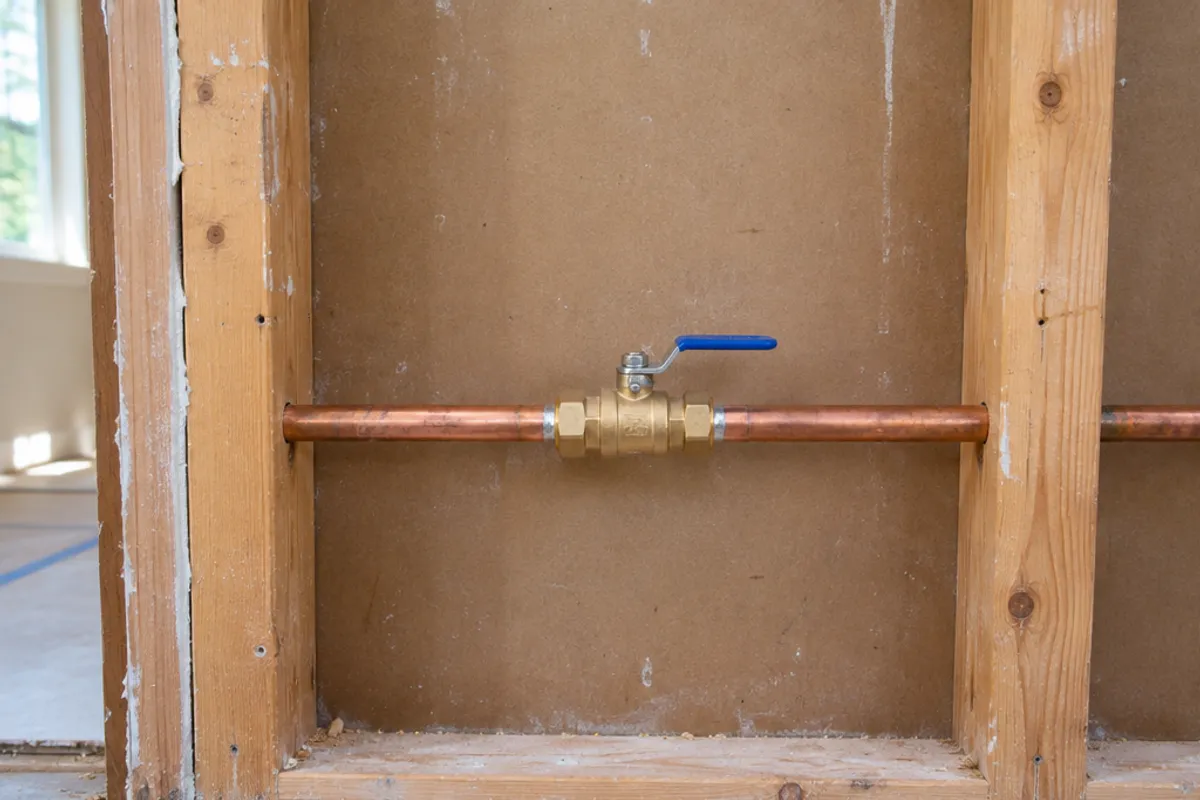
Valves, the main water shutoff valve included, get boxed in when a basement is finished or a wall is closed up during a remodel. A valve you can't reach in an emergency is not much use. Before the drywall goes up, ask your local building department what access it wants in front of a valve.
If a valve is already behind drywall, cut an opening in front of it and fit an access door or panel. Measure the valve with room for your hand to turn the handle all the way: a lever needs space to swing through its quarter turn, and a wheel handle needs room for your fingers around the rim. Our guide on how to measure for an access panel covers the rest. Then compare:
- A single valve with a small handle. PAD0808 hinged door: maximum service opening 6.35 × 6.35 in, overall 8 × 8 in.
- A larger valve, or two side by side. PAD1212 hinged door: maximum service opening 10.35 × 10.35 in (estimated), overall 12 × 12 in.
- A bigger opening you will rarely open. SAP1414 spring-loaded panel: fits 10 × 10 to 14 × 14 in openings, overall 16 × 16 in.
A hinged door suits a main valve well: it stays attached and latches shut, so there is no loose cover to set aside in a hurry. Its cut-out is the size of its service opening, with rounded corners, and the door's product page has a full-size template. The frame sits on the wall and is screwed on, and the screws come with the door. See them all on the access doors page, or compare options for pipes and valves on the plumbing access panels page.
How do you make sure you can find it in an emergency?
A shut-off you can find in the dark, with water on the floor, is worth more than a better valve you have to hunt for: the sooner the main shutoff is closed, the less water damage there is. Once you have found yours:
- Label it. Hang a tag on the main water valve that says what it is. If it is behind an access door, label the door too.
- Show everyone. Make sure everyone in the house knows where it is and which way to turn it.
- Keep it clear. Don't stack boxes, shelves or a freezer in front of the valve or its access door.
- Test it. Operate it now and then: close it and reopen it, so you know it works before you need it. A valve that never moves is the one that sticks, and a stuck valve means more water damage. If it sticks or drips, have it replaced.
- Know what else it feeds. If your home has a fire sprinkler system, ask its installer or your local fire department whether it is fed through the main water shutoff valve before you ever need to close it.
- Stay clear of electricity. If water reaches outlets, appliances or the electrical panel, keep away and call an electrician.
- Know the street side. Note where the curb stop is, and keep the utility's number where you can find it.
- Keep a flashlight nearby. Basements and crawl spaces are dark, and an emergency may come with a power cut.
Measure before you order: our guide on how to measure for an access panel shows how, and the access panel size chart compares every opening and cover.