
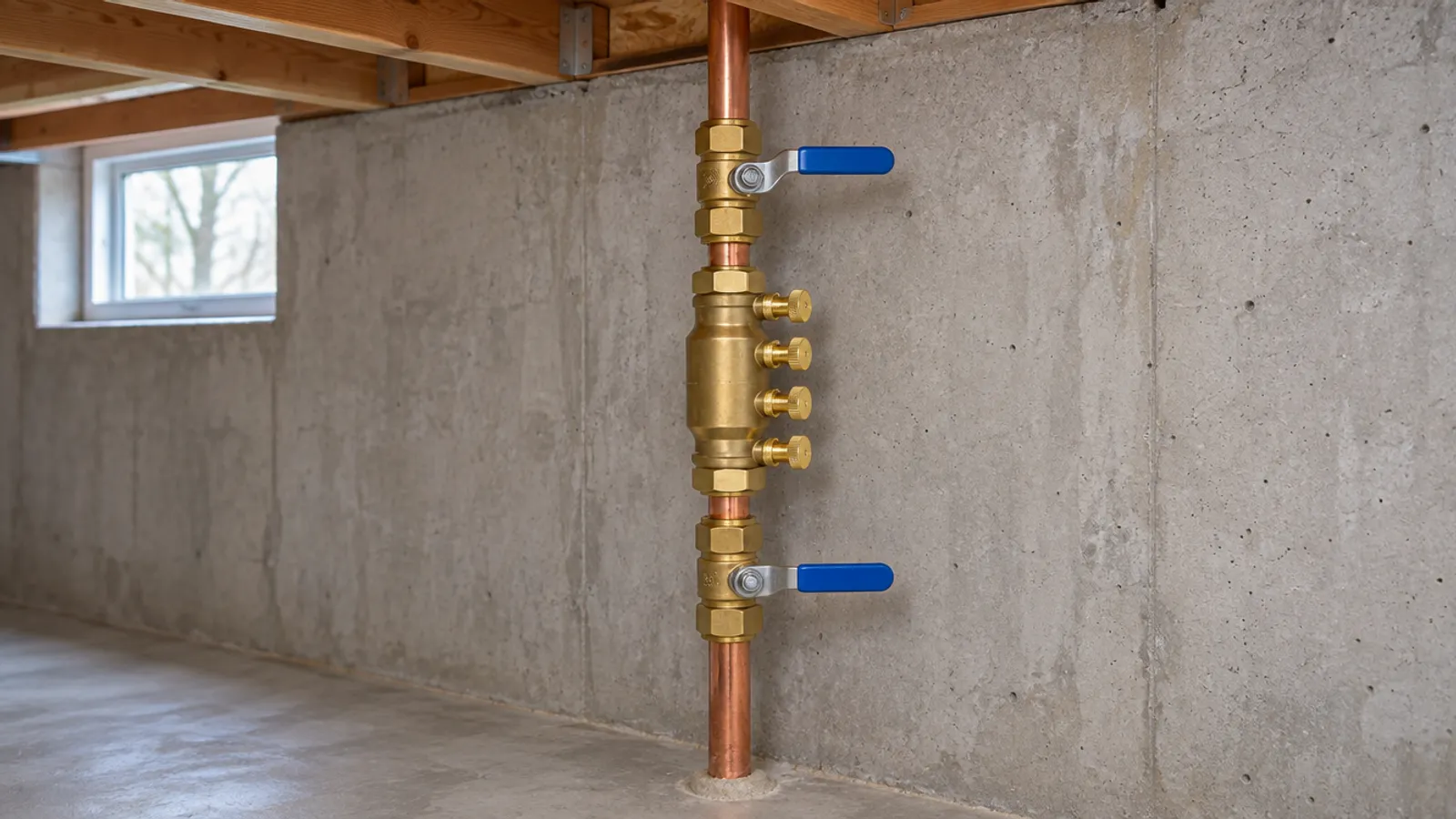
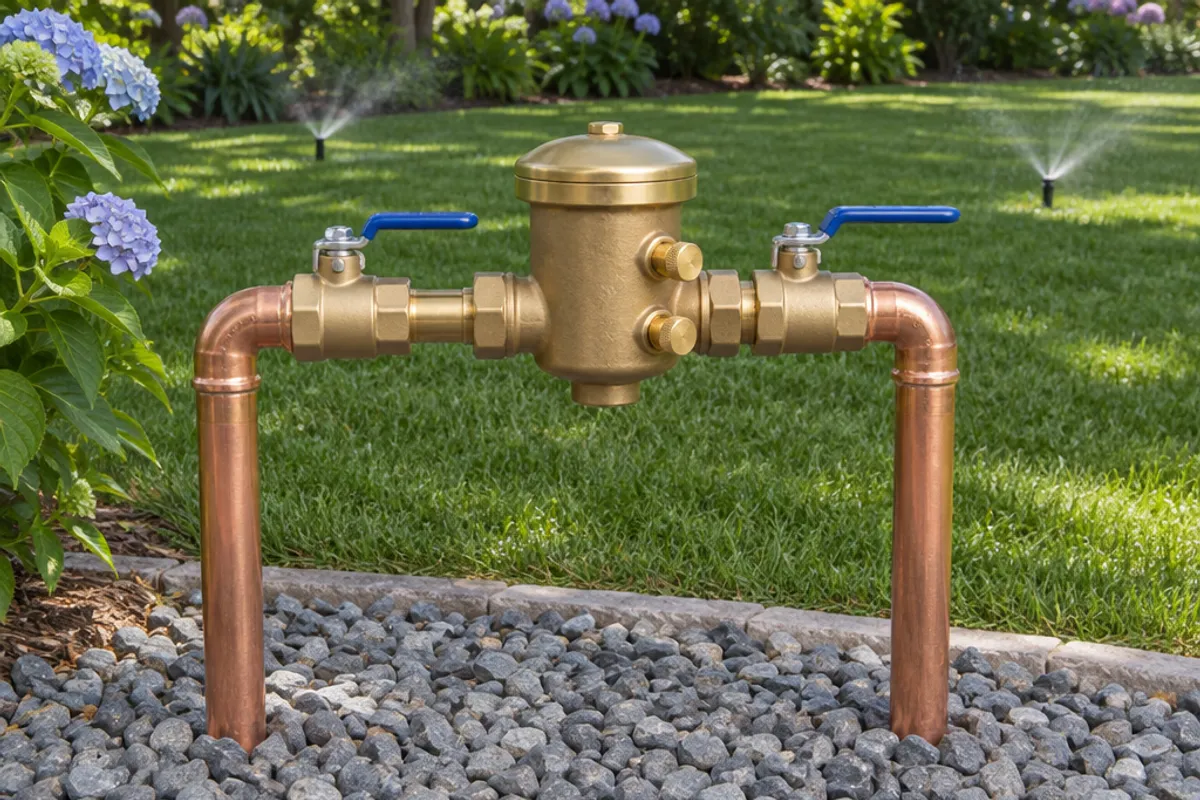
In most homes, the backflow preventer is on the lawn sprinkler line: outdoors on two pipes rising out of a lawn or garden bed, or in a small in-ground box near the water meter. A backflow preventer for the whole house or a fire sprinkler system sits indoors, where the water line enters a basement, garage or mechanical room.
Where a utility requires one, a certified tester has to test it, usually every year, so it must stay where that tester can reach it.
Where is my backflow preventer?
Backflow prevention devices are installed on the supply lines that feed whatever could send contaminated water back into the potable water supply, so start with what the house has. Each is a cross connection. Portland Water Bureau (read 2026-11-17) lists the usual ones: a lawn irrigation system, fire sprinklers, a water feature, a pool, hot tub or spa, solar heating, a private well or a boiler.
Lawn irrigation system
Most residential backflow prevention devices are installed here. Follow the irrigation supply from the house toward the sprinkler valves: the device protects the whole system, so it comes before every zone valve. Colorado State University Extension says a pressure vacuum breaker may be installed under constant pressure upstream of all control valves, upright and at least 12 in above all downstream piping, so it stands above the sprinkler heads it feeds. Where heads sit higher than that, it says a reduced pressure device is often used instead.
A double check valve assembly can go below grade. In Portland, irrigation backflow prevention assemblies are usually near the water meter box, in a small buried box with a green lid.
Main water line
An assembly that protects the whole water supply is called containment or premises isolation. The City of Boulder (read 2026-11-17) says it is installed after the meter and before any plumbing branches, and Portland's installation requirements put an indoor one on the riser where the service enters, at least 12 in above the floor. Look on the same pipe as the main water shut-off valve.
Fire sprinkler system and commercial properties
A fire sprinkler system has its own assembly, usually in a mechanical room, closet or garage, Portland says. Commercial properties often have several.
Hose bibs
A small hose connection vacuum breaker, a type of atmospheric vacuum breaker, can screw onto an outdoor faucet. CSU Extension calls it the minimum protection when you apply fertilizer or pesticide with a hose end sprayer, and Portland says it does not need testing.
What does a backflow device look like?
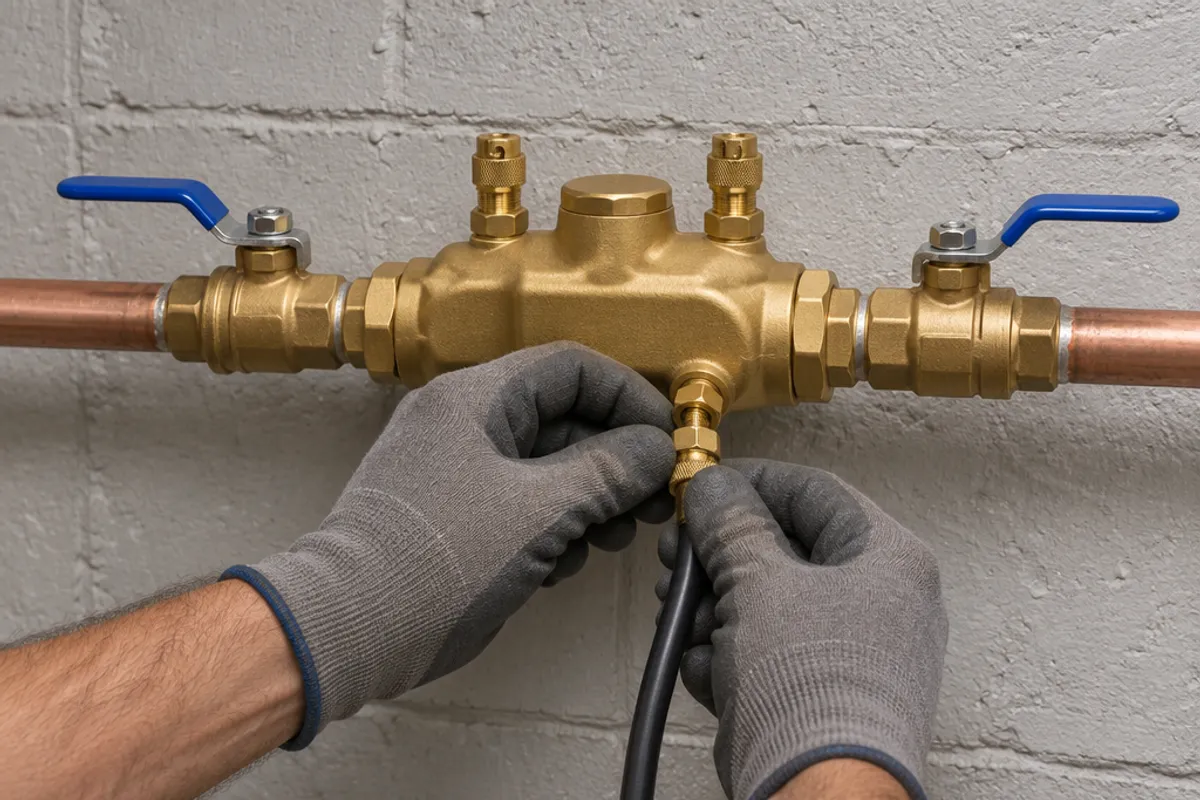
A testable assembly is a valve body between two shut-off valves, usually quarter-turn ball valves, with small test cocks along it: four on one maker's double check valve assembly, two on its pressure vacuum breaker. Utilities call these backflow prevention assemblies. Simpler backflow prevention devices, such as an atmospheric vacuum breaker on a sprinkler zone, have no way to be tested. Portland says the make, model and serial number are usually on the face of the device.
| Device | Where it usually sits | Tested every year? |
|---|---|---|
| Hose connection vacuum breaker | On a hose bib | No, says Portland |
| Atmospheric vacuum breaker | On each sprinkler zone, after its valve | No, it is not testable |
| Pressure vacuum breaker | Above grade, ahead of all sprinkler valves | Yes, where required |
| Double check valve assembly | In a box by the meter, or on the main line indoors | Yes, where required |
| Reduced pressure assembly | At least 12 in above grade, with drainage | Yes, where required |
| Air gap | Open space above the water being filled | Nothing to test |
A reduced pressure assembly also has a relief valve underneath. Portland says a working one periodically releases small amounts of water, and one clogged by debris may discharge a large volume.
How do backflow prevention devices keep contaminated water out?
Water should flow in only one direction, from the public water system into the house. A cross connection is any point where drinking water piping meets something not safe to drink: Portland names hot tubs, irrigation and fire sprinkler systems, and temporary ones such as a garden hose left in a bucket. If water starts flowing backward through one, it can carry contamination into the drinking water system, which Portland calls a public health concern. Boulder describes two ways backflow occurs: back-siphonage, when water pressure in the public supply drops, as in a water main break or firefighting, and backpressure, when a pump pushes water against its regular flow.
Check valves do the work in most assemblies: spring-loaded valves that close when water tries to reverse flow. A double check has two in a row. A reduced pressure assembly holds the zone between them below the supply pressure and opens its relief valve to discharge water if either leaks. A vacuum breaker lets air in to break a siphon. The simplest backflow protection is an air gap: when you fill a pool, Portland asks for a gap twice the hose's diameter, never less than 1 in. Each method aims to prevent contamination of the potable water that you and your neighbors drink.
What is a backflow test?
Backflow testing checks that each check valve, and any relief valve or air inlet, is still functioning properly. Boulder says certified testers use gauges to add or relieve pressure and record each assembly on a test report. One maker's testing protocols for a double check run like this:
- Open each test cock briefly to flush out debris.
- Fit a hose from a differential pressure gauge to a test cock and bleed the air out.
- Put both shut-off valves in the closed position. Water flow to that line stops for several minutes, Portland says.
- Open the next one to read the pressure drop across check valve 1, then check valve 2. That maker wants at least 1.0 psi across each.
- Close them all, reopen the shut-offs and file the report with the utility.
What are the backflow testing requirements?
No single national rule exists: each water utility runs its own cross connection control program under its state's rules. Here is what three utilities' own pages say about backflow testing, read 2026-11-17: Portland Water Bureau, San Antonio Water System and the City of Boulder.
| Utility | How often | Who tests | Report |
|---|---|---|---|
| Portland, Oregon | Yearly; homes usually in spring | A state-certified tester | Within 10 business days |
| San Antonio, Texas | Annual testing | A licensed tester; a licensed fireline tester for fire lines | One report for each assembly |
| Boulder, Colorado | Annually; single-unit homes generally exempt unless a hazard is identified | Certified by the American Backflow Prevention Association or the American Society of Sanitary Engineers | Online, within 10 days |
Boulder adds that building, fire or plumbing codes may still require an assembly inside a house that its program does not track. One maker's double check sheet says its assemblies must be inspected and maintained at least once a year, or more often where local codes require. In Canada, ask your municipal water utility.
Can you do your own backflow testing?
Not for the record. These utilities want a certified or licensed tester, and your water purveyor accepts only that tester's report. Booking the test is your job: Portland puts the scheduling on the property owner.
What happens if a backflow preventer fails the test?
It is repaired or replaced, then tested again. San Antonio counts a failed report as a delinquency. Boulder wants a failure reported within 24 hours, and a compliance plan if the repair takes longer than 30 days. If a new double check fails its first test, the maker's sheet says to remove both check valves, flush the device and clean debris off the rubber and seats.
A replacement must be an approved backflow prevention device: Portland accepts only assemblies on the Oregon Health Authority's list, and CSU Extension says to get the list from your county health, planning or building department.
Repairing or replacing an assembly means shutting off the water supply and opening the line. The maker's sheets say only qualified, licensed personnel should install them, and Portland wants its approval before a replacement. Use a licensed plumber where your area requires one.
How do you keep an indoor backflow preventer reachable?
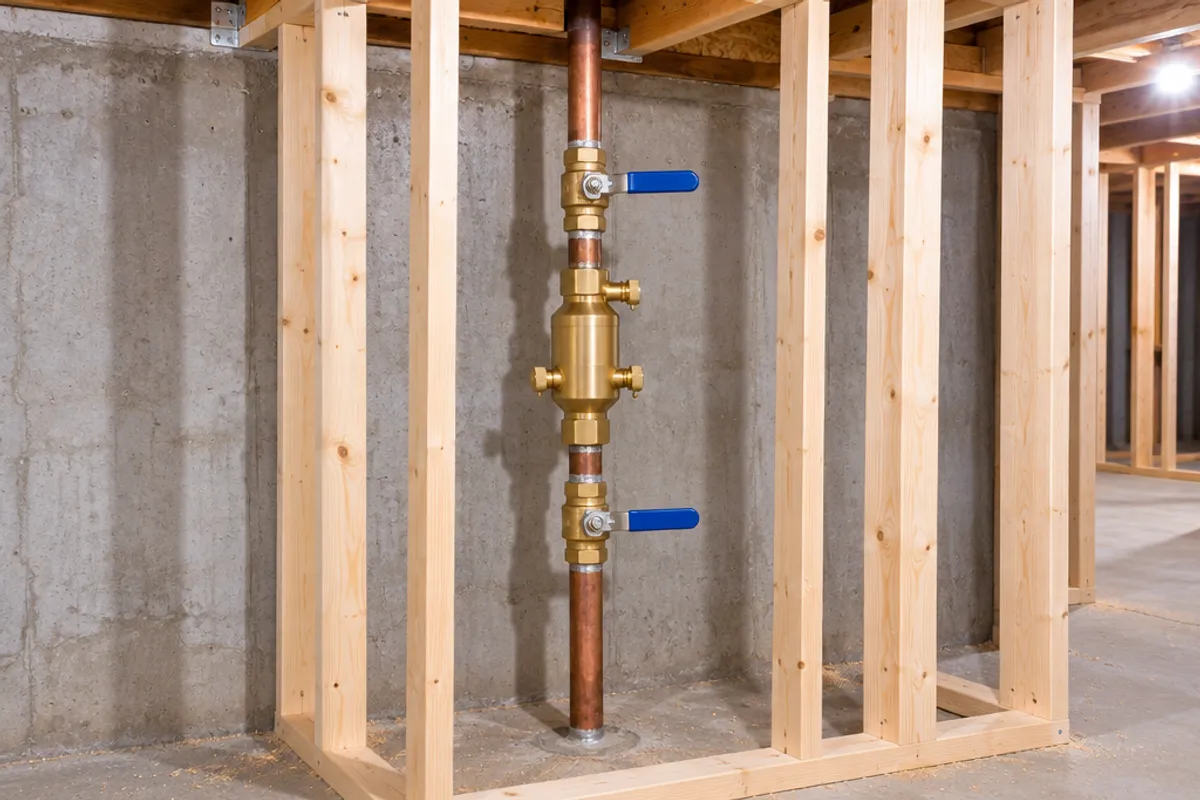
The yearly test needs a hose and a gauge at every test cock. One maker's installation instructions say to provide adequate space around the installed unit so the test cocks stay accessible for testing and servicing. Portland wants premises-isolation assemblies readily accessible, with at least 4 in of clearance on all sides and at both ends of one smaller than 2 in.
So when a basement is finished, leave the assembly in the open if you can. If a wall or soffit has to pass a double check on the main line, ask your utility or tester first. Then frame around the assembly to protect those clearances, and fit a hinged door in front of the valve body:
- A short double check: PAD1212 hinged door: maximum service opening 10.35 × 10.35 in (estimated), overall 12 × 12 in.
- A longer assembly up a vertical riser: PAD1216 hinged door: maximum service opening 10.35 × 14.35 in (estimated), overall 12 × 16 in.
Measure from one shut-off valve to the other and compare it with the opening: the door is the tester's way in, and the framing keeps the clearance. Never close in a reduced pressure assembly or an indoor pressure vacuum breaker. Both can release water, and both need adequate drainage.
Our plastic access panels and doors are not fire-rated, and we publish no water-resistance rating for them, so don't fit one in a fire separation, such as the wall between a house and an attached garage.
For the outdoor side, see what a stop and waste valve is and how to turn off outside water. Compare doors on the access doors page or see plumbing access panels.
Measure before you order: our guide on how to measure for an access panel shows how, and the access panel size chart compares every opening and cover. How to install an access panel in drywall covers fitting it.