
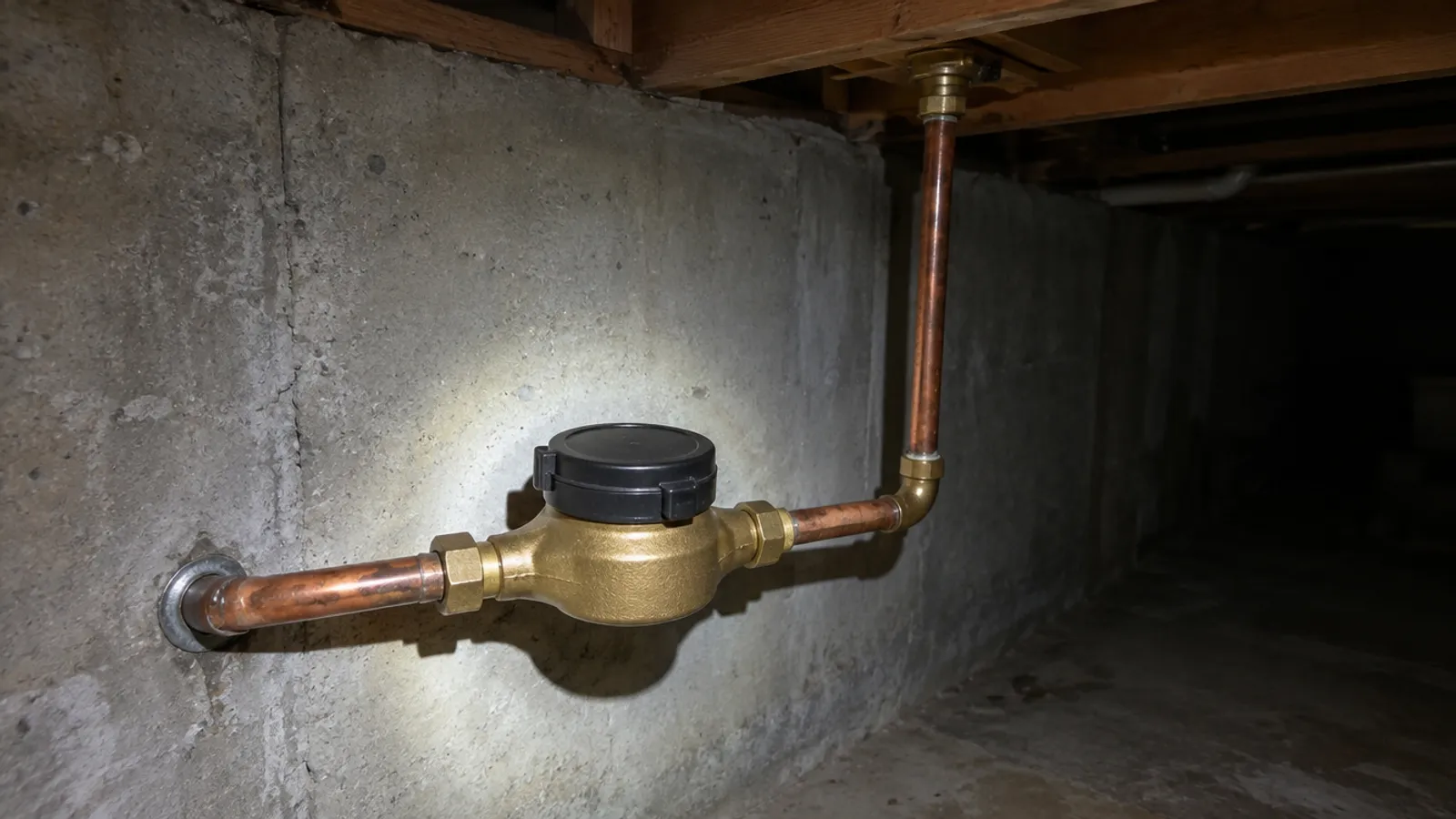
Your water meter is usually in one of two places. Outside, it sits in a meter box in the ground near the street, often in line with the main outside faucet. Where winters are cold, it is often inside, typically in the basement where the main water line comes through the foundation, next to the main shut-off.
If you still can't locate it, your water utility can tell you where it is.
Where is my water meter usually located?
Each utility decides where meters are installed, and climate plays a part: in warmer climates the water meter is typically outside in the yard, and where winters are hard it is often inside the house. Five examples, from what utilities tell their own customers (every utility page linked in this guide was read 2026-11-17):
| Utility | Where the meter usually is | What to look for |
|---|---|---|
| City of San Diego, California | Near the curb in front of the home or business, in a direct line with the main outside faucet | A concrete box, usually marked "water" |
| Suburban Water Systems, California | Near the street at the front of the property | Concrete or plastic, marked "WATER" |
| Seattle Public Utilities, Washington | In the parking strip or sidewalk, at the front or side of the house | Iron, sunk in the ground, or a metal plate marked CWM |
| City of Calgary, Alberta | Inside, usually in the basement, installed just after the main shut-off where the service comes in | On some homes, a remote read-out device outside where the service enters |
| City of Bloomington, Minnesota | Inside, in the furnace or laundry room | A touch pad on the outside wall, wired to the meter |
Outside: the meter box in the yard
An outdoor box typically sits flush with the ground under a metal or plastic lid. Look in the front yard, the lawn strip by the curb, the parking strip and the sidewalk. Grass, bark and soil hide them fast: Seattle warns that plants can leave a meter covered very quickly in the growing season, and it charges for a return visit when a reader can't get to the meter. Clearing it is simple maintenance.
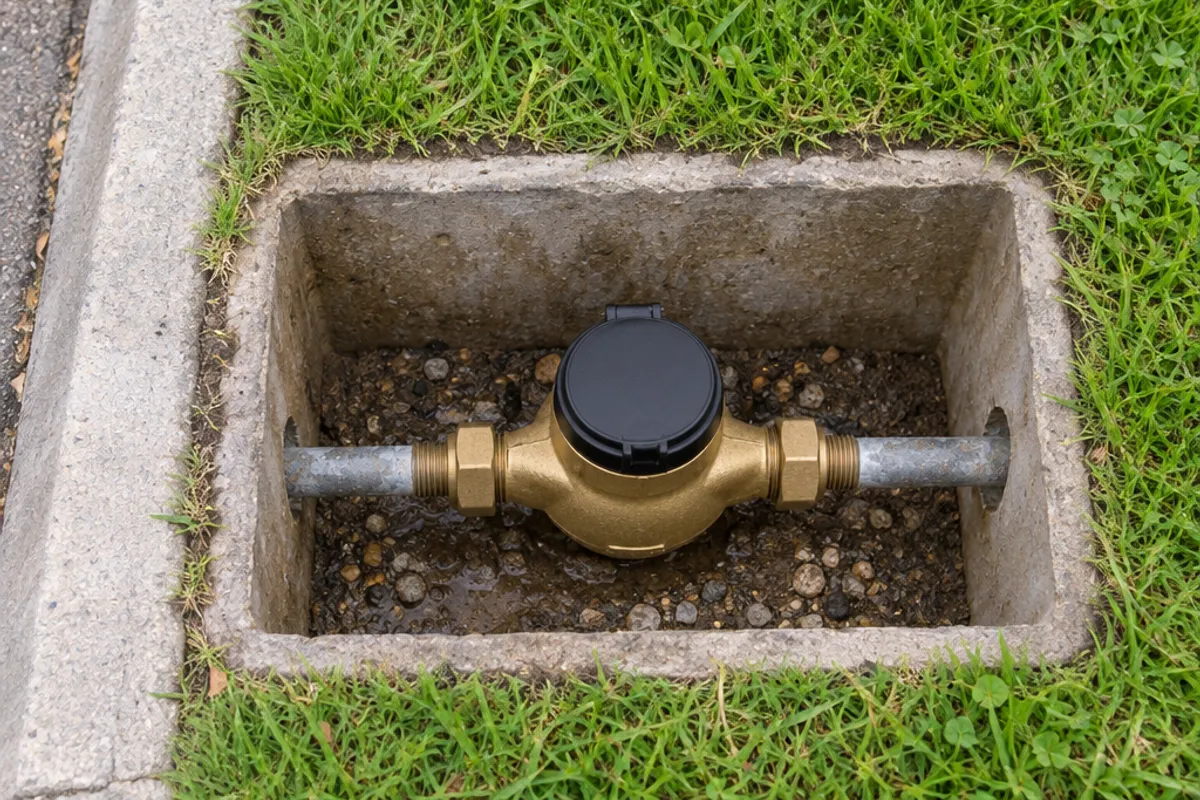
Some cold-climate utilities use outdoor pits too. Westminster, Colorado, asks residents to make sure the meter pit lid is in place for winter.
Inside: the basement or a utility room
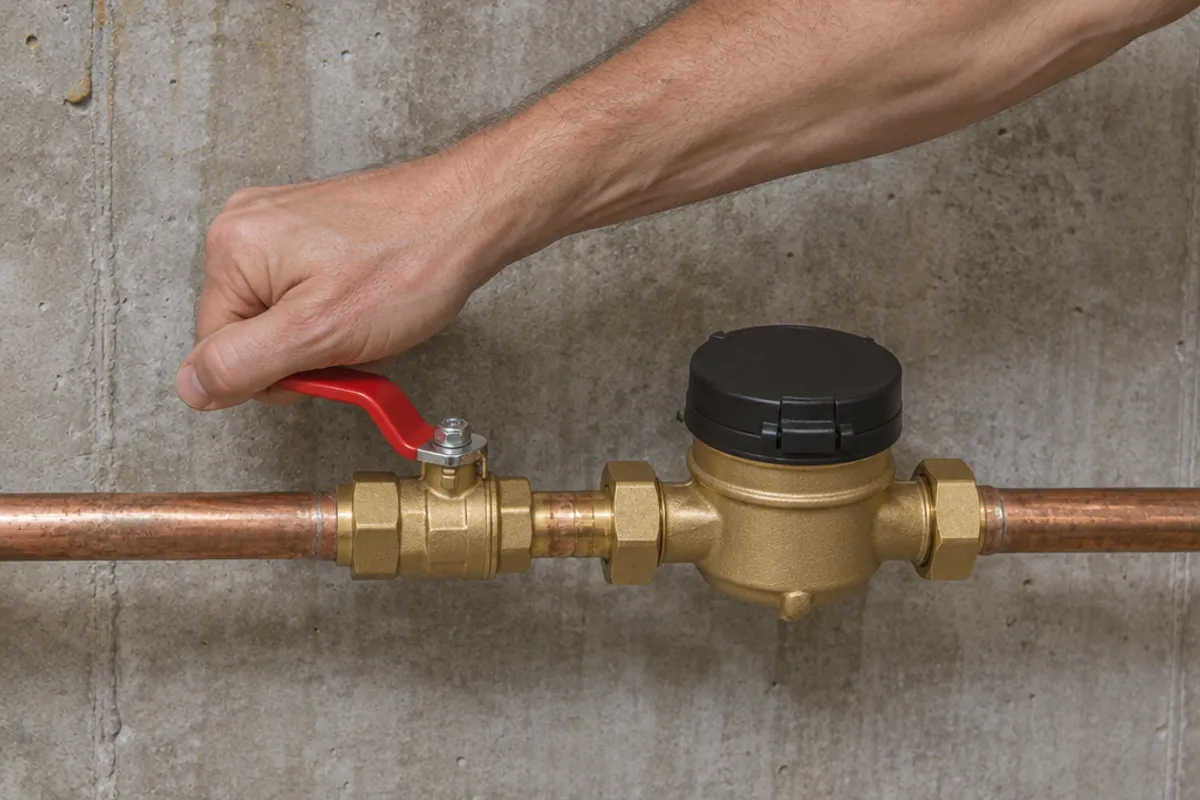
Indoors, follow the main pipe from where it comes through the foundation wall or up through the floor. Calgary's meters are installed on that pipe, right where the service comes in. Bloomington's drawing for a house meter shows a valve on each side of it. In a finished basement, start in the utility closet or the unfinished room around the furnace and water heater. If the house has a crawl space instead, or the pipe enters through an attached garage, look where it comes through the wall, and take a flashlight.
How do I locate my water meter when I can't see it?
- Stand at the main outside faucet and look toward the street. San Diego says its meters are usually in a direct line with that faucet.
- Look at the outside wall. In Calgary, a remote read-out device sits outside where the service enters, so the water meter is inside, near that spot. A touch pad wired to the meter, as on Bloomington's drawing, also tells you the meter is indoors.
- Probe gently through grass or bark for the edge of a box, and look under parked cars, bins and landscaping.
- Call your water utility and ask for your meter location.
What do residential water meters look like?
A water meter is a short body on the pipe with a register on top, usually under a flip-up cap. Calgary describes the register as a small display or dial: older meters have number wheels or a needle, and newer ones may have a digital display. Most meters now have a small radio transmitter wired to the register, which sends readings to the utility.
Analog meters
Analog meters show the total as a row of rotating numbers, read like a car's odometer. Suburban Water Systems describes a large red clock-like dial, its high flow indicator, and a small star-shaped low flow indicator that spins at the slightest water movement. Calgary's analog meters have a sweep hand or a flow indicator shaped like a round gear or a triangle, and its meter-reading page shows examples of each.
Digital meters
A digital meter shows the reading on a small screen. Suburban Water Systems says the display is often off when you first look at it; shine a flashlight or a phone light on it to wake it. While water is flowing, it flashes between the reading and the rate of flow.
How do you read a water meter?
- Lift the lid off with a large screwdriver or a similar tool. San Diego asks you not to use your fingers.
- Use caution: insects and small animals like meter boxes, Suburban Water Systems warns.
- Flip up the cap over the register.
- Read the numbers left to right, as on an odometer, and record the reading. Seattle says to write down the four black and two red numbers.
- Close the cap and set the lid back securely.
If you're interested in how much water your household uses, San Diego suggests reading the water meter at the start and end of a day and comparing the two readings. The difference is your water usage for that day.
Cubic feet, gallons or liters?
Check the unit printed on the register. A meter measures the volume of water that has passed through it. San Diego's meters measure cubic feet, and one cubic foot is about 7.5 gallons; it bills in units of 100 cubic feet (748.5 gallons), so a reading of 81,710 cubic feet becomes 817 on the bill. Suburban Water Systems' meters count gallons. On Calgary's meters the reading shows cubic meters left of the decimal point and smaller units to the right; 1,000 liters make 1 cubic meter.
How do you read a water meter for a leak?
Seattle Public Utilities calls leaks a common cause of higher than expected water bills, and the meter perhaps your most useful tool for finding that water loss. A meter only moves when water is flowing through it, so with everything off it should stand still. Suburban Water Systems suggests a leak check whenever a bill shows more water use than normal and nothing explains it. Seattle's leak test:
- Locate the water meter and the building's shut-off. It can be indoors or outdoors.
- Turn off every faucet and appliance that uses water.
- Note the position of the 1 cubic foot dial, and record the reading.
- Wait 30 minutes, then take a second reading.
| What you see | What it means |
|---|---|
| The two readings match | No water passed through the meter in that period |
| The dial moved | Water is flowing somewhere: a leak on the property |
| Outdoor meter: it stops when you close the building's shut-off | The leak is inside: look at toilets and faucets first |
| Outdoor meter: it keeps moving with that closed | The leak is underground, between the meter and the shut-off |
The last two rows assume the meter is outdoors. Indoors, installed just after the main shut-off, it stops when you close that, wherever the leak is.
Leak detection on a digital meter
A spinning low flow indicator gives the same answer at a glance: water is flowing somewhere. Digital meters also make monitoring easier: Suburban Water Systems says they record flow over the previous 24 hours, and a solid tap or droplet symbol means water was flowing the whole time, which most likely means a leak.
To determine where an indoor leak is, find it in the wall before you open anything. A leak on your side of the meter is usually yours to repair: San Diego says the property owner fixes the private side and city crews fix the city's side.
Don't remove, move or repair the meter, its couplings or the wire to its transmitter. In Calgary a meter that leaks or stops working is reported to the city, and owners are asked not to store anything on it, because that can damage the register or the wire. Cutting into the pipe next to the meter is a job for a licensed plumber where your area requires one.
What must a finished basement leave open around the meter?
Bloomington's house-meter drawing puts it plainly: "Meter must be accessible for repair, reading and replacement." Calgary tells customers due for a new meter that the technician needs to reach the meter and the main shut-off, with a clear path and room to work. If the meter is in an inaccessible spot or behind drywall, Calgary makes opening it up the homeowner's responsibility and cost.
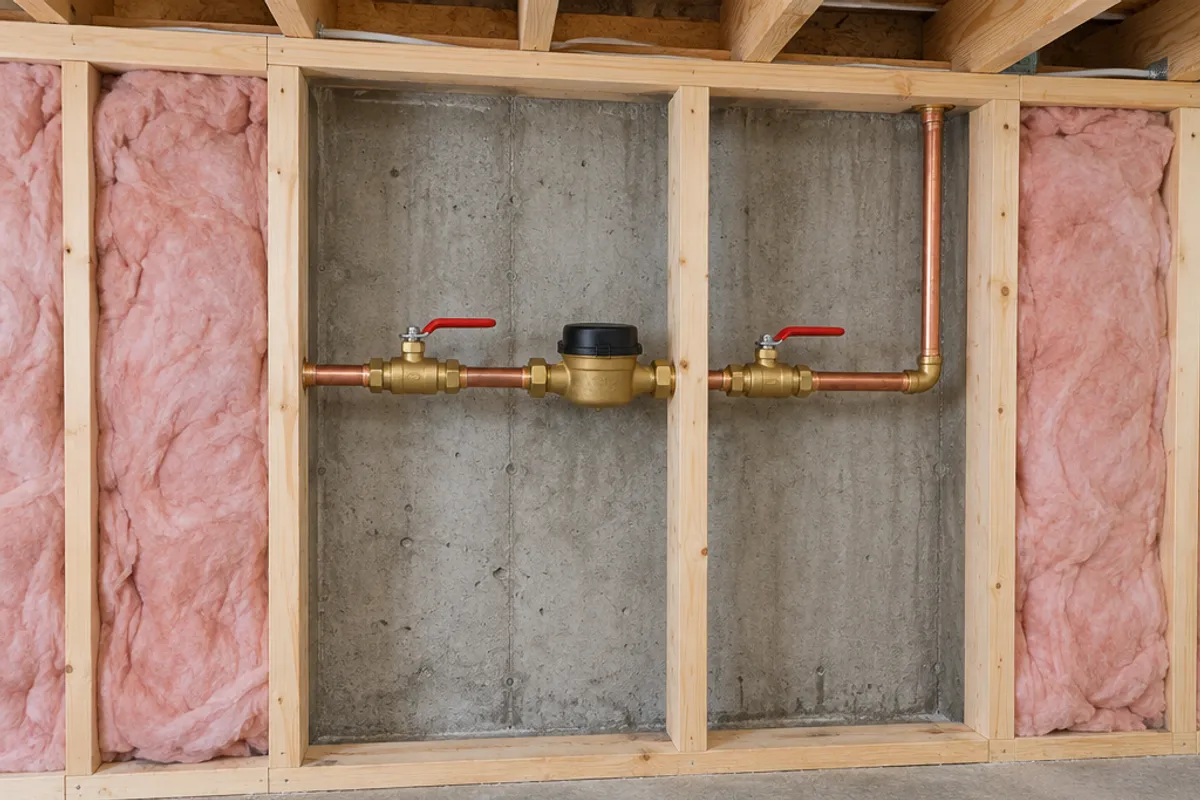
Your part is maintaining a clear path; the meter itself is the utility's. Before you frame around the meter location:
- Leave it in the open. An unfinished utility room, or a utility closet with a full-size door, makes maintaining a clear path easy.
- Keep the wiring. Don't cut or bury the wire from the meter to an outside touch pad or read-out.
- Keep it warm. Calgary makes owners protect the meter, valves and pipes from freezing and damage, so don't wall it into an unheated space.
- Ask your utility how much room it wants around the meter before the drywall goes up.
What size access panel does a water meter need?
Size the opening to the whole meter set, not just the register. Measure from the outer edge of one valve to the outer edge of the other, and from the wall to the front of the register, then add room for your hands on the handles. Our largest openings suit reading the meter, the leak test and the handle next to it:
- A panel you open now and then: SAP1414 spring-loaded panel: fits 10 × 10 to 14 × 14 in openings, overall 16 × 16 in.
- A door that stays attached and latches: PAD1216 hinged door: maximum service opening 10.35 × 14.35 in (estimated), overall 12 × 16 in.
If the meter set is longer or taller than those openings, or your utility wants room to exchange the meter, use a framed, removable cover or a full-size door into a utility closet instead. Don't plan on the meter coming out through an opening smaller than the job needs.
Our plastic access panels and doors are not fire-rated, and we publish no water-resistance rating for them, so don't fit one in a fire separation, such as the wall between a house and an attached garage.
Compare panels for plumbing on the plumbing panels page, or hinged doors on the doors page.
For the main shut-off beside the meter, see where it is and how to close it. For the regulator that often sits near it, see how long pressure regulators last, and for a sprinkler system's device near the meter, where the backflow preventer is.
Measure before you order: our guide on how to measure for an access panel shows how, and the access panel size chart compares every opening and cover.