
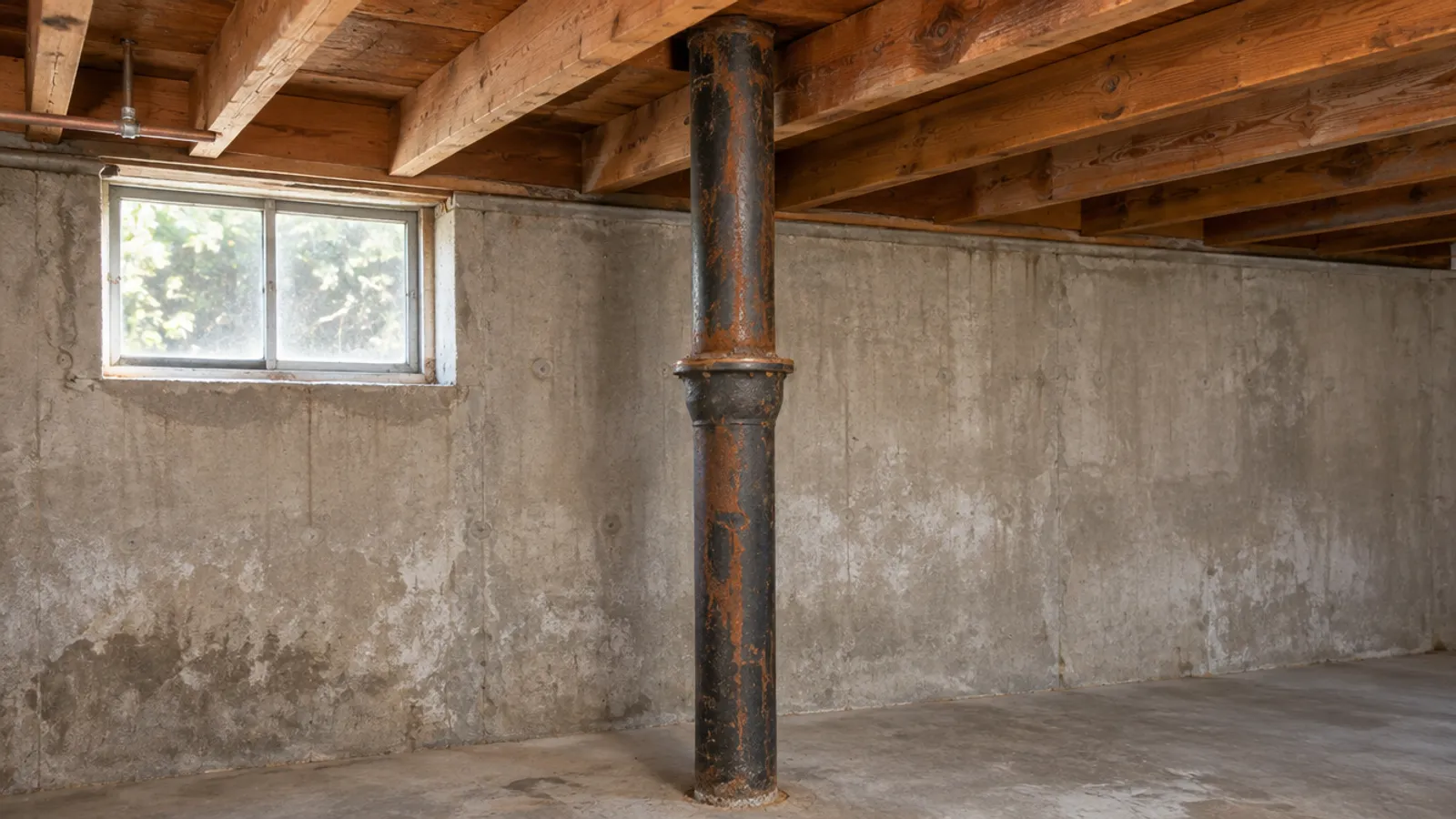
Replacing a cast iron drain pipe means cutting out a cracked, rusted or leaking section, or the whole stack, and installing new pipe, usually PVC or ABS, joined to the remaining cast iron with transition couplings. A plumber inspects the old pipe with a camera first, then recommends a spot repair or a full replacement.
Below: the signs of cast iron pipe problems, how to choose between repair and replacement, how plumbers cut out and replace a section, how new plastic pipe joins the old cast iron, and which joints should stay reachable afterward.
What are the signs of problems with old cast iron pipes?
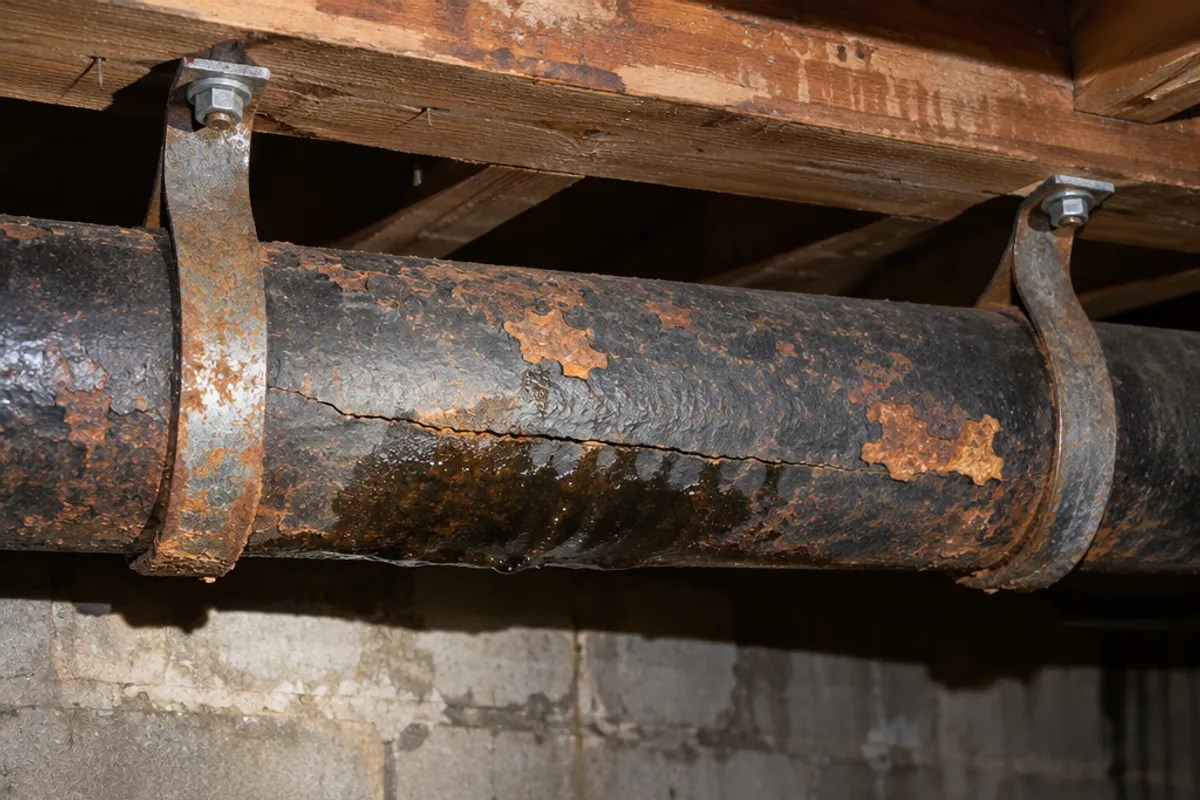
Cast iron was commonly used for drain, waste and vent plumbing in homes built before plastic pipe took over, and much of it has been in service for decades and still does its job. Cast iron is durable, but it does rust. Over time, rust and scale build up inside a cast iron pipe, narrowing it and roughening its walls so debris catches and blockages form, and corrosion can thin the pipe from the inside until it cracks or leaks. On horizontal runs, the damage is often worst along the bottom of the pipe, where waste water flows. Age alone tells you little; the condition of the pipe is what counts.
Most homeowners first notice cast iron pipe problems as one of these signs:
| What you notice | What it can mean | What to do |
|---|---|---|
| Rust that flakes, bubbles or leaves wet streaks on the pipe | Corrosion working through the cast iron, or a weeping joint | Have a plumber look at it. Light, dry surface rust alone is common on old pipes and isn't a sign of failure. |
| A crack, a wet spot or a drip on the pipe | The cast iron pipe or a joint is failing | Stop using the fixtures that drain into it and call a plumber. |
| Slow drains, or clogs that come back within weeks, at more than one sink, tub or toilet | Scale narrowing the inside of the pipe, a damaged section, or a problem in the sewer line | Ask for a camera inspection before anyone replaces anything. |
| A sewer smell near a drain line or in the basement | Sewer gas escaping through a crack or a failed joint | Find the source; don't just mask the odor. |
| Water stains on a ceiling below a bathroom | A leak from a drain line above | Trace the leak before you repair the water damage. |
| A soggy or sunken patch in the yard over the sewer line | A cracked, separated or root-blocked buried pipe | Have the sewer line scoped from a cleanout. |
One slow kitchen sink is usually a clog in its own trap or waste arm. When the kitchen sink, the bathroom sink on the second floor and a basement floor drain all slow down together, the problem is further down the plumbing system, in the main stack or the sewer line. Several drains that gurgle at once can point there too, as why a drain gurgles explains. A brown ring on the ceiling under the master bathroom is worth tracing too: our guide to a water stain on the ceiling shows how to find where a leak starts.
If you see any of these signs, a camera inspection is the key next step, because it shows the inside of the pipes. Through a cleanout, a camera goes down the drain and records the inside of the cast iron pipe: scale, cracks, sagging runs, failed joints and, in a buried sewer pipe, roots. If you don't know where your cleanouts are, start with what a sewer cleanout is and how to find yours. Ask for the video, and ask them to point out where each problem sits.
Should old cast iron drain pipes be repaired or replaced?
Being cast iron is not, on its own, a reason to replace a drain. What matters is how much of the cast iron pipe is damaged and where, and that is what the camera helps you determine. Most plumbers will suggest one of three approaches.
Spot repair: replacing one section
When the camera shows one cracked or leaking length, or one bad fitting, and the cast iron on either side looks sound, the plumber cuts out the damaged length of pipe and installs new pipe with a coupling at each end. If only a foot or two of pipe is cracked, that may be the whole job. Repairing cast iron pipes this way saves the sound pipe on either side, keeps the rest of the plumbing in place and opens only one part of a wall or ceiling.
Full replacement: a whole stack or branch
Consider a full replacement when there are leaks in several places, the camera shows extensive damage or heavy scale along the run, the pipe crumbles where it is cut, or one repair keeps following another. Replacing cast iron pipes also makes sense during bathroom remodeling, when the old pipes are already exposed and the new run can be laid out with modern materials.
Buried drains and the sewer line
For a drain under a basement slab, or the sewer line under the yard, cast iron pipe replacement is a bigger process: it means breaking concrete or digging. Tree roots and shifting soil can also damage a buried line, so the camera matters even more here. In a house built on a slab foundation, the concrete floor is cut open along the run and patched with new concrete afterward. Outside, a trench is dug through the earth down to the sewer line, from where it leaves the house through the foundation or an exterior wall. Some plumbers also offer trenchless repair for a buried sewer pipe, such as lining the old sewer pipe from the inside, which can save digging a long trench across the yard. Whether a sewer line can be lined depends on its condition, so ask the plumber to show you on the video why they recommend one repair over another.
Before you agree to a cast iron pipe replacement, ask the plumber:
- which sections are damaged, and whether a spot repair is possible;
- whether you can save a copy of the camera video;
- what the new pipe will be made of, and where it will join the cast iron;
- whether the plumbing work needs a permit and an inspection;
- how the process will run, and which fixtures you can't use while it does;
- who hauls away the old pipe and cleans up the debris;
- where the cleanouts will be, and how they will stay reachable.
Before a full cast iron pipe replacement, many homeowners find it helpful to have a second plumber review the same video.
How do plumbers go about replacing cast iron pipes?
Replacing cast iron pipes is work that may need a permit, and many areas require you to hire a licensed plumber for it. Cast iron is heavy, broken edges are sharp, and older hub joints may contain lead.
Every cast iron pipe replacement is different, but the process inside a home usually follows the same order:
- Stop sending water and waste into the section: no showers, toilet flushes, dishwasher or laundry on that line. If you live in the house during the work, ask which bathroom stays usable. Confirm with the camera where the damage starts and ends.
- Open the wall, ceiling or floor around the section, with room to work at both ends of the cut.
- Support the cast iron pipe above and below the section so nothing can drop or shift when it is cut.
- Cut the cast iron square at both ends of the bad section, with a soil pipe snap cutter or a saw blade made for cast iron, and lift the section out with a helper.
- Check the cut ends. If the old pipe crumbles, or is thin with rust or badly scaled at the cut, cut back to sound cast iron so the repair has solid pipe to grip.
- Install the new section, with fittings for any branch drains and a cleanout where one is needed, and join each end to the cast iron with a transition coupling. Tighten the clamps as the coupling maker's instructions say.
- Support the new pipe, run water through every fixture on the line and check each joint for leaks. If the job has a permit, the plumbing inspector may want to see the joints before the opening is closed.
- Close the opening, with an access panel wherever a cleanout or a transition coupling needs to stay accessible.
On older cast iron pipe, hub joints may be sealed with oakum and lead. Cutting through or heating an old joint calls for care with lead dust and fumes, so ask how the crew handles lead, and keep children and pets out of the work area until the lead dust is cleaned up.
How does a cast iron to PVC transition work?
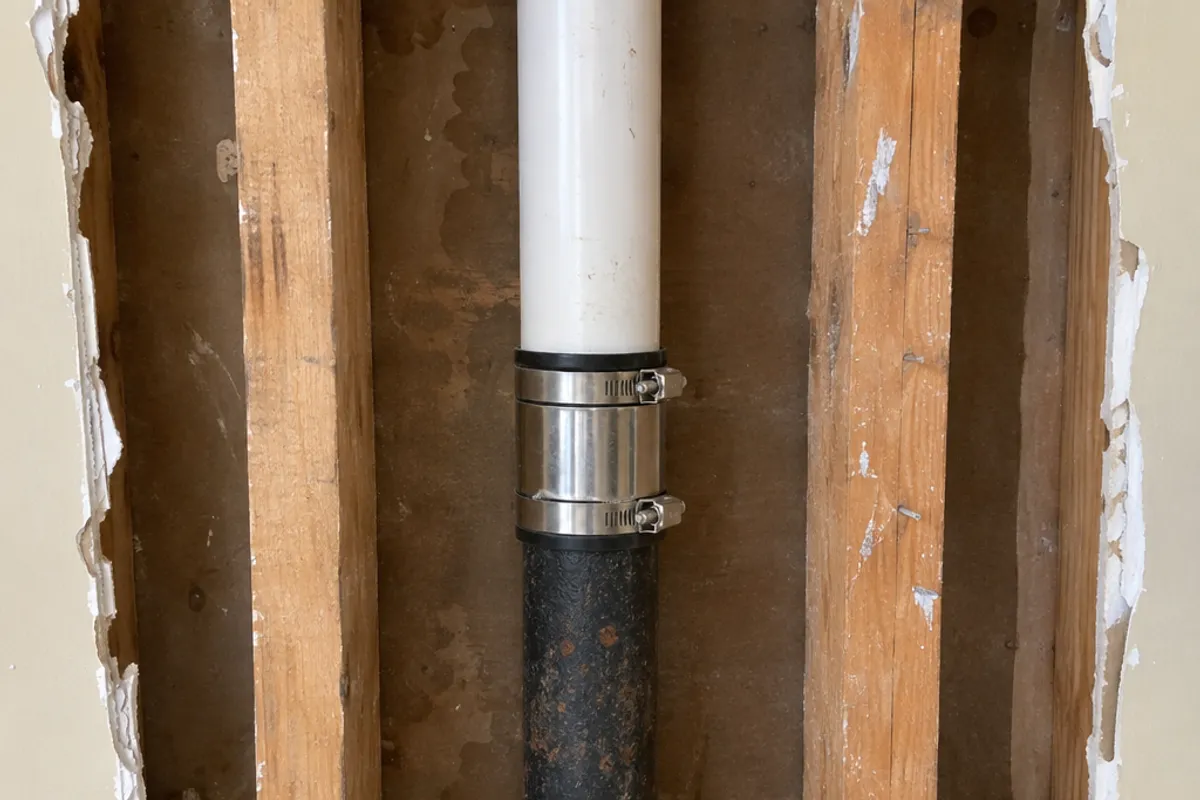
The cast iron to PVC transition is the point where new plastic pipe meets the old cast iron in a repair. The two can't be glued together, and they don't always have the same outside diameter at the same nominal size, so the joint is made with a mechanical coupling sized for each pipe. Main stacks are commonly 3 or 4 in, with smaller waste branches for sinks and tubs, but measure the outside of the old pipe before you buy a coupling rather than going by the nominal size alone.
You will see three kinds of transition fittings:
- Shielded transition couplings. A rubber sleeve inside a stainless steel shield, tightened with band clamps. The shield helps keep the two pipes aligned.
- Unshielded rubber couplings. A flexible rubber sleeve with band clamps and no metal shield. Whether one is acceptable for a given joint depends on your local plumbing code, so ask before you choose one.
- Hub gaskets and adapters. Where new plastic pipe goes into an existing cast iron hub, there are gaskets and adapters made to seal it in the hub.
Read the label before you buy. A transition coupling is marked for the pipe materials and sizes it joins, and the maker's instructions say how tight to make the clamps. The new pipe is often PVC, and ABS is used in some areas too; use what your local plumbing code allows, and match the plastic already in the home where you can.
Why does a cast iron stack need support during pipe replacement?
Cast iron is much heavier than plastic, and that matters when replacing cast iron pipes. A vertical stack in an older home carries waste from every floor above it and may be held by clamps at floor levels, by its own joints and by the bend at its foot, with the weight of the cast iron pipe above bearing on the pipe below. Cut a section out of the middle and the pipe above loses that support. It can drop, and the pipe below can shift and crack at a joint. Take that weight into account before anyone cuts.
General practice before any cut:
- Clamp the stack above the cut with a riser clamp that rests on the floor framing, and secure the cast iron below the cut.
- On a horizontal run, hang or strap the cast iron pipe on both sides of the cut before anything is removed.
- Plan how each cut piece comes out. Even a short length of cast iron is heavy enough to crush a foot, so never let it fall.
After the repair, support the new pipe and the couplings as your local plumbing code and the coupling maker's instructions say. A coupling seals the joint; it isn't meant to hold up the stack. If the old stack turns out to be resting on a failing joint, that is a reason to support or replace more of it, not less.
Which parts of a replaced stack should stay reachable?
After a cast iron pipe replacement, two places are worth keeping accessible, so you can reach them without cutting into the finished surface again:
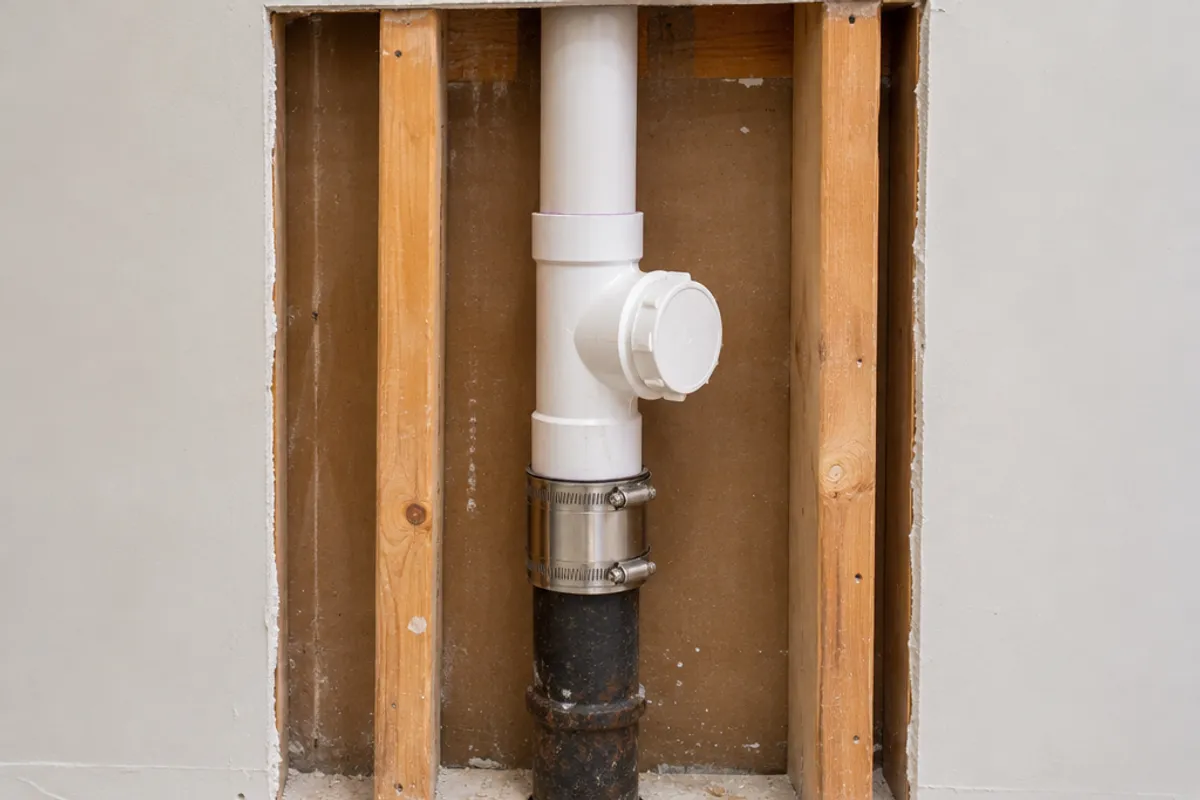
- The cleanout. If the new stack has a cleanout fitting, that is how a drain cable or a camera gets into the waste line, and on toward the sewer line, the next time it clogs.
- The transition couplings. The joints where new pipe meets old cast iron are where you will look first if a leak shows up later, and where the next repair will start if more of the old pipe fails. Check them for drips again over the first few weeks after the work.
Leave both where you can get at them. Frame the wall opening between two studs and fit a removable access panel instead of patching it shut; it will save you cutting into the wall again. Make the opening big enough for the next repair rather than just the fitting: a wrench has to turn the cleanout plug, a drain cable has to go in, and you want a clear view of the nearest coupling. For sizing, see our guide on how to measure for an access panel.
Two of our spring-loaded panels cover most cleanouts on a stack:
- The SAP1414 takes openings from 10 × 10 up to 14 × 14 in, and its cover is 16 × 16 in. That leaves room for a cleanout plus the coupling next to it.
- The SAP0808 takes openings from 6 × 6 up to 8 × 8 in, with a 10 × 10 in cover: enough for a cleanout plug by itself.
Neither panel is fire-rated or rated for water resistance, so if the stack passes through a fire-rated wall or ceiling, check with your building department before you cut. More options are on the plumbing access panels page.
What should you read next?
If a cast iron drain has already leaked, read how to find a water leak behind a wall before you open anything up. When the plumbing repair is done, follow our guide to installing an access panel in drywall, and compare every model on the access panel size chart.