
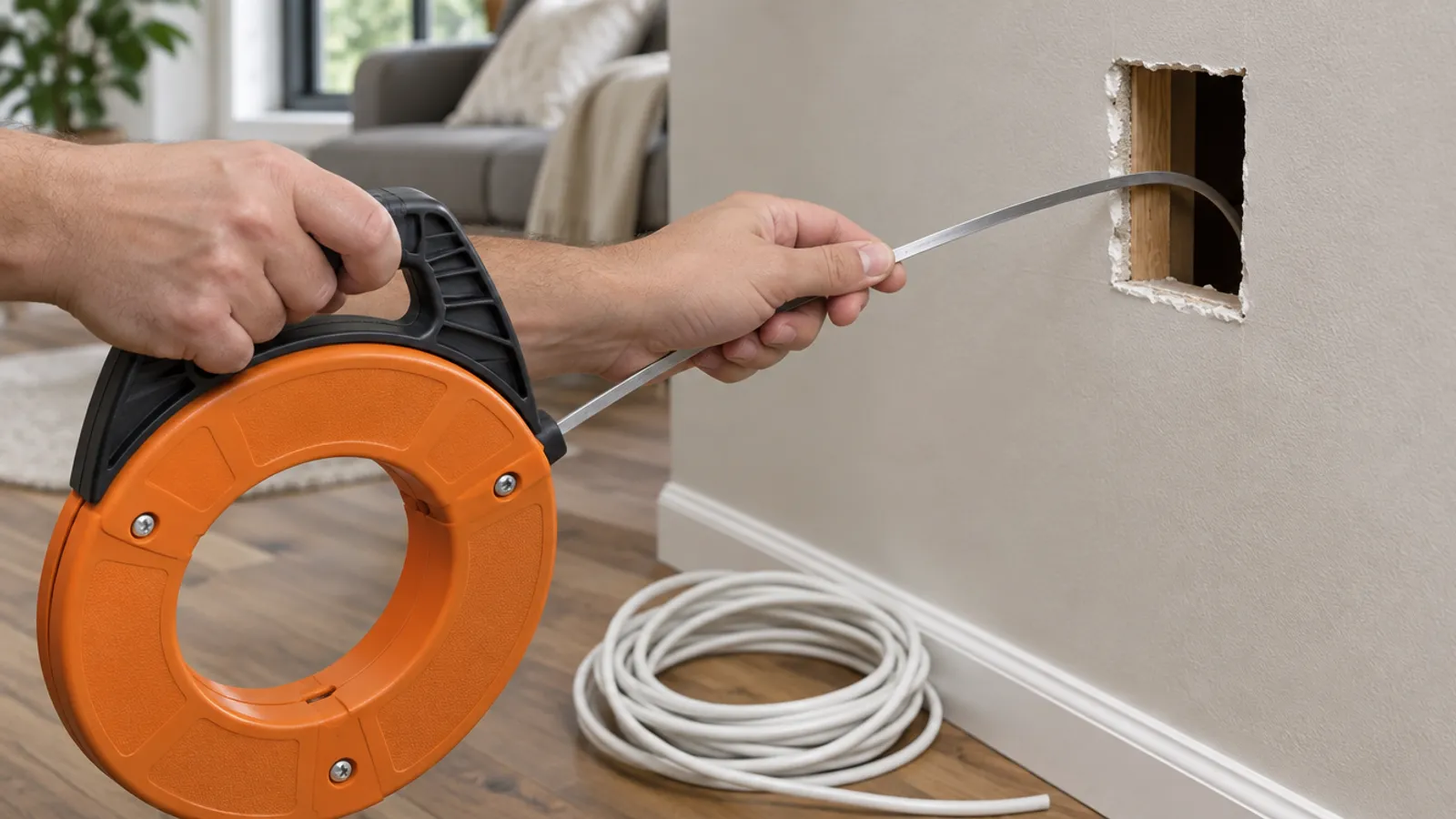
To fish wire through a wall, cut the box opening first, then drill through the top plate from the attic or the bottom plate from the basement. Push a fish tape or glow rod through the wall cavity to the opening, hook the wire to its head, and pull it back. No drywall comes off.
This guide shows how to fish wire through wall cavities in finished walls, from above and below: the tools, the routes, getting past obstructions, the rules for low-voltage and line-voltage wire, and how to close the holes.
What tools do you need for fishing wire through a wall?
Electricians fish wire through finished walls with three main tools. The rest help you find a clear route.
| Tool | Use it for | Watch out for |
|---|---|---|
| Fish tape | Pulling wire or cable through an open stud bay or through conduit; the hook on its head holds the wire | A steel tape conducts electricity: keep it away from live wiring, or use a flexible fiberglass or nylon tape |
| Glow rods (fish sticks) | Getting through insulation, across a ceiling or into a box opening; the flexible rods screw together to the length you need | They are stiffer than tape and won't turn a tight bend |
| Flex bit | A long, flexible drill bit for drilling through a plate or other framing from an opening you already have | Drill slowly and check for pipes and cables first; the bit can wander |
| Stud finder or inspection camera | Finding studs and seeing what is in a wall cavity before you cut | Readings through plaster or foil-faced insulation are less reliable |
A fish tape is a long steel or fiberglass band wound on a reel, with a hook at its head. The job is called fishing because you work blind: you send the tape in, hook the wire and reel it back.
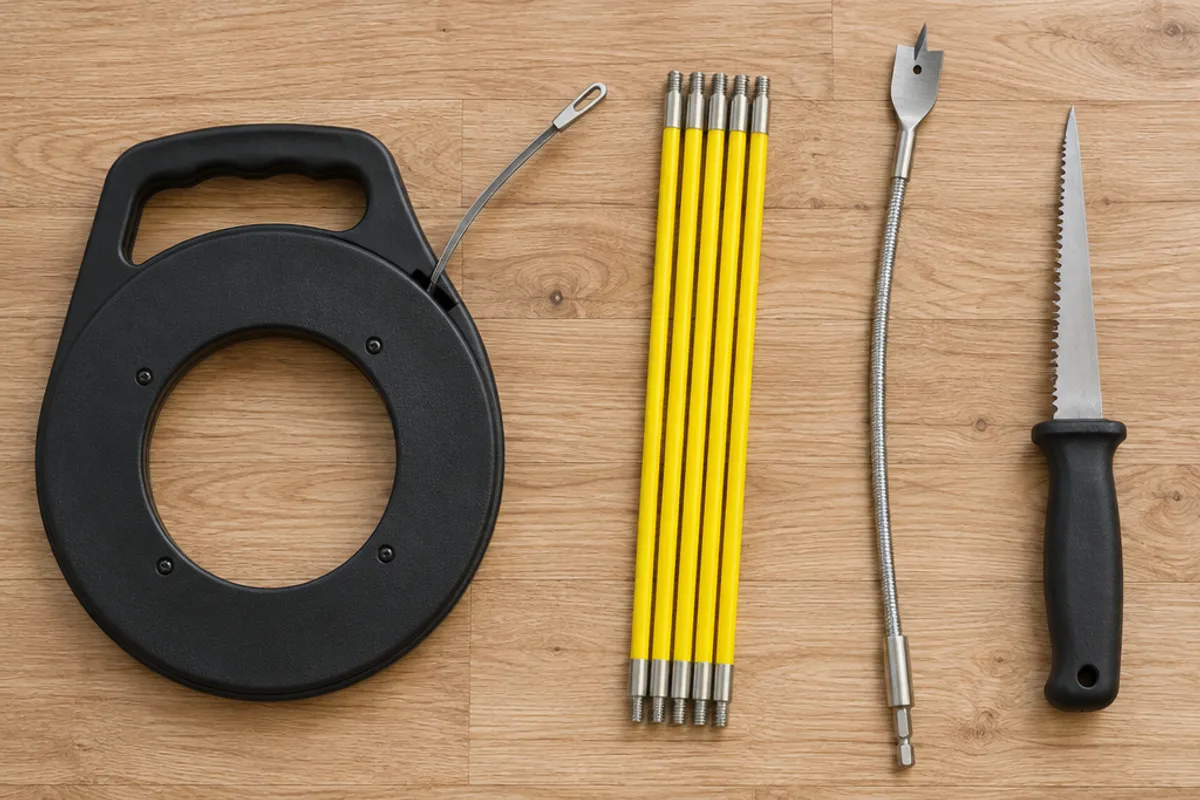
You will also want a drywall saw, old-work boxes (remodel boxes with wings that clamp to the wall when you turn their screws), electrical tape, a voltage tester and a helper at the other end. A spade bit or a long auger bit handles any plate you can reach from above or below. An inspection camera is handy but not essential, and a wire detector with an AC mode warns you of live wiring behind the drywall.
How does fishing wire through finished walls work?
In new construction, the cable goes in before the drywall. Whether you're adding an outlet on a new circuit or an Ethernet drop, fishing wire through finished walls means working through the fewest, smallest holes: the box cutout, one hole in a plate, and a small extra hole only where something blocks the route. Knowing how to fish wire through wall framing this way saves a lot of patching.
- Plan the route. Pick the entry point and the exit point, mark the wall studs, and choose a stud bay with no window, door, duct or drain in it. Brick and concrete walls have no cavity, so use a surface raceway there instead.
- Turn off the power. Switch off the breaker for every circuit in that wall, and check nearby outlets and switches with a voltage tester.
- Cut the box opening. Trace the old-work box between two studs, check the cavity for pipes and other stuff through a small hole with a bent wire or the camera, then cut it out.
- Get into the wall. Drill through the top plate from the attic, or the bottom plate from below (next two sections).
- Feed the fish tape or glow rod. Run it from the plate toward the opening while your helper watches for its head and grabs it.
- Attach the wire and pull steadily. Hook the cable to the tape (below) and pull while your helper feeds it in, so it can't kink or get caught.
- Finish. Leave enough length at each end for the connections, set the old-work box in position, and close any extra holes.
How do you attach and pull wire with a fish tape?
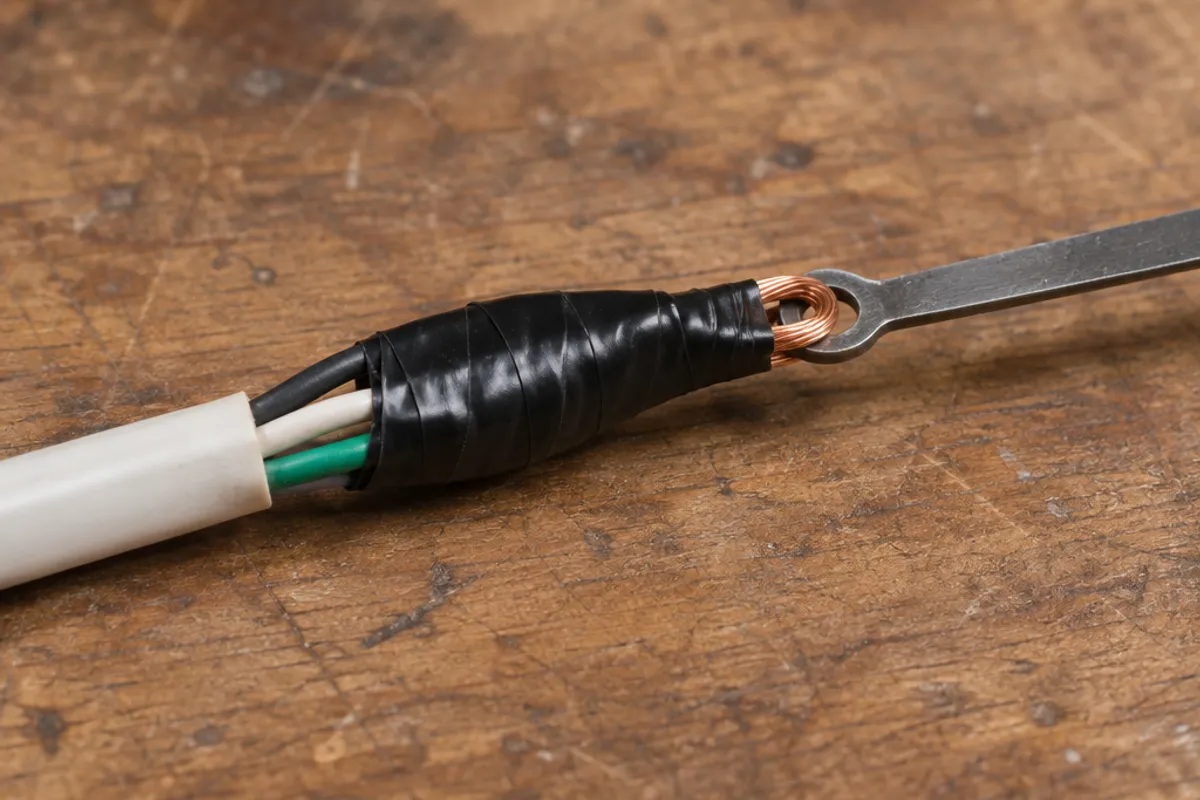
Strip the outer jacket from one end of the cable and bare the conductors. Hook them through the eye in the fish tape's head, bend them back on themselves, and wrap the joint in electrical tape. Taper the wrap so it has no edge to catch on a plate or a staple. For data or coaxial cable, tie a pull cord to it rather than bending its conductors, and follow the cable maker's instructions on pulling force and bend radius.
Pull the cable in one smooth, steady run, because stopping and starting lets it snag. If the wire won't move, don't force it: pull it back a little and try again.
What if you can't find the fish tape at the other end?
This is the tricky part of fishing wire. If the head of the tape doesn't show up at the opening:
- Bend a small hook into a length of stiff wire, reach in, and sweep the wall cavity for the tape.
- Switch to a glow rod. It is easier to see, and its stiffness keeps it on course.
- If insulation bunches up in front of the tape, back it off a little, twist it and try again.
- If it stops dead at the same point every time, you have hit solid lumber across the cavity (see below).
How do you fish wire from an unfinished attic down a wall?
Fishing wire down from above suits a wall on the top floor, below an unfinished attic. On a lower story, the floor above caps the wall, so come up from the basement instead.
- Figure out where the wall is. Measure from a reference point you can see in both places, such as an exterior wall, a plumbing vent or a ceiling light. Or push a stiff wire up through the ceiling right where the wall meets it, and look for it in the attic.
- Drill the plate. Move the insulation aside and drill down through the plate in line with the opening. It is often two boards thick, so use a long auger or spade bit, and keep the hole near the center.
- Drop a line or feed the tape. Lower a weighted pull string or a light chain down the hole, or feed the fish tape down until your helper can grab it. Then tie on the cable and pull it up.
How do you fish wire up from a basement or crawl space?
Fishing wire up from below is the usual route for a ground-floor wall in houses with unfinished basements or a crawl space. Electricians often wire a whole room this way.
- Find the bottom plate from below. Measure from a pipe, duct or wall you can see from both sides. Or take the baseboard off, drill a small hole straight down through the floor against the wall, and slide a wire through it as a marker.
- Drill up into the wall. Drill through the subfloor and the plate in line with the opening.
- Feed up to the opening. Run the glow rod or fish tape up to the box, then attach the cable and pull wire back down with it.
What about running wire sideways across studs?
Going sideways is the hardest route, because every stud is in the way. There are two common ways to run wire through walls without removing drywall:
- Behind the baseboard. Take the baseboard off, cut a strip of drywall away behind it, drill or notch each stud, run the cable, and put the baseboard back over the channel. Protect it with steel nail plates wherever it passes close to the face of a stud, as electrical codes generally require; ask your inspector how close is too close.
- Stud to stud. Cut a small hole at each stud, drill through the stud with a flex bit, and fish from hole to hole, pulling the wire along as you go.
Around a door or window, going down to the basement or up to the attic and back is usually easier. In commercial buildings, steel studs come with punched holes for wiring, but commercial wiring is work for licensed electricians.
What about insulated exterior walls?
Fishing wire through an exterior wall is harder. These walls are full of insulation, and in cold climates such as Alberta, Quebec and the Atlantic provinces there is often a plastic vapor barrier behind the wallboard. A glow rod will get through fiberglass batts with patience; spray foam won't let it through, so plan another route. Where a box opening cuts the vapor barrier, use a box made to seal to it where your local code calls for one.
How do you get past a fire block in a wall?
A fire block is solid lumber fitted between the studs to slow fire and smoke moving up the wall cavity. The plates at each floor do this job in most houses, but some walls also have lumber partway up, and some have horizontal framing added as drywall backing.
When your fish tape or glow rod stops dead, mark it where it enters the plate, pull it out and lay it along the wall. The mark lets you figure out the height of the obstruction. Then:
- Cut a small hole at that height. A round hole made with a hole saw is neat, and you can close it later without patching.
- Drill through. Use a flex bit through the opening or the small hole, or a short bit straight through the hole.
- Finish the pull. Push the tape through, carry on to the opening, and pull the cable back.
- Seal around the cable. Fill the gap with a fire-stop sealant or foam your building department accepts, so the lumber still slows fire.
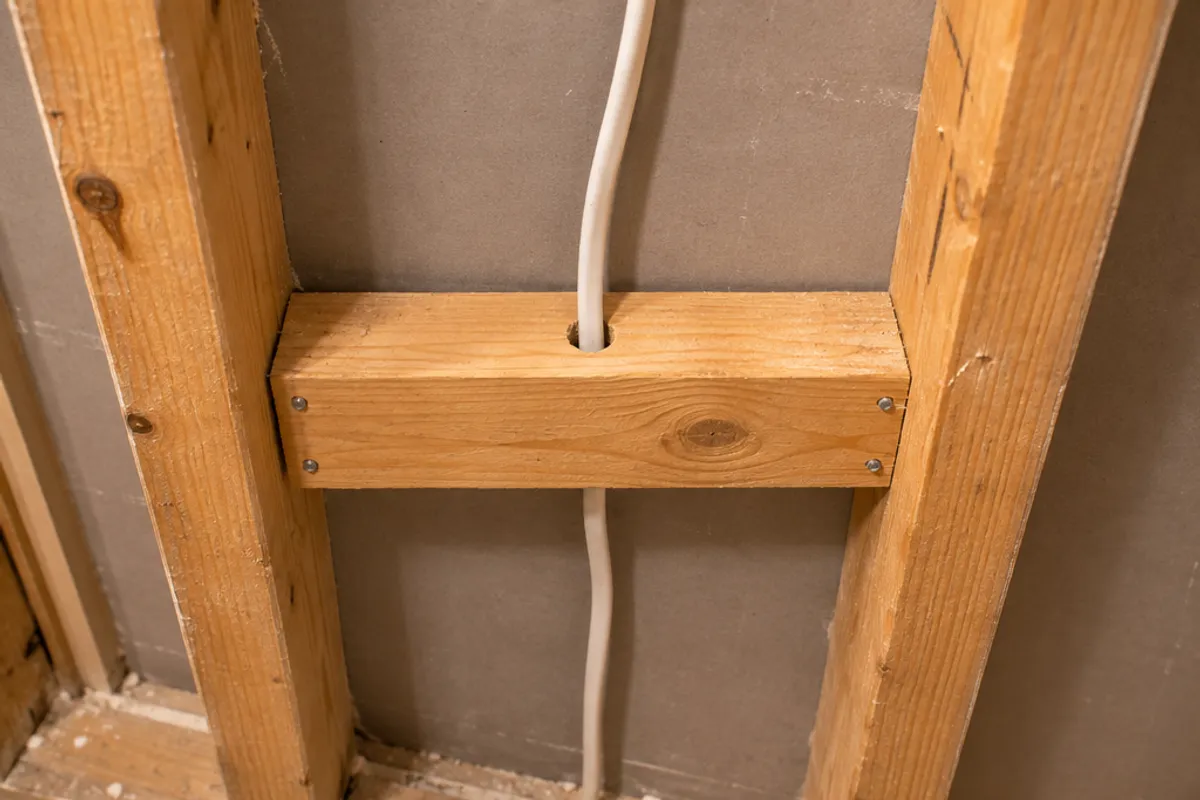
A flex bit fed through the opening can often reach lumber a short way above or below it, with no extra hole at all. When you do cut one, you don't have to patch it: as mentioned below, a round access panel closes it and leaves a way back in for the next wire.
What are the rules for low-voltage vs line-voltage wire?
Fishing works the same way for both, but the rules don't.
| Question | Low-voltage wire | Line-voltage wire |
|---|---|---|
| Examples | Ethernet cable, coaxial cable, speaker wire, thermostat wire and doorbell wire | 120-volt house wiring for a lighting or outlet circuit, such as nonmetallic sheathed cable with a bare ground wire |
| Who can do it | Usually a DIY job | Often needs a permit, and in many areas a licensed electrician |
| What it ends in | A low-voltage mounting bracket, an open ring with no back box | An electrical box, with every splice inside a closed box |
Keep the two apart. Never put low-voltage and line-voltage wiring in the same box unless it has a divider made for that, and where a data cable has to cross a power cable, cross it at a right angle to limit interference.
Turn the breaker off and test for voltage before you cut or drill into a wall with wiring in it. Installing a new circuit or extending one is electrical work: use a licensed electrician where your area requires one, and check whether you need a permit. Be careful with a steel fish tape near any live circuit.
Why do junction boxes have to stay reachable?
Because the splices inside them may need to be checked or redone. Never bury a splice in the wall without a box, and never close a box in behind drywall; if you're unsure where a new box may go, ask your electrical inspector before you cut. Our guide to what a junction box is explains the rest.
How do you close the holes when you're done?
Fishing wire usually leaves a hole or two besides the box cutout: where you drilled through framing, at a stud, or where you looked for a plate. You can patch them, or fit a round access panel.
- Patch. Small holes take a mesh patch or a drywall plug with joint compound; see how to patch a hole in drywall.
- Round panel. A round access panel fits a round hole and comes off again, so it suits any spot where you expect to fish another wire later, such as behind a wall-mounted TV.
| From our catalog | Fits round openings | Outside diameter | Pack |
|---|---|---|---|
| SAP50 | 3.75–4 in across (smallest estimated) | 5 in | 1 |
| PAP65 | 5.25–5.5 in across (smallest estimated) | 6.5 in | 1 |
| SAP10R | 6 in up to 9 in across | 10 in | 1 |
Before installing one, cut the hole with a hole saw inside the model's range, or measure the hole you have with how to measure a round access panel opening. The round access panels page shows all three.
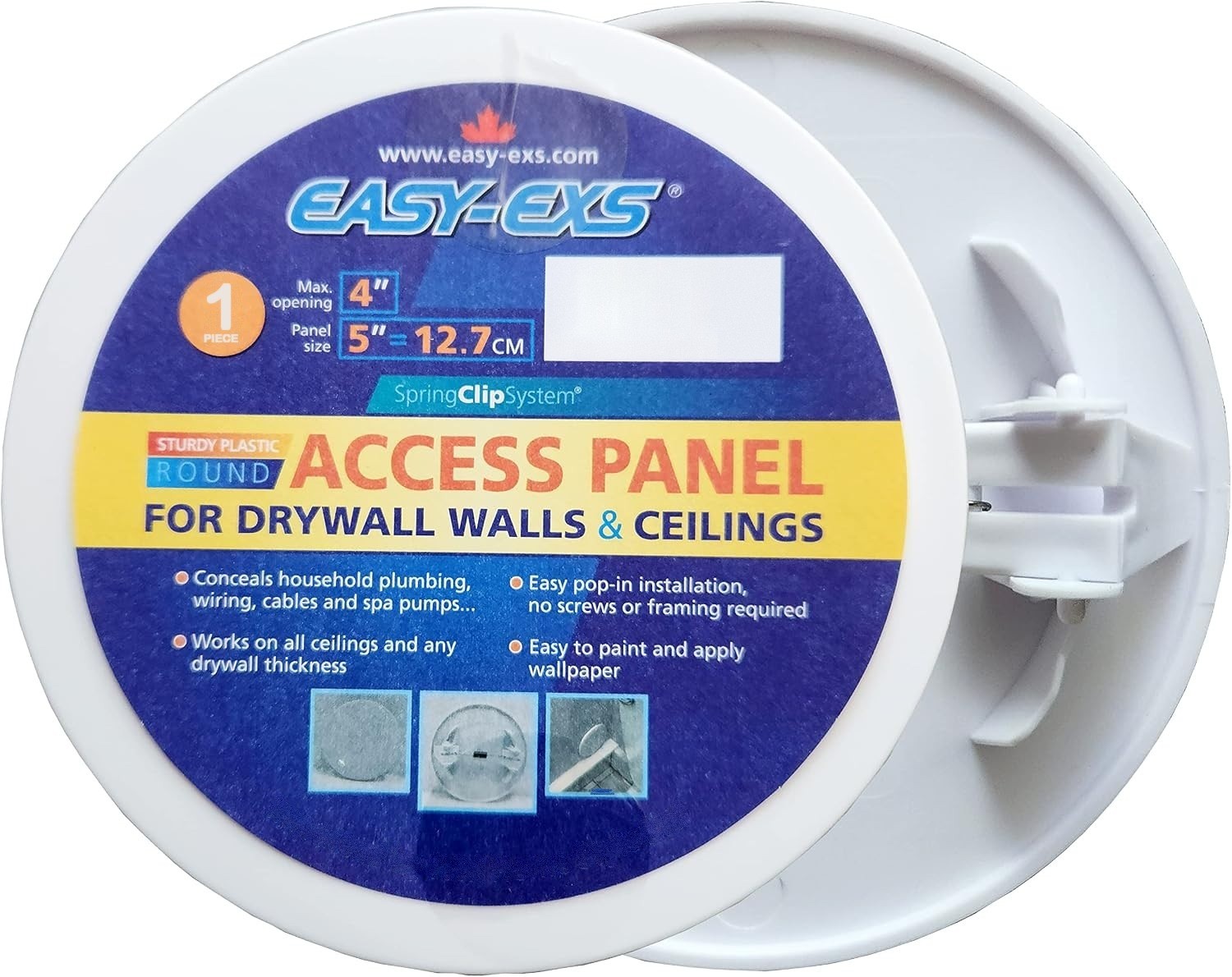
Easy-Exs · SAP50
Access Panel Round 4 in Click-Fit (Outside Dimension 5 in) Plastic White
Fits 3.75–4 in round openings (smallest estimated) · Overall 5 in diameter
USD $5.49 each
- 10+ panels: $4.79 each
- 80+ panels: $3.99 each
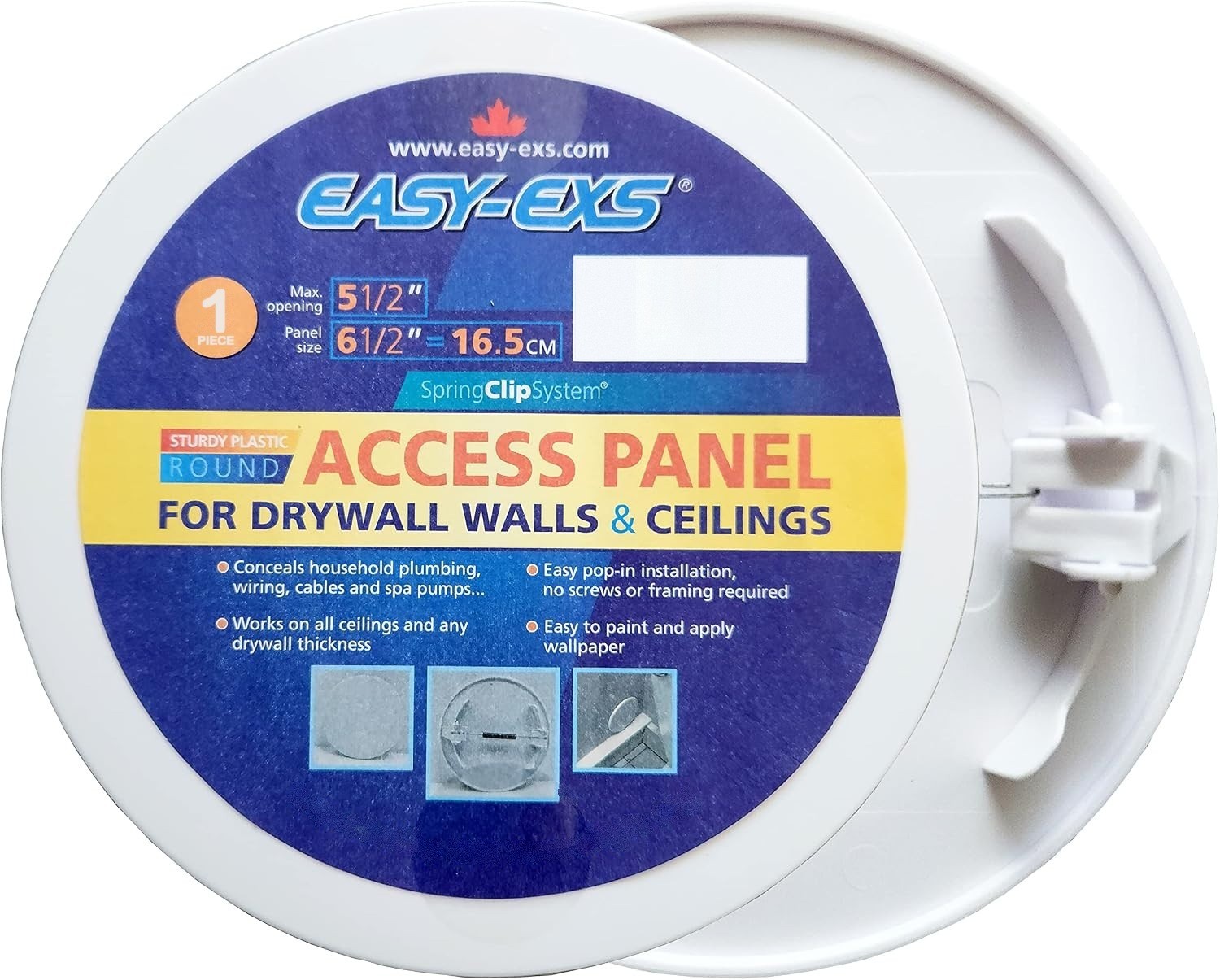
Easy-Exs · PAP65
Access Panel Round 5.5 in Click-Fit (Outside Dimension 6.5 in) Plastic White
Fits 5.25–5.5 in round openings (smallest estimated) · Overall 6.5 in diameter
USD $6.49 each
- 10+ panels: $4.99 each
- 80+ panels: $4.49 each
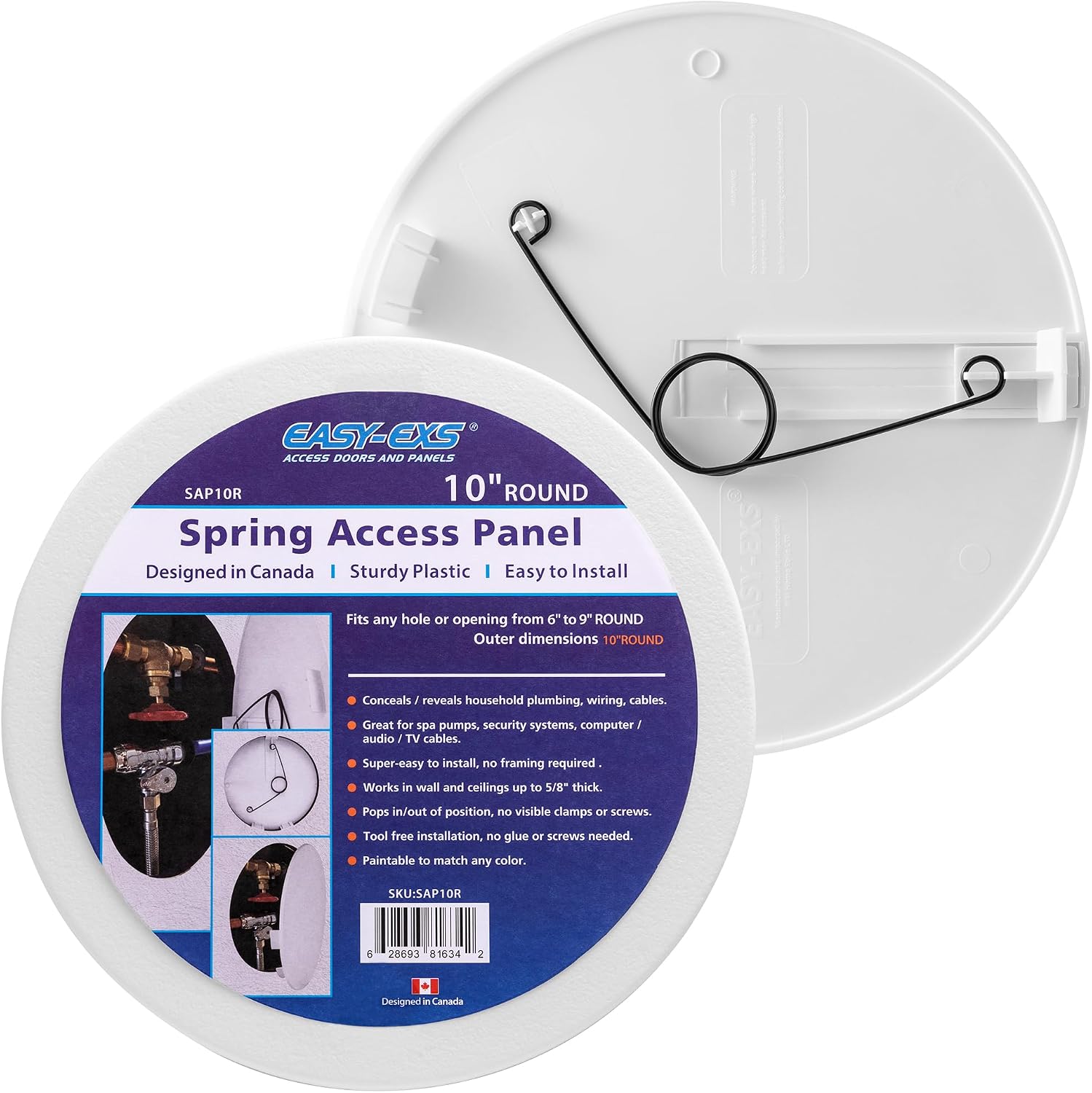
Easy-Exs · SAP10R
10 in Round Spring-Loaded Access Panel for 6–9 in Openings
Rated 4.5 out of 5, 243 ratings online
Fits 6–9 in round openings · Overall 10 in diameter
USD $10.99 each
- 10+ panels: $9.49 each
- 80+ panels: $7.49 each
A round panel is not an electrical box. If a splice sits behind the hole, it still needs a junction box with its own cover, kept reachable; see can you drywall over a junction box? Our round panels are plastic and are not fire-rated, so in a fire-rated wall ask your building department what may close the opening.
For a square opening, follow how to install an access panel in drywall, and compare every size on the access panel size chart.