
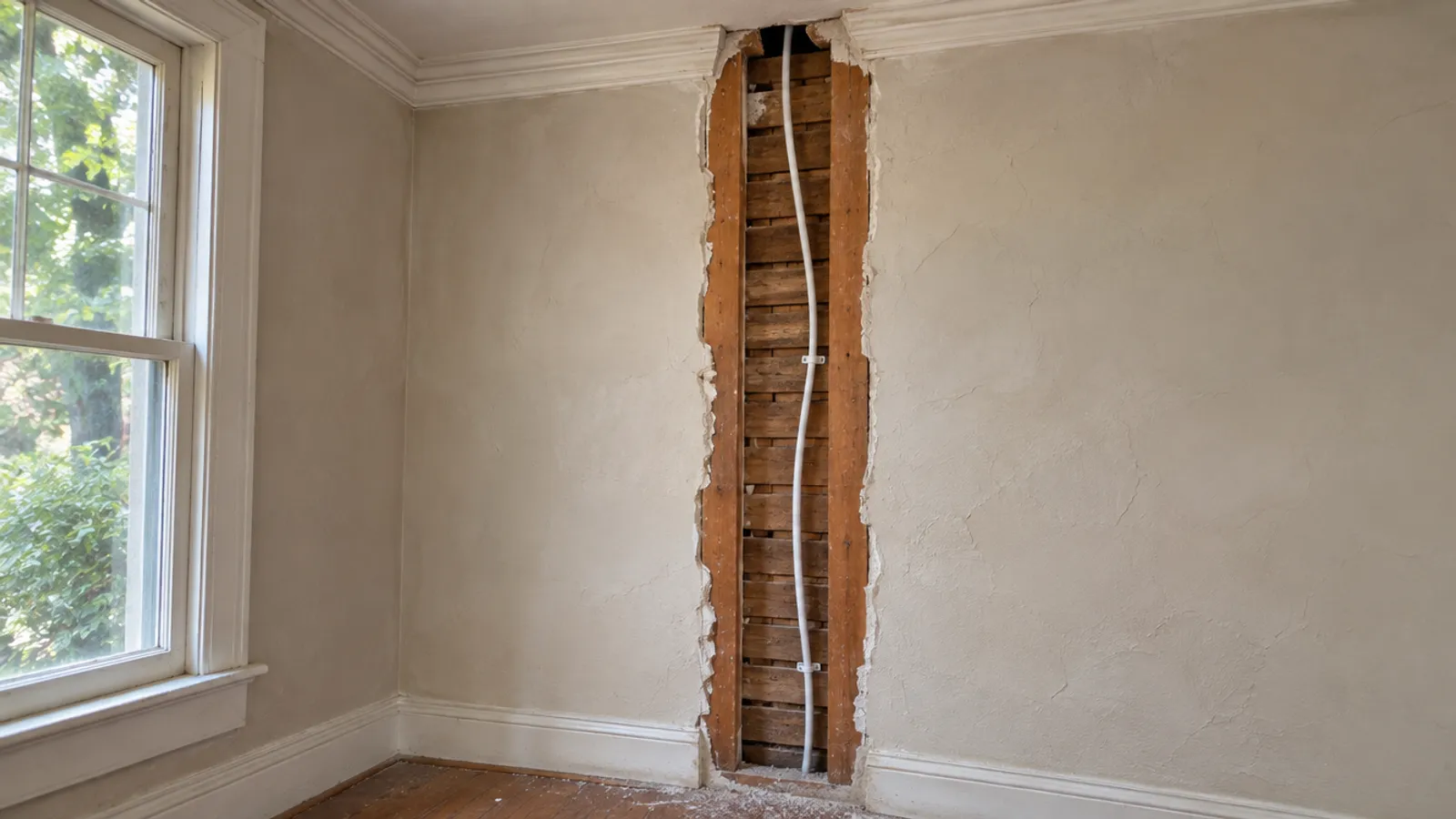
Knob and tube wiring replacement means a licensed electrician runs new grounded wiring from the panel to every outlet, switch and light, then disconnects the old circuits so they can never carry power again. The rewire starts with an assessment and a permit, and it ends with an inspection.
This post explains what to expect at each stage, from the permit to the last junction box, for older homes in British Columbia, Alberta, Quebec, the Atlantic provinces and the US. The plan you agree on decides how much plaster gets opened, how long rooms go without power and whether every splice stays reachable afterwards. If you haven't confirmed what's in your walls yet, start with how to identify knob and tube wiring.
A rewire is licensed electrical work in most places, and an old wire that looks abandoned can still be live. For safety, leave the testing, disconnecting and new circuits to a licensed electrician, and don't cut or pull old wires yourself: a dead-looking wire can still give an electric shock. Before anyone opens a box or touches a wire, the circuit has to be switched off at the panel and confirmed dead with a tester.
What does replacing knob and tube wiring involve?
It replaces the whole electrical system in stages: installing new wiring, boxes, outlets and devices, then taking the old knob and tube system out of service. The City of Menlo Park describes knob and tube as an early wiring method used in buildings until the 1940s, so any of it still in service has been there a long time. Owners usually decide to replace it after an assessment turns up electrical problems and safety hazards, such as faulty splices, brittle insulation or a circuit overloaded by modern appliances, or when a renovation opens the plaster anyway. Warning signs that send owners to an electrician include flickering lights, sparks at an outlet and fuses that blow often.
The new cable carries a ground wire, a basic safety feature the old system never had, so grounded sockets for computers and appliances become possible. The new system also has to meet today's power needs, not the ones the house was built for decades ago. The City of Berkeley's knob and tube replacement measure pairs the rewire with new 240-volt outlets for future electric appliances, so the house doesn't need rewiring again. Settle that at the start: which rooms will run kitchen appliances, a home office with computers and TVs, heat or a car charger, and whether the panel and service need an upgrade too.
Some owners rewire everything at once; others upgrade one floor or a few circuits at a time. In a staged rewire, new wiring meets the old knob and tube that stays in junction boxes, which matters later in this post.
Do you need a licensed electrician and a permit?
Replacing knob and tube wiring almost always needs a permit, and in many places a licensed electrician too. The rules belong to your province, state or city. Examples from official sources:
- British Columbia. Technical Safety BC says an electrical homeowner permit is required for many kinds of home alterations, and owners of strata units, non-strata duplexes and homes run as a business cannot obtain one.
- Alberta. Medicine Hat's homeowner permits and electrical wiring guide allows a homeowner permit only to an owner who lives in the house and does the work, not for a rental. It says homeowners need at least a basic knowledge of electric wiring and that a rough-in inspection must be done.
- Quebec. The Régie du bâtiment du Québec lists work you can do yourself, and electrical installations are the exception: a contractor holding the right licence must do them.
- Atlantic Canada. A Nova Scotia electrical safety card says electrical contractors working in your home must be trained and licensed, and tells you to ask for the wiring permit and a copy of the inspection report.
- United States. Washington's Department of Labor and Industries says an electrical permit is required for most electrical work, bought by whoever does the work, property owner or contractor, and that you must request inspection before covering any of it. Other states and cities differ, so consult your local electrical inspector.
For a whole-house rewire project, a licensed electrician is the normal route even where a homeowner permit exists. The inspector's visit is your independent safety check: keep the report as your record that the new electrical system passed, and check your policy with your insurer.
How do you rewire an old house, step by step?
A typical rewire project in an occupied house runs in this order:
- Assess the old electrical system. The electrician tests each circuit, traces it to its fuse or circuit breaker, and notes which runs are live, where previous owners spliced newer wire into old and any signs of overheating. Older homes carry decades of changes, so expect to discover a few surprises.
- Plan the new circuits. Decide which outlets, switches, lights and appliances share a circuit, and where each new box goes. Plan ahead for the kitchen, bathrooms, heavy loads and any panel upgrade.
- Get the permit. Work starts once it is issued.
- Run the new wiring. Each new run goes from the panel to the first box of a circuit, then box to box, usually room by room.
- Pass the rough-in inspection. The inspector checks the new work before plaster, drywall or insulation hides it.
- Cut over. The electrician finishes installing the new switches, devices and fixtures and connects each circuit at the panel. Rooms lose power while this happens.
- Disconnect the old circuits. Each knob and tube circuit is cut off at the panel and at its ends, so nothing can feed it again.
- Patch and close. The openings are patched and the final inspection is booked.
How is new wiring fished through the plaster walls of older homes?
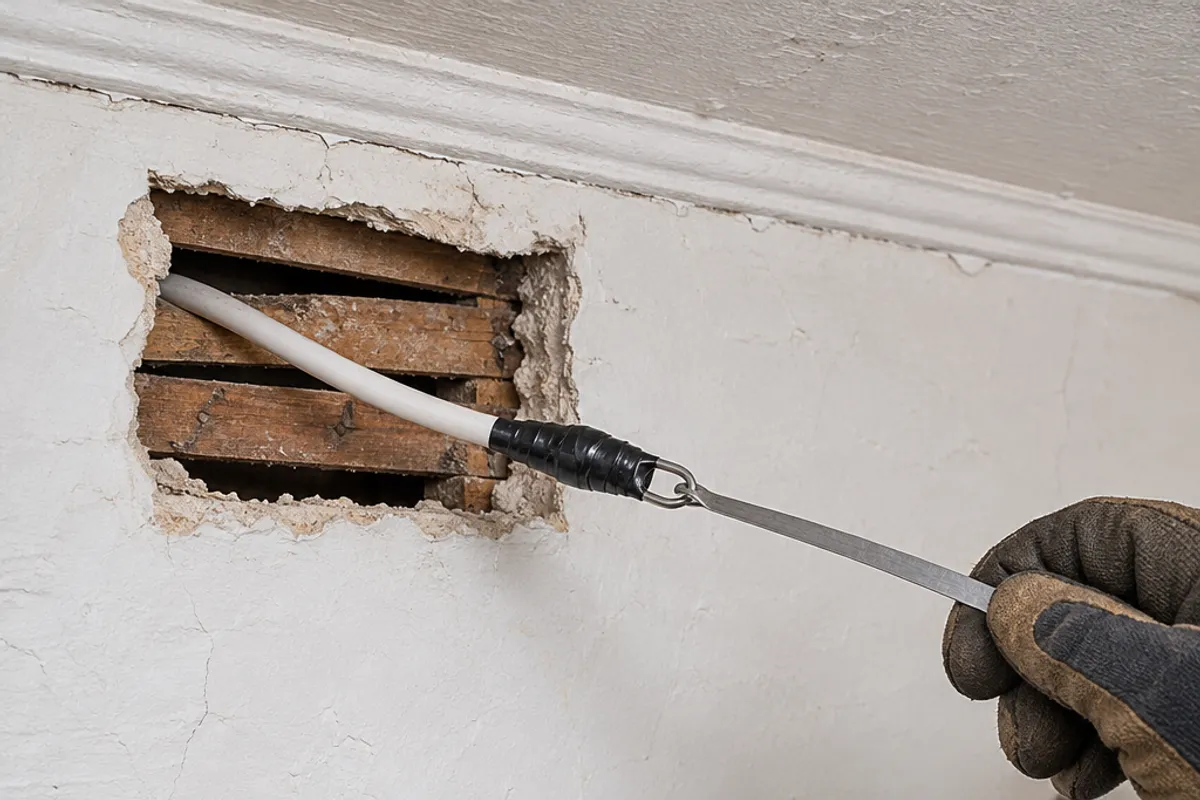
Mostly without opening the plaster. Plaster on wood lath is harder and more brittle than drywall, and it cracks around a careless cut, so on most rewire jobs electricians fish new wiring through the existing cavities instead:
- From the attic down. A hole through the top plate lets a fish tape drop to the new box below.
- From the basement up. The same works through the bottom plate, from an unfinished basement or crawl space.
- Across a room. Going sideways across studs needs more openings, often behind a baseboard lifted off, or through the floors above.
- At each new box. The hole cut before installing the box is often where the wire is pulled through.
Blocking or a fire block inside the cavity stops a fish tape and needs a small opening at that spot; see how to fish wire through a wall for each technique. Old paint on plaster may contain lead, so test before anyone cuts or sands it: see should you test for lead paint in our plaster repair guide. Ask who patches the openings; on some jobs the electrician does, on others a plasterer.
What happens to the old wiring: is it removed or left in place?
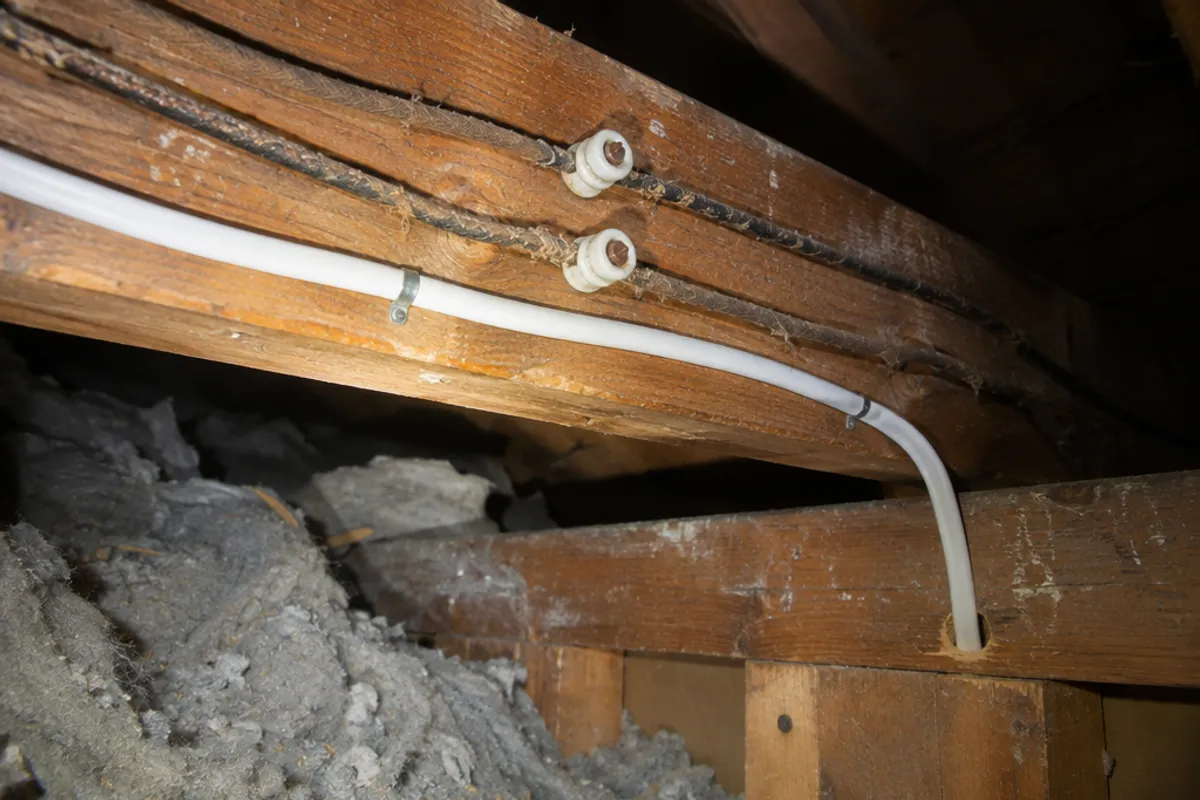
Physically removing the old wiring isn't always necessary, though a building department may push for it: the City of Menlo Park recommends that knob and tube discovered in the course of construction be removed entirely or in part, to the maximum extent practical. In practice it depends on where the old wiring runs:
- Exposed runs in an open attic or an unfinished basement are often taken out. Old wire left on knobs in plain view confuses the next electrician, home inspector or buyer.
- Concealed runs inside plaster are commonly disconnected at the panel and at each outlet, switch and fixture, then left in place. Pulling them out would mean opening the plaster along their whole length.
Either way, no old conductor should be able to reach power again. Ask the inspector what proof they want that the old circuits are dead, and ask the electrician to note in writing which runs were abandoned in place. If attic insulation is planned, tell the electrician first: any knob and tube that is still live relies on open air around its wires.
Where do the new junction boxes go, and how do they stay reachable?
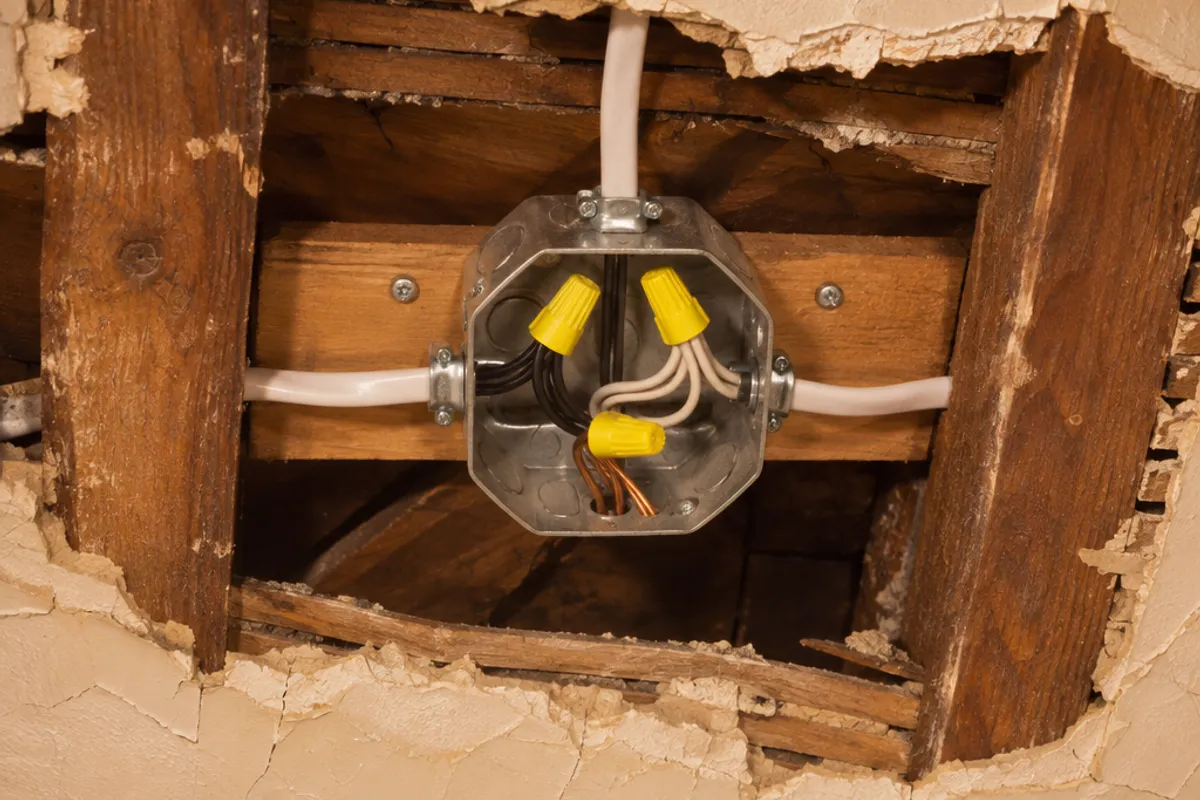
All outlets, switches and lights get new boxes, and junction boxes go wherever a new run splits, or where new wiring has to connect to old knob and tube wiring in a staged rewire. Many end up in an attic, a basement ceiling or a wall cavity. If boxes are new to you, read what is a junction box?; for the boxes left by a partial rewire, see where the junction boxes go in our identification guide.
Every box in the new electrical system has to stay reachable. In the US, NEC 314.29 (NFPA 70, 2023 edition, as revised by TIA 23-10) wants the splices and devices in every box kept accessible, so a box that ends up behind plaster needs an opening in that surface, which may carry a removable cover. In Alberta, Medicine Hat's guide puts it plainly: make sure all junction boxes are accessible after installation. In British Columbia, Quebec and the Atlantic provinces, ask your provincial electrical inspector how a hidden box must be reached.
So fix the box locations before the plaster is patched. Where a box can't come forward to the finished surface, for example above a plaster ceiling or behind a furred-out wall, fit an access door or panel in front of it:
- A hinged door that stays attached when open: PAD0808 hinged door: maximum service opening 6.35 × 6.35 in, overall 8 × 8 in
- A spring-loaded panel whose cover lifts off: SAP0808 spring-loaded panel: fits 6 × 6 to 8 × 8 in openings, overall 10 × 10 in
Measure the box with its cover on, at the widest point, and center the opening on it so the box cover comes off through the panel. Plaster and lath is often thicker than drywall, so measure it at the first opening and read the product details before installing anything. If a box may already be buried, read can you drywall over a junction box?
Our plastic access panels and doors are not fire-rated, and we publish no water-resistance rating for them, so don't fit one in a fire separation, such as the wall between a house and an attached garage.
How long does a rewire take, and what should you expect?
It depends on the size and age of the house, how much of it the electrician can reach from the attic and basement, and how soon the inspector can come. The labor is mostly fishing and patching, so access drives both the schedule and the cost. Get the electrician's advice in writing before the job starts:
- the schedule by phase, with a start date, a finish date and the inspector's visits;
- the cost broken down by phase;
- whether the panel needs an upgrade first;
- which rooms lose power, and when;
- which openings get cut, and who patches them;
- which old knob and tube wiring is removed and which stays in place, dead;
- where every new junction box ends up.
Expect dust and some days or weeks of open holes. Two tips for living through it: move furniture away from the walls along each new run, and watch where each new box goes, so you can mark the junction boxes before the plaster is patched. A good electrician will walk you through the rewire plan and review the list at the end.
Measure before you order: our guide on how to measure for an access panel shows how, and the access panel size chart compares every opening and cover.
To compare panels for a wiring project, see the electrical access panels page. Next, read our guide to fishing wire before the openings are planned.