
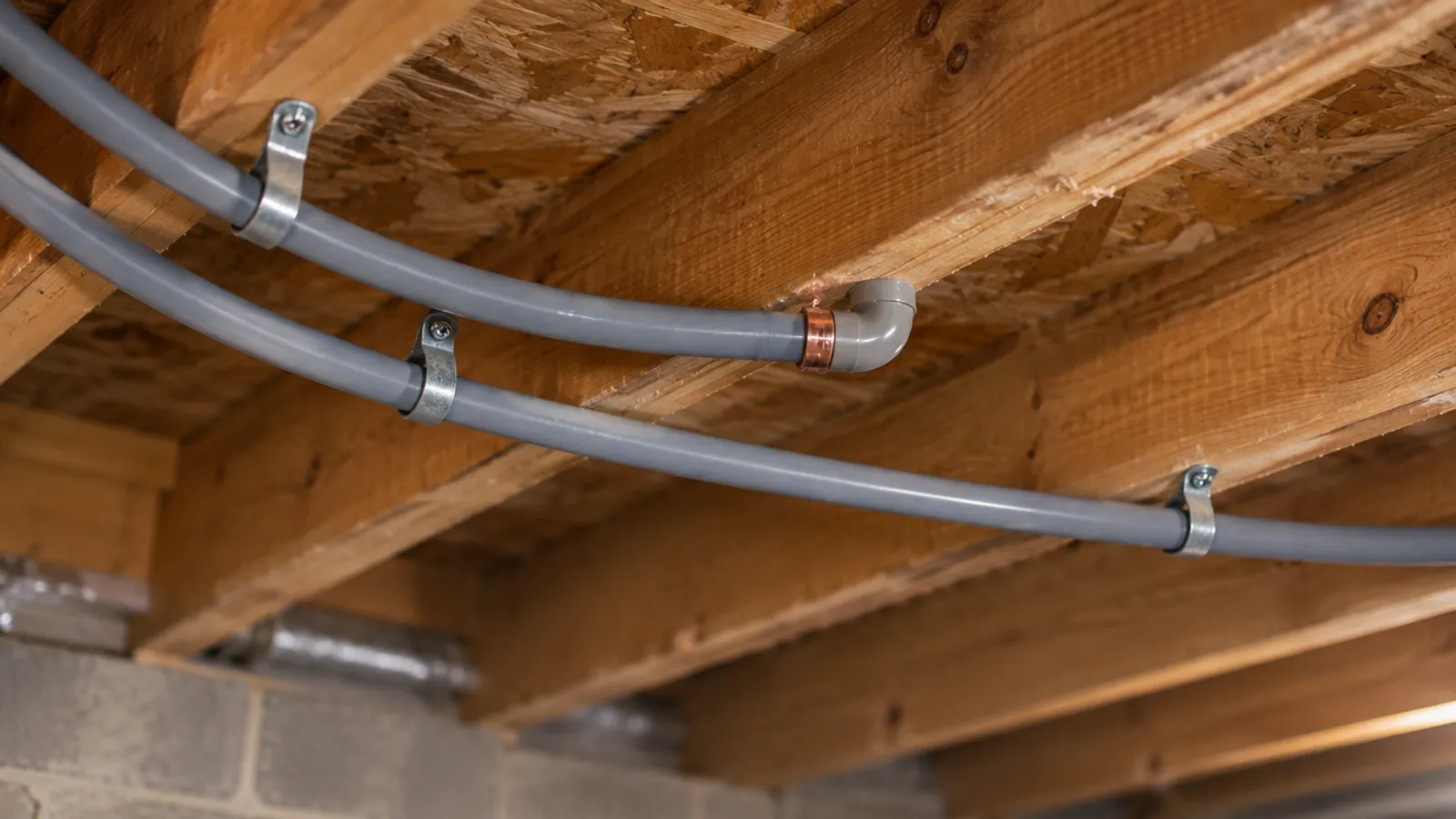
Poly-B (polybutylene) is a flexible plastic water supply pipe, most often gray, joined with insert fittings held by crimp rings or bands. Look for it where pipes show: at the water heater, the main shut-off, under sinks and across an unfinished basement ceiling. Read the printing on the pipe, and have a qualified inspector confirm what you find.
Poly-B is the name commonly used in Western Canada, in British Columbia and Alberta; in the US it is called polybutylene piping or PB pipe. It is the same material. This guide shows how to tell Poly-B plumbing apart from PEX and copper, where to look without opening a wall, and what to plan for if Poly-B replacement is on the table.
What is Poly-B piping?
Poly-B piping is polybutylene piping: plastic pipe used for the water supply piping in a home, meaning the hot water and cold lines, under pressure, that feed faucets, toilets, showers, the washer and the water heater. It is not a drain pipe. Drains are larger in diameter and rigid, and are commonly black ABS or white PVC.
Poly-B was once a common supply pipe in Canadian and US homes, so older homes that still have their original plumbing are the ones to check, and a home inspector or plumber can confirm what yours has. Later repairs often replaced part of the plumbing system, so one home can have Poly-B plumbing, copper and newer plastic pipe side by side. Finding copper at one fixture doesn't clear the whole house.
How does Poly-B compare with other pipe materials?
Check four things together: how the pipe bends, what is printed on it, how it is joined, and its color. No single clue settles it, and markings and colors vary from one maker to another, so compare it with the other piping materials you find in the same home.
| Clue | Poly-B | PEX | Copper | CPVC |
|---|---|---|---|---|
| Color | Usually gray | Often red, blue or white; other colors exist | Copper-colored metal, often darkened or with green spots | Usually cream or tan |
| Flexibility | Flexible; runs in long, gentle curves | Flexible; runs in long, gentle curves | Rigid; turns corners with elbows | Rigid; turns corners with elbows |
| Printing | May include PB, if still legible | Usually printed PEX, with its size and standard | The metal is the giveaway | Usually printed CPVC |
| Joints | Insert fittings, plastic or metal, held by crimp rings or bands | Crimp, clamp or expansion rings, or push-fit connectors | Soldered joints, compression or push-fit joints | Glued (solvent-cemented) joints |
Three things catch people out:
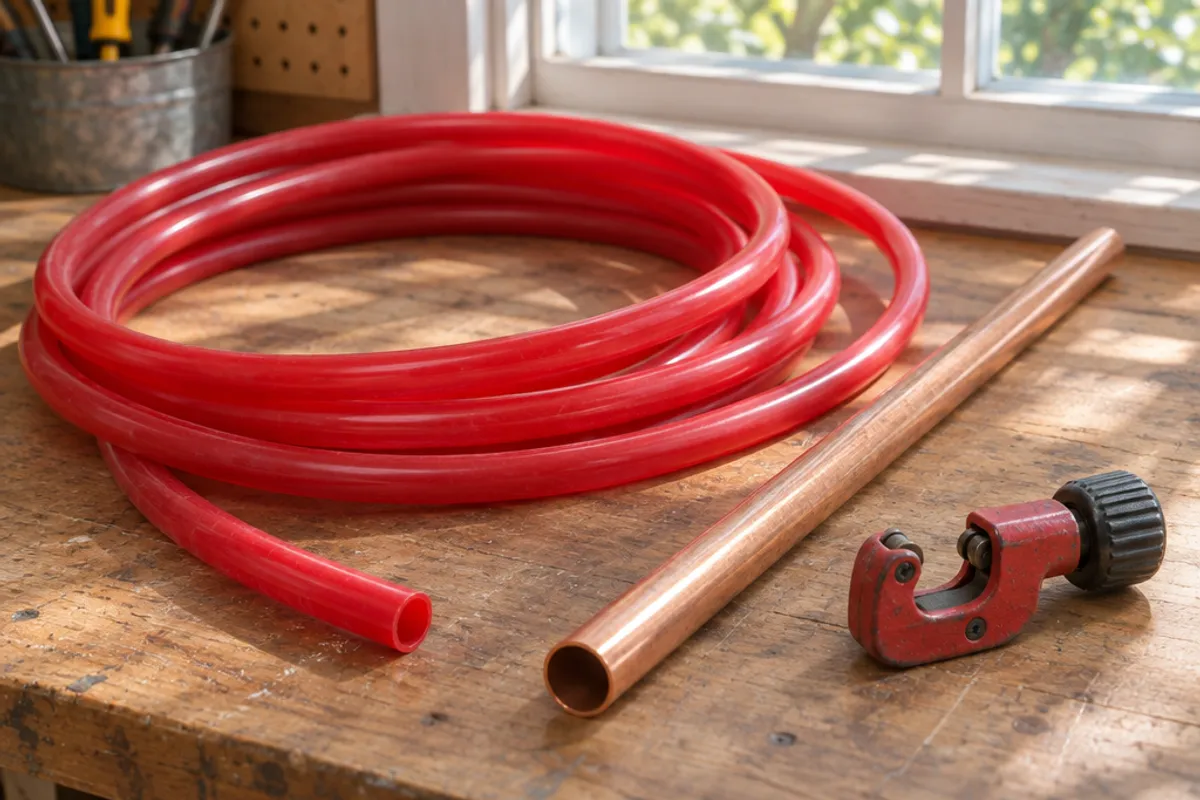
- Color alone isn't proof. Poly-B is most commonly gray, but some PEX and some CPVC is gray too, so not all gray plastic pipes are Poly-B. PEX is often red for hot lines and blue for cold ones.
- Crimp rings aren't proof either. Copper rings are also a standard way to join PEX piping. Look at the pipe and its print, not only the ring.
- Faded print proves nothing. Wipe a section with a damp cloth and shine a flashlight along it; the print repeats along the length. Modern PEX is usually printed with its name. On Poly-B, legible print may include PB, the material's abbreviation. If you can't read anything, the pipe could still be either.
Copper fittings or plastic fittings: what do the joints show?
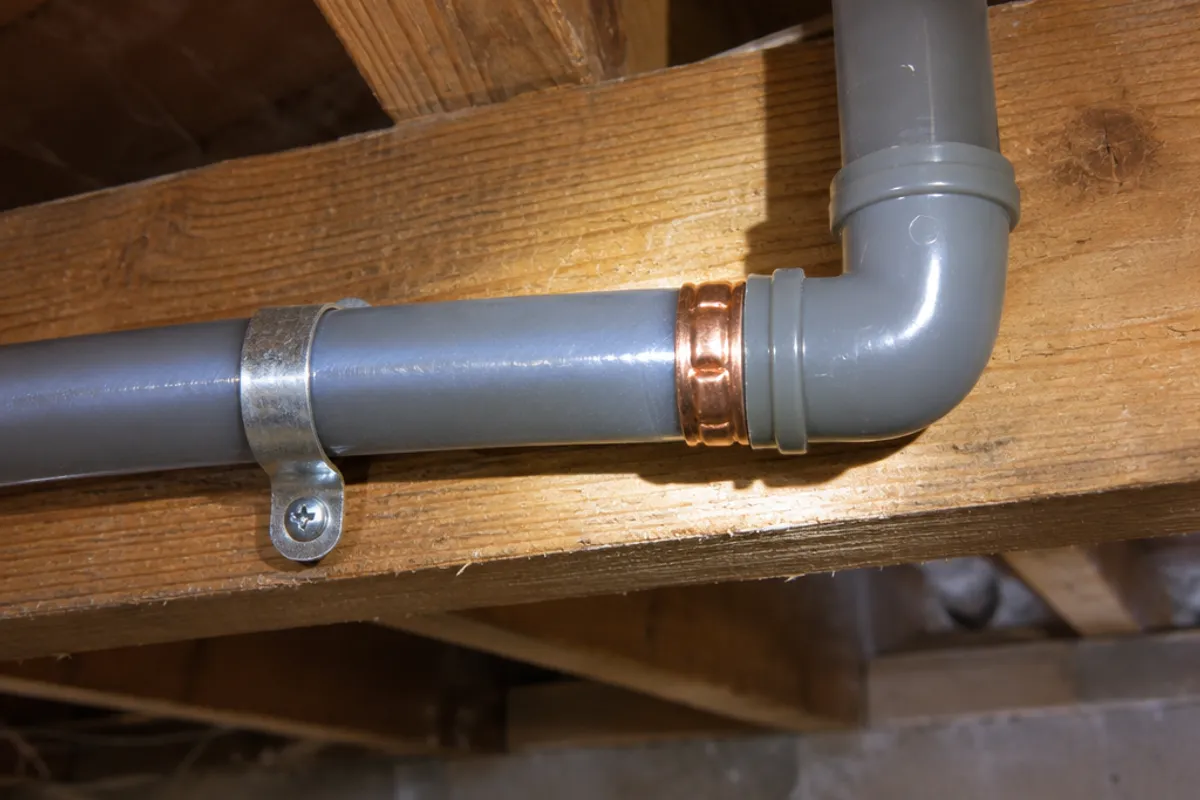
Poly-B joints were made with insert fittings pushed into the pipe and held by a ring or band. Some are plastic fittings; others are metal, usually copper or brass. The joint alone doesn't identify the pipe, because other plastic pipe uses insert fittings too, but it is one more clue to photograph for your inspector.
Where should you look for Poly-B plumbing without opening walls?
You can usually find out without cutting drywall. Check each point where pipe comes out of a wall, floor or ceiling, and look in more than one place. Look for visible repairs too: a short piece of newer pipe or copper spliced into a gray plastic line means someone has worked on that run before, and the rest of the plumbing may still be original.
At the hot water tank
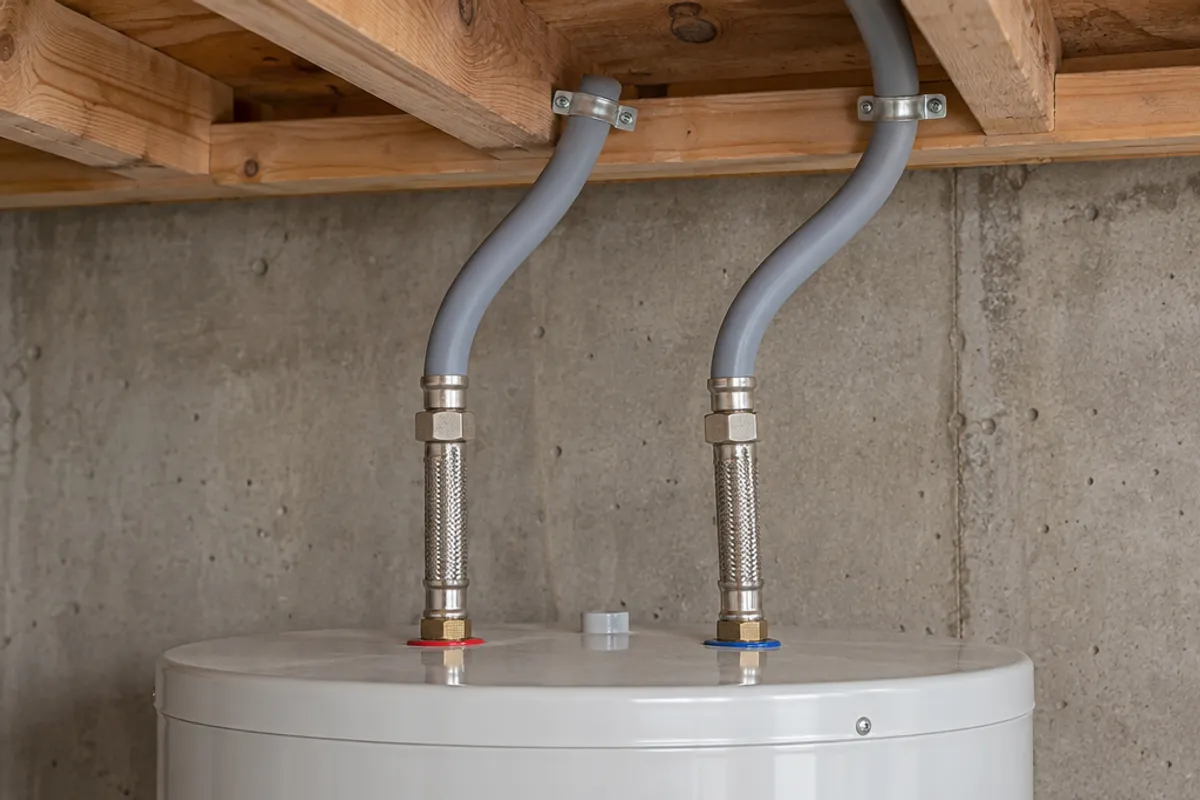
The tank is a good starting point: follow the hot water and cold lines away from the hot water tank. The connection at the tank may be a short metal connector, so trace each line until you reach the main run.
At the main shut-off and water meter
Where the water main comes into the home, look at the pipe on both sides of the main shut-off and the meter. Our guide on where to find the water shut-off valve shows the usual places.
Under sinks and behind toilets
Look at the plumbing between the wall and each fixture's shut-off. A short copper stub out of the wall can hide plastic pipes behind the drywall, so look closely at the point where it goes in.
In unfinished basements, crawl spaces and the utility room
Runs between the joists of unfinished basements are the easiest place to see long lengths of pipe, its print and its joints. Check the utility room, the laundry hookups and the line that feeds an outside faucet too.
Use a flashlight and a small mirror to read print on the back of a pipe. Don't pull on pipes or twist joints to see better: a joint you move can start to leak.
Why does polybutylene piping come up in a home inspection?
Because of its history, which a provincial safety sheet sums up, and because nobody can judge a pipe's condition from the outside.
What the Alberta safety sheet says about class action lawsuits
The Government of Alberta's safety sheet on Poly-B, from Municipal Affairs, says failures of Poly-B water piping in Canada and the US led to a number of class action lawsuits. It says the Canadian claims deadline was May 31, 2005, or up to 15 years after the date of installation (Safety tips: Polybutylene (Poly-B) pressure water piping, updated August 1, 2016).
What it means for your home
That history is why home inspectors look for Poly-B plumbing and polybutylene piping when a home is bought or sold. What it means for your home depends on things a photo can't show: the condition of the pipe, its fittings, any improper installation, and how much of it is left. You can't see the inside of a pipe from the outside, so "it looks fine" isn't an answer either way, and nobody can tell from a photo whether or when a joint will fail. So:
- Check with your insurer. Insurance companies each set their own terms, so check your policy and ask how yours treats Poly-B before you buy, renew or start replacing pipe. Keep the answer in writing.
- Have a home inspector or qualified plumber confirm it. They can confirm the material and look at the fittings and connections you can reach.
- If you are buying, ask the seller what has been replaced, when, and by whom, and what records they have.
What should you do if you find Poly-B piping?
- Photograph the Poly-B piping, its print and its joints at each place you found it, and note where each photo was taken.
- Have a home inspector or plumber confirm the material.
- Ask your insurer how it affects your policy.
- Get advice from licensed plumbers on whether to replace it, which runs first, and what to use, with the scope and cost in writing. Modern PEX and copper are the usual replacement piping materials, as they are in new construction.
- Ask your local building department whether the work needs a permit.
Already seeing Poly-B issues, such as a damp joint or a drip? Shut off the water at the main and call a plumber before anything else.
A full repipe replaces the entire system of supply plumbing in the home. A partial job replaces the runs that can be reached or that worry you most, and joins the new pipe to the old with transition fittings. Your plumber can explain the trade-offs for your plumbing system. No material is trouble-free: copper, for example, can develop pinhole leaks in some water conditions, so ask what local plumbers see in your area.
New installation work, such as cutting into supply lines, soldering and connecting to the water heater, may need a licensed plumber and a permit where you live. Shut off the water supply at the main before any pipe is opened, and leave Poly-B fittings alone until then.
Where should new valves go after Poly-B replacement?
Poly-B replacement means new pipe through walls and ceilings, often fished through small openings rather than whole walls opened up. Along the way, the new plumbing system gets parts you will need to reach again:
- Shut-off valves installed on the new lines, so if a joint fails you can stop the leak before it causes water damage, or isolate one fixture for a repair.
- A manifold, if your plumber runs a separate line to each fixture from a block of valves, so you can shut off one line at a time.
- A joint between new pipe and remaining Poly-B piping, if only part of the home is replumbed, so you can check it later.
Any of these installed behind drywall or a finished ceiling can only be reached by cutting again. Before installation starts, ask the plumber where each one will go. Before the openings are closed, mark the ones that sit over a valve, a manifold or a transition fitting, and close those with an access panel or door instead of a patch. Patch the rest as usual (patching a hole in drywall). From our catalog:
| Model | Type | Opening | Size on the wall |
|---|---|---|---|
| SAP1414 | Removable spring-loaded panel | Fits openings from 10 × 10 to 14 × 14 in | 16 × 16 in cover |
| PAD1212 | Hinged door | Cut-out and service opening 10.35 × 10.35 in (estimated), rounded corners | 12 × 12 in overall |
The SAP1414 suits an opening the plumber has already cut, if it falls inside its range; its wire-loop spring holds the removable cover. The PAD1212 suits a valve you will open more often; for installation, its frame screws onto the wall over a cut-out traced from the 1:1 template on its product page, with the screws that come with the door. For a manifold, measure it with its valves and the room your hands and a wrench need. The PAD1216 has a taller service opening of 10.35 × 14.35 in (estimated).
Our plastic access panels and doors are not fire-rated, and we publish no water-resistance rating for them, so don't fit one in a fire separation, such as the wall between a house and an attached garage.
Compare them on the plumbing access panels page and the access doors page.
What should you read next?
If a supply line is leaking under a concrete floor, read what a slab leak is; for a wet wall, see water leaks behind walls.
Measure before you order: our guide on how to measure for an access panel shows how, and the access panel size chart compares every opening and cover.