
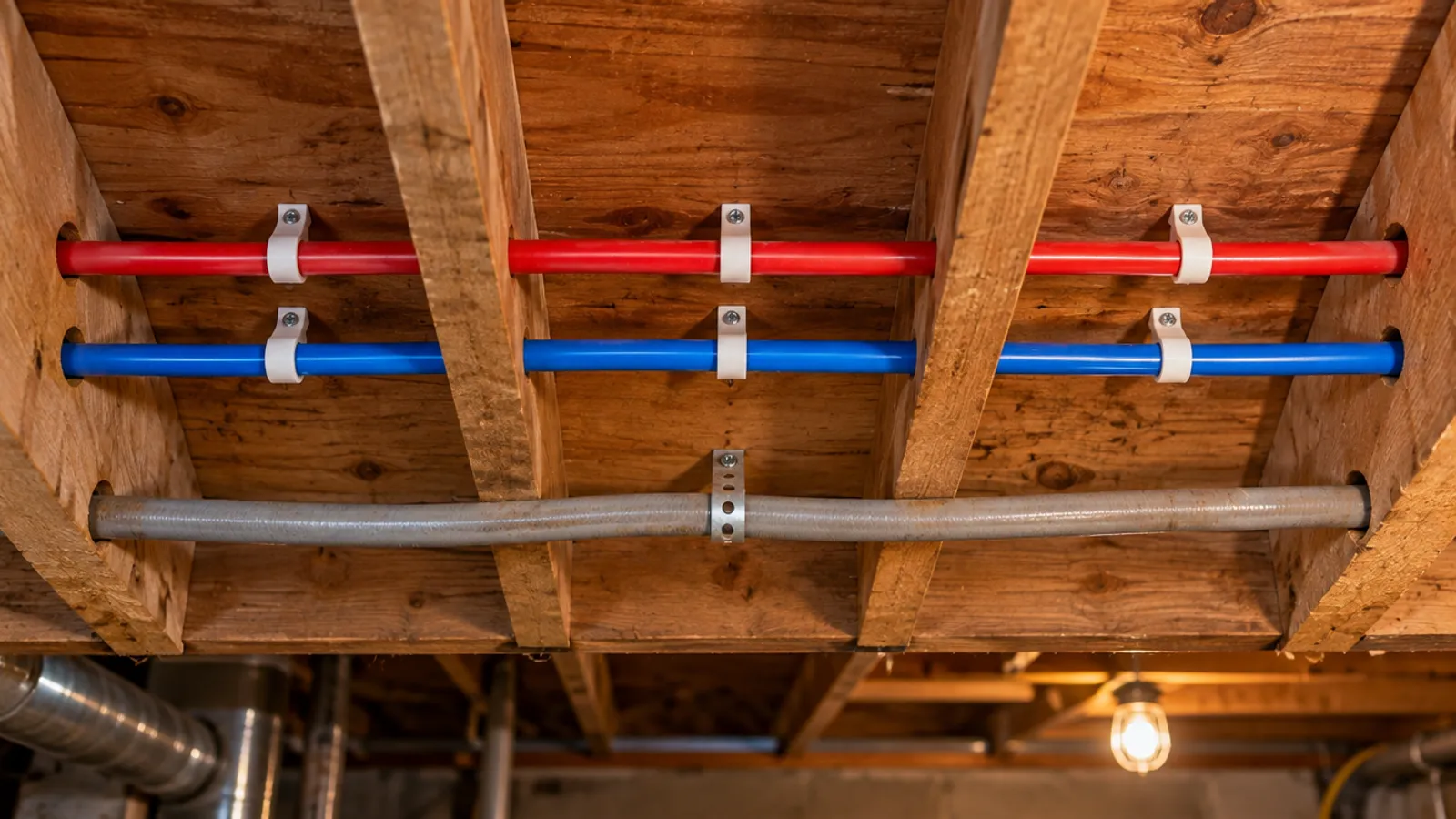
Poly-B replacement means replacing every polybutylene water supply line in a home with PEX or copper, a job called a repipe. A licensed plumber usually runs the new lines through small openings in walls and ceilings rather than gutting rooms, then the work is inspected, the water is turned back on, and the openings are closed.
This guide is for homeowners in British Columbia and Alberta, from Calgary to the Fraser Valley. If you haven't confirmed that the gray plastic pipe in your home is Poly-B piping, start with how to identify Poly-B.
What does replacing Poly-B plumbing involve?
Replacing Poly-B plumbing means swapping out the water supply piping: the hot and cold lines under pressure that run from the main shut-off and the hot water tank to every fixture. Drains and vents are a separate system and stay as they are.
A full repipe takes out the entire system of Poly-B piping. A partial job covers only the runs that are easy to reach, such as the exposed pipe in an unfinished basement, and joins the new piping to the remaining Poly-B with transition fittings. Ask the contractor to list in writing which runs stay and where each transition fitting ends up, so you know where to check first in case of a joint failure.
| Part of the plumbing system | In a whole house replacement |
|---|---|
| Main run inside the house | New piping from the main shut-off valve onward; ask whether the valve is new too |
| Hot water tank | Hot and cold piping reconnected to the tank or tankless water heater |
| Branch piping | New piping to every sink, toilet, tub, shower, laundry hookup and outside faucet |
| Old Poly-B piping | Disconnected, and removed where it can be reached |
The water service, the pipe that brings municipal water in from the street to where the lines enter the house, is not part of every Poly-B repipe. Ask whether yours is included.
Is replacing the plastic fittings enough?
Some contractors offer to swap accessible plastic fittings for brass fittings or copper fittings. That changes the joints you can reach, even ones that look perfectly fine, but the gray plastic pipe stays hidden, so it is a stopgap, not a long-term solution for Poly-B plumbing. A paper by Jana Laboratories and the University of Illinois at Chicago on chlorine testing notes that the early failure of polybutylene piping systems has been attributed to chlorine in drinking water, and that failures of both the pipe and its acetal fittings have been reported. Ask a qualified plumber what a joints-only repair leaves in place.
Should you replace Poly-B with PEX or copper?
Both are common in new construction, and either material can take the place of Poly-B. The choice changes how the new piping runs and how many openings the job needs.
| Question | PEX piping | Copper piping |
|---|---|---|
| How it runs | Flexible; long runs can be fished through finished walls | Rigid; turns corners with elbows |
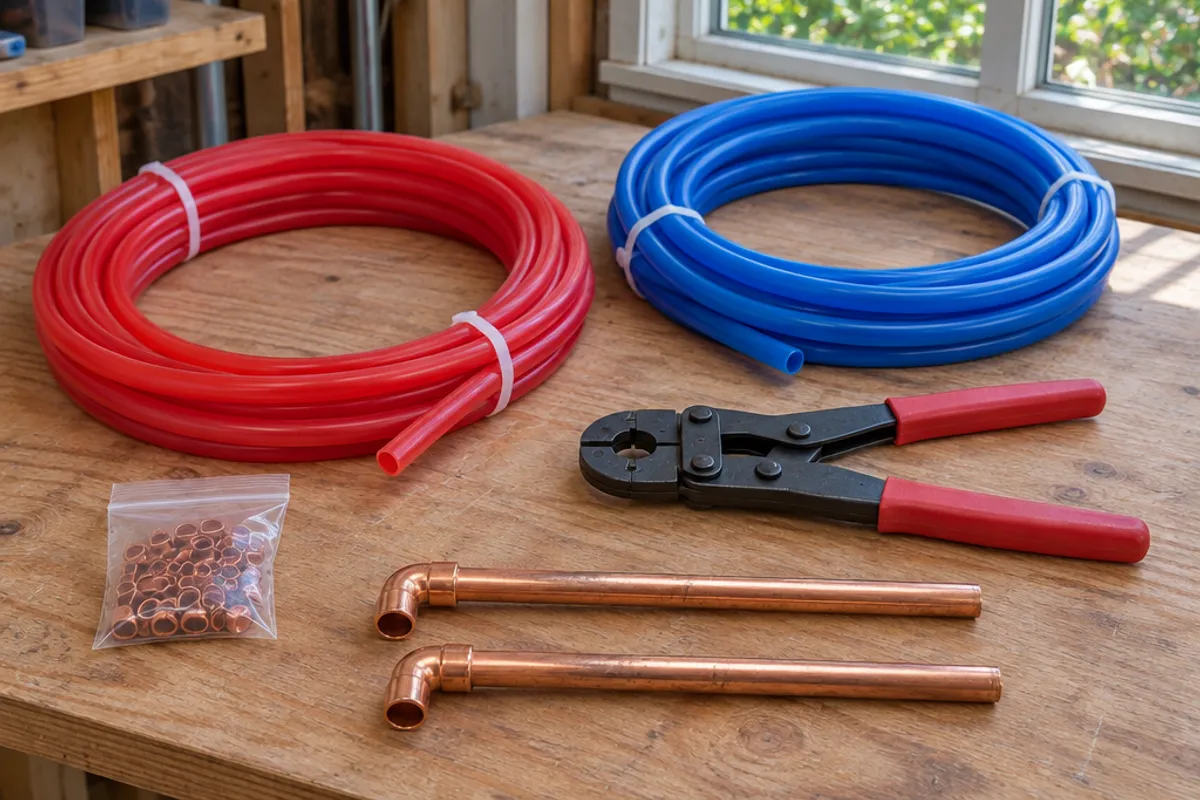
| How it is joined | Crimp, clamp or expansion rings, or push-fit connectors | Soldered, press or push-fit joints |
| Openings it needs | Fewer joints along a run, so fewer places to reach | A fitting at every turn, and each concealed one has to be reached |
| Layout | Branches off a main run, or one run per fixture from a manifold | Branches off a main run |
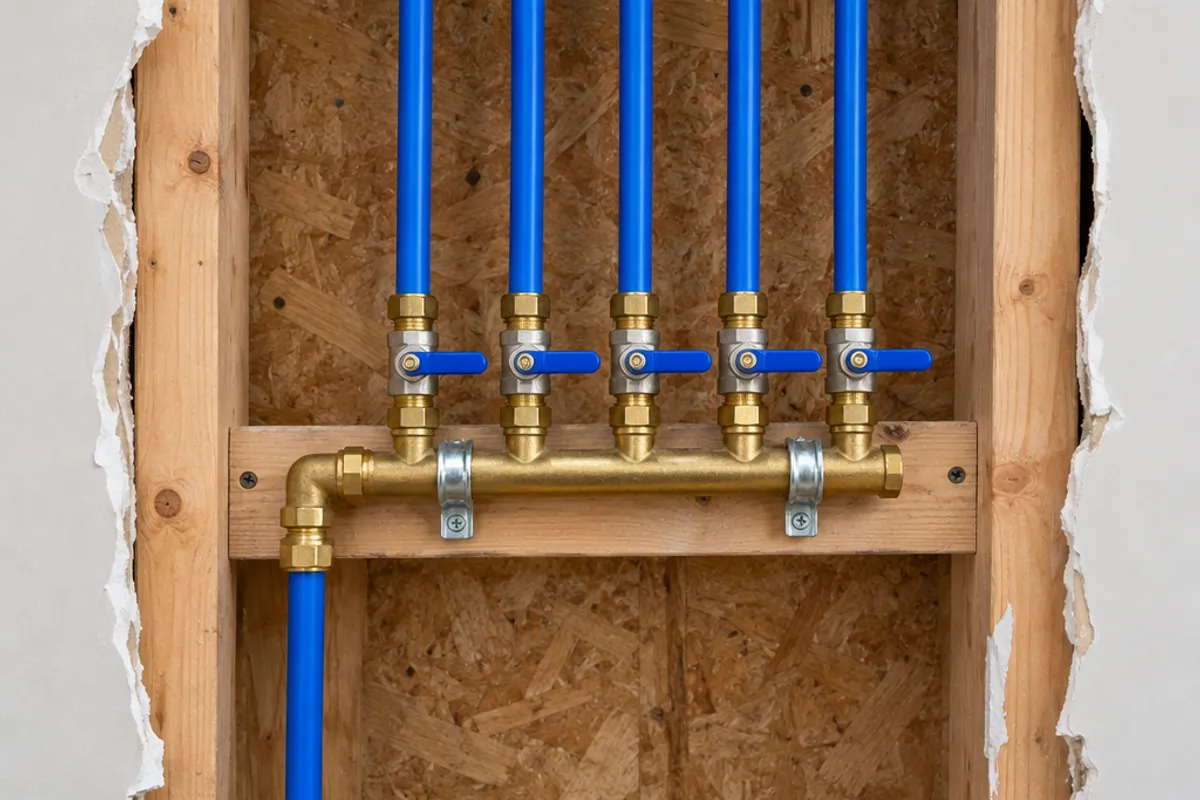
That flexibility is why PEX is often the replacement material chosen for a Poly-B repipe in a finished home. With one pipe per fixture, each starts at a manifold, often with its own valve, so you can shut off one bathroom without shutting off the whole house. No material is free of failure: copper can develop pinhole leaks in some water conditions, so ask what local contractors see in your area. The chlorine paper cited above found that the one cross-linked polyethylene material it tested appears to have good resistance to chlorine in drinking water. That is one product, not every brand, so ask which one your contractor uses.
In Alberta and the BC Interior, ask for the new piping to stay out of exterior walls where possible: the water in any pipe can freeze, flexible or not (can PEX pipe freeze).
What is the order of work when replacing Poly-B piping?
Every contractor runs the process a little differently, but the order is usually this:
- Plan. The contractor traces where the existing Poly-B lines run, chooses a route for the new lines, and marks where openings will go. Ask to see the marks before anything is cut.
- Permit. The plumbing permit is issued before work starts.
- Shut off. Floors near each opening are covered, the water is shut off at the main shut-off valve, and the pipes are drained.
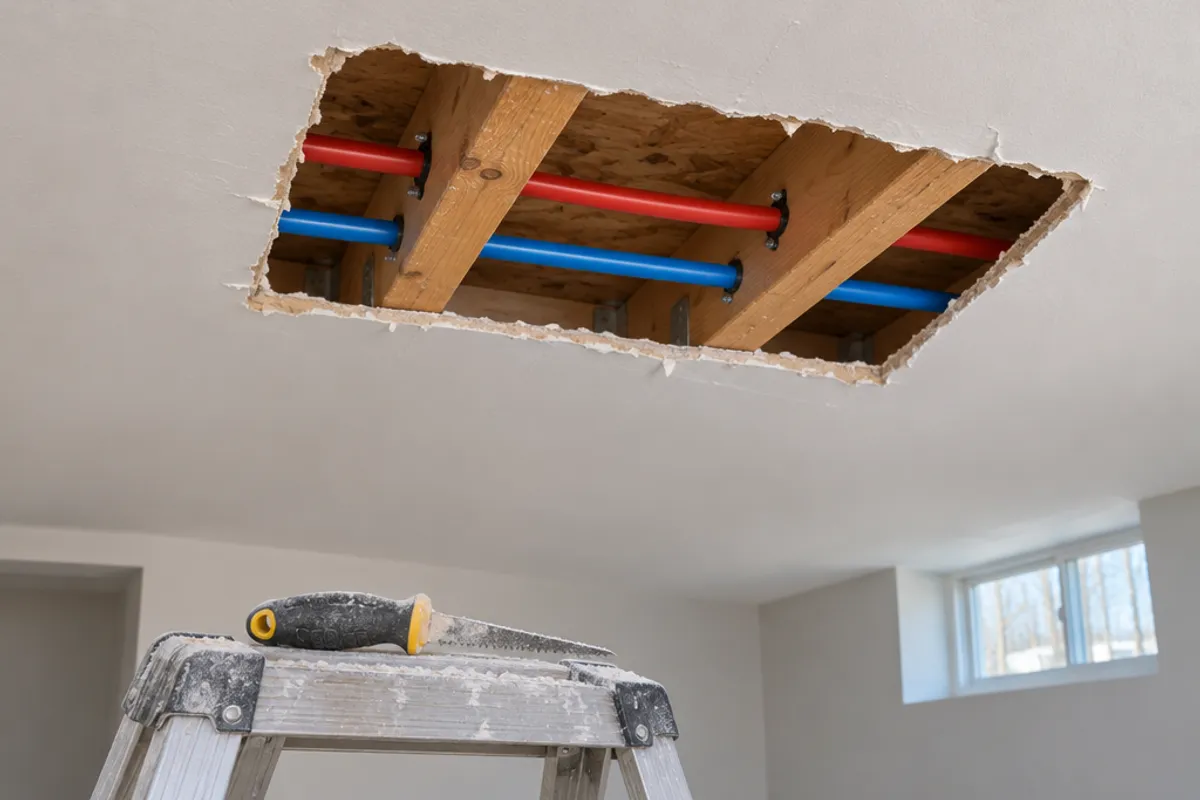
- Open. Small openings are cut at fixtures, at floor and ceiling crossings, and in finished ceilings.
- Install the new piping. It runs through the openings, then connects to each fixture, the hot water tank and any new valves or manifold.
- Pressure test. The new piping is held under pressure to check every joint before anything is closed.
- Rough-in inspection. In Calgary, the water lines must be installed, connected to the rest of the water distribution system and properly supported before you book it.
- Water on. The new plumbing system is flushed, each tap is run, and the water pressure and every joint are checked.
- Final inspection. In Calgary, the drywall doesn't have to be finished for it.
- Close the openings. Patch the ones that hold only pipe; fit an access panel or door over each valve, manifold or joint to old Poly-B.
When do the pressure test and final inspection happen?
The pressure test and the rough-in inspection come before any opening is closed, and the last visit closes the permit. Ask the contractor who books each one, and keep the results.
Ask how long the water will be off each day. Valves you can reach lower the risk that a joint failure turns into water damage; that is the point of step 10.
Soldering copper, reconnecting the tank and altering the plumbing system may need a licensed plumber and a permit where you live. Shut off the water at the main before any pipe is opened. If the tank burns gas, work on its gas connection is for a licensed gas fitter.
Where will the walls and ceilings be opened?
Openings follow the pipe routes. An unfinished basement ceiling gives open access to the main runs; a finished basement, or bathrooms upstairs, means more openings. Decide before the work starts how each one will be closed:
| Where | Why it is opened | How to close it |
|---|---|---|
| Below sinks and behind toilets | To connect the new pipe and stop valve | Patch, if the stop valve sits in the room |
| Behind the tub and shower valve | To connect the valve | Access panel or door |
| Finished basement ceiling | To run new piping across the joists | Patch, unless a valve or joint sits there |
| Manifold or main shut-off | Where the new piping starts | Hinged access door |
| Where new pipe meets remaining Poly-B piping | Transition fittings | Access panel, so the joint can be checked |
For the shower valve, see what size access panel a shower valve needs. Before any opening is closed, photograph it with a tape measure in the frame and mark every valve and fitting on a floor plan. Keep that with the house papers.
Who does the drywall repair?
Some plumbing companies include drywall repair, texture and paint; others leave the openings for a separate trade or for you. Get the answer in the written scope. To do it yourself, see patching a hole in drywall.
Which openings should get an access panel instead of a patch?
A patch suits an opening that holds only pipe. Over a shut-off valve, a manifold, a tub or shower valve, or a transition fitting, fit an access panel or door instead, so you can check for drips before they become water damage, and the next repair doesn't start with a saw. Choose it before the replacement project starts, and the opening can be cut to suit. From our catalog:
| Model | Type | Opening | Outside size |
|---|---|---|---|
| SAP1414 | Removable spring-loaded panel | Fits openings from 10 × 10 to 14 × 14 in | 16 × 16 in cover |
| PAD1212 | Hinged door | Cut-out and service opening 10.35 × 10.35 in (estimated), rounded corners | 12 × 12 in overall |
| PAD1216 | Hinged door | Cut-out and service opening 10.35 × 14.35 in (estimated), rounded corners | 12 × 16 in overall |
The SAP1414 suits an opening that is already cut, if it falls in that range; its wire-loop spring holds the cover. The PAD1212 suits a valve you will open often, and the taller PAD1216 is a practical solution for a manifold. Each door's frame screws on over a cut-out traced from the 1:1 template on its product page, with the screws that come with the door. Size for your hands and a wrench, not just the valve: see how to measure for an access panel.
One limit after a repipe: none of these panels or doors is fire-rated, and we publish no water-resistance rating for them. If a new valve lands in a fire separation, such as the wall or ceiling between the house and an attached garage, ask your plumber how to reach it another way. Compare them on the plumbing access panels page and the access doors page.
How do you choose a plumber for a Poly-B repipe?
Look for a licensed plumbing contractor who repipes finished homes with Poly-B plumbing, and compare written scopes from more than one company, line by line, not just the cost.
What affects the cost of a repipe?
No two quotes cover the same work, so compare what drives the cost in each:
- the number of bathrooms, fixtures and floors;
- whether the ceilings under the runs are finished or open;
- the pipe material and layout;
- whether patching, finishing and the permit are included.
Common questions to ask before you hire
- Will you take out the permit?
- Which piping and layout do you recommend for this house, and why?
- Where will each opening, valve and manifold go?
- Is drywall repair included?
- When are the pressure test and inspections?
- Will you check the water pressure at every tap when you finish?
- What happens to the old Poly-B piping?
- What would change the cost once work starts?
Insurance companies each set their own terms, so check your insurance policy before the work and ask what records your insurer wants afterwards.
Do you need a permit to repipe a Poly-B plumbing system?
Usually. A repipe alters the plumbing system, and the permit process is set locally, so ask your municipality about it, and its lead time, before work starts.
Poly-B replacement in Calgary and Edmonton
- Calgary. The City of Calgary says a plumbing permit is required when a plumbing system is constructed, extended or altered, including when water and sewer lines in or around the home are replaced; repairing a leak or replacing faucets and fixtures doesn't need one. The legal owner who lives in the home can apply for a homeowner plumbing permit, except in an apartment-style condo. Plumbing concealed behind drywall without a permit needs a licensed plumbing contractor to have it inspected (Homeowner electrical and plumbing permits).
- Edmonton. The City of Edmonton says to begin work only after the required permits are issued, and that missing a required inspection may mean removing finished walls (Plumbing permits, residential).
British Columbia, from the Fraser Valley to the Interior
Whether you live in the Fraser Valley, on Vancouver Island or in the Interior, ask your city's or regional district's building department whether the repipe needs a permit, who may apply, and which inspections it needs. Ask the same office what access it expects for the new shut-offs you plan to close into walls.
What should you read next?
Planning the openings with your plumber?
Measure before you order: our guide on how to measure for an access panel shows how, and the access panel size chart compares every opening and cover.