
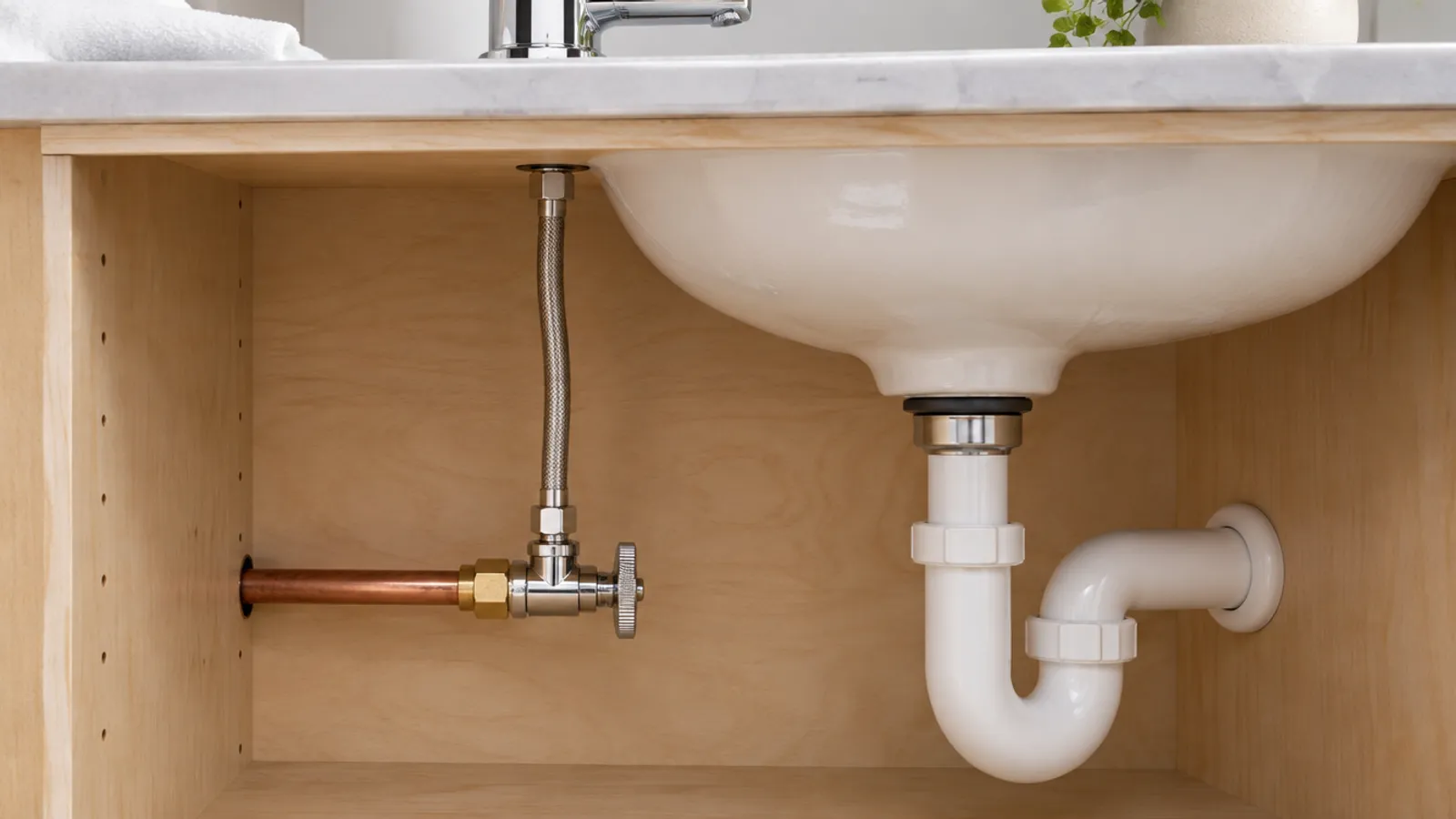
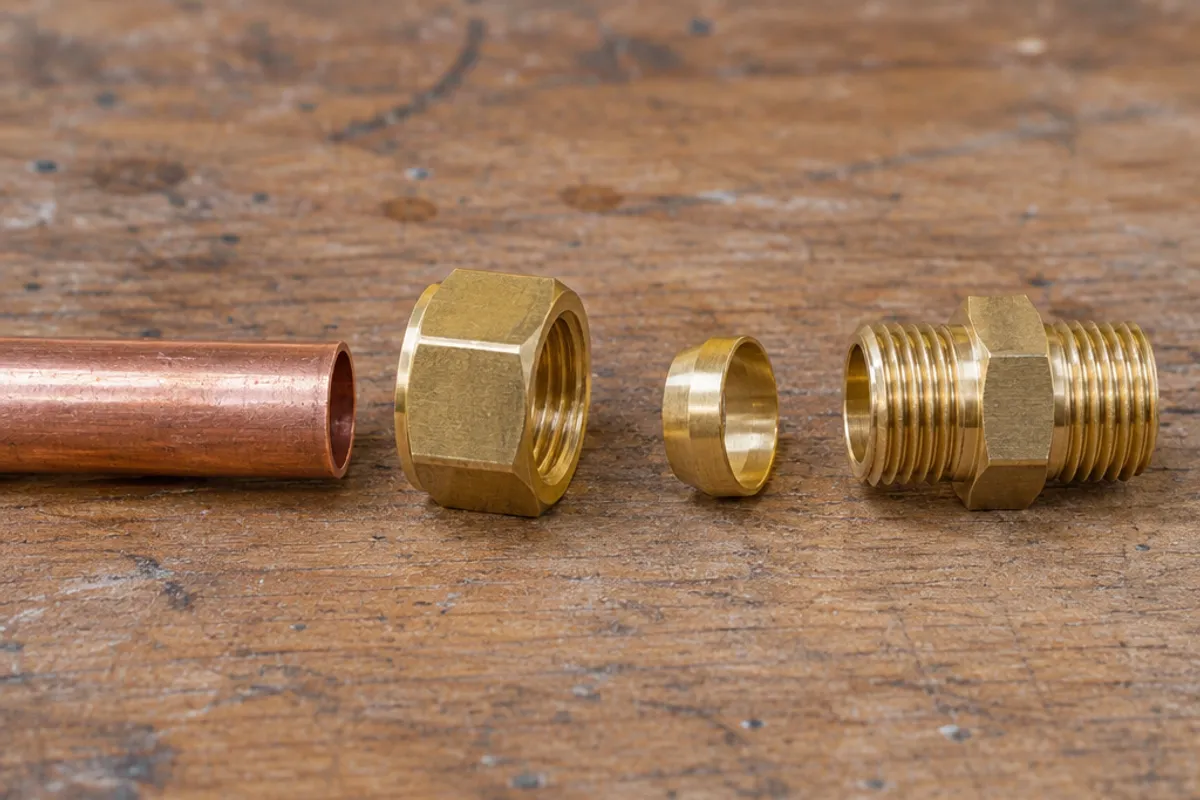
A compression fitting joins a pipe or tube to a valve or another pipe with no solder, glue or special tools. It has three parts: a nut, a ferrule (a brass or plastic ring) and the fitting body. Tightening the nut squeezes the ferrule onto the tube and against the body, which seals the joint.
If you are a homeowner or remodeler swapping a sink stop or opening a wall, one detail matters most: compression fittings typically sit at the shut-off valves under sinks and toilets, and one maker says those stops belong in accessible locations only. Below: how compression fittings work, how to install them, why they leak and how long they last.
What is a compression fitting made of?
Every compression fitting has the same three basic elements, or components, under several names:
| Part | Other names | What it does |
|---|---|---|
| Compression nut | Nut | Threads onto the body and drives the ferrule into place |
| Ferrule | Sleeve, compression ring; an olive in the UK | A brass or plastic ring compressed around the tube to make the seal |
| Fitting body | The stop, coupling, tee or elbow itself | Holds the tube end and has the tapered seat the ferrule seals against |
The compression fitting body can be a coupling that joins two pipes, a tee, an elbow, or the inlet of a stop. Supply stops come in many configurations: one maker's stop sheet covers compression, solder, threaded, crimp, expansion and push-connect inlets.
Home plumbing uses standard compression fittings with a single ferrule. One industrial fitting maker's guide explains why: single-ferrule designs suit softer materials, while harder materials such as steel tubing call for a second ferrule behind the first. The two-ferrule fittings that fill the search results are built for that industrial work, including high pressure applications, not for a home water line. Ferrules for home water lines come in metal (brass) or plastic, and the sheet for your fitting says which materials suit your tube.
How do compression fittings work?
As you screw the compression nut onto the threads of the fitting body, it pushes the ferrule into the body's tapered seat. The angled seat compresses the ferrule onto the outside of the tubing, deforming it slightly, as the industrial guide above describes. That squeeze seals in two places: ferrule to tube and ferrule to body. The threads seal nothing; they only pull the nut in, so the whole assembly depends on the ferrule and the surface under it.
So the tube matters. One maker's compression fittings sheet says the tubing must be cut square and free of dings, dents, burrs, paint, putty or gouges that could keep the connection from sealing, and the fitting kept seated and square to it. A second maker's supply stop sheet asks for round, square tubing for a permanent seal. A smooth, clean pipe end is the start of a proper seal.
Is a compression fitting the same as NPT? No. A tapered pipe thread seals on its threads, with tape or pipe dope. A compression fitting seals at the ferrule, which is why the first maker's stop sheet rules out putty, gasket material and thread seal tape.
Where are compression fittings used in home plumbing?
They commonly show up in three places:
- Fixture shut-off valves (supply stops) under sinks and behind toilets, where a compression inlet goes onto a stub-out without a torch, which helps in a tight cabinet where soldering would be awkward. See where the water shut-off valve is.
- Supply connectors from the stop to the faucet. One maker's connector kit fits stops with a 3/8 in compression outlet.
- Repair couplings and adapters, where a damaged section is cut out or copper pipe meets PEX or other plastic tubing.
The first maker's fittings sheet also lists potable and non-potable water, instrumentation, and hydraulic and pneumatic systems, and rules out gas connections of any kind.
Can you use a compression fitting on copper pipe or PEX?
Yes, on the right tube. The first maker limits its compression inlet to type L or M copper and rules out thick-wall type K tubing. For PEX, its fittings sheet calls for a brass sleeve with a stainless steel insert on 1/2 in OD tube and larger, and a plastic sleeve with no insert on 3/8 in OD and smaller. Match compression fittings to your tubing materials, too: the same sheet says to check that they suit the pressure, temperature, tubing type and fluid.
How do you install a compression fitting on copper tubing?
Read the sheet for your fitting first, and lay out the components in order of assembly. These steps follow the two makers linked above:
- Shut off the water and drain the line.
- Cut the tubing square with a tube cutter and deburr the pipe end.
- Slide on the compression nut, threads facing the fitting, then slide on the ferrule, oriented the way the sheet shows. On PEX tubing, add the tube insert where the sheet calls for one.
- Push the tube into the fitting body until it bottoms out.
- Start the assembly by hand: screw the nut on, with no putty or tape. For lubrication, a drop of oil on the threads eases tightening.
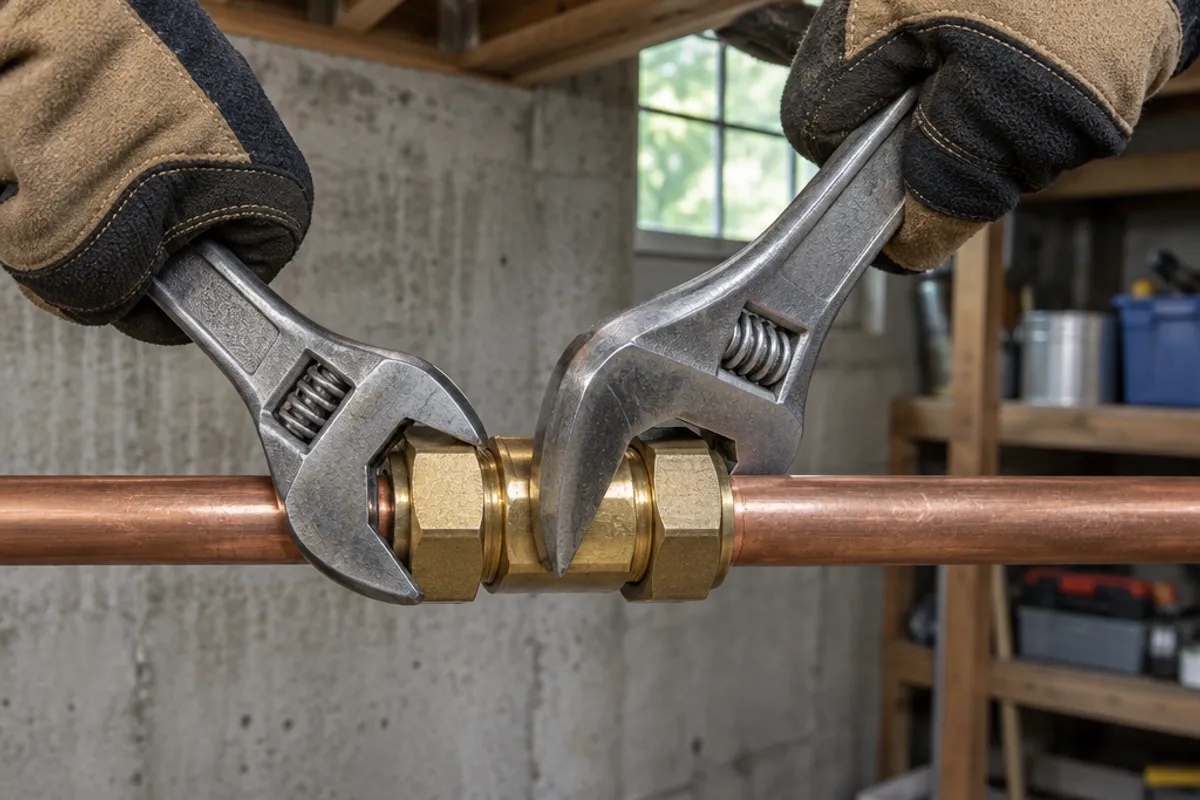
- Hold the body with one wrench and turn the nut with a second wrench, tightening it by the amount the sheet gives.
- Turn the water on and check for leaks. If the fitting weeps, the first maker says the fix is tightening the appropriate nut.
How far past hand tight? The makers differ, and so do ferrules:
| Sheet | Tube and ferrule | Extra turn after hand tight |
|---|---|---|
| First maker's stops | Compression inlet | 3/4 turn |
| Second maker's stops | Copper tubing, brass ferrule | 3/4 to 1 turn |
| Second maker's stops | PEX tubing, brass ferrule | 3/4 turn |
| Second maker's stops | PEX tubing, plastic ferrule | 1/2 turn |
Tightening past that figure doesn't make a better seal; the makers warn it can lead to failure.
The first maker rules out gas connections of any kind. Gas piping needs parts made for gas and a licensed gas fitter where required. Use a licensed plumber for work on your home's water supply where your area requires one.
Are compression fittings reliable?
A compression fitting can make a strong and reliable connection when the tube is clean and square and the nut is tightened as the maker says. Most leaks trace back to the installation process, not the components:
| Mistake | What the makers' sheets say |
|---|---|
| Over tightening | Can lead to failure and leaking long after installation |
| Putty, gasket material or tape | Can cause a water leak |
| Sealant on the ferrule | A thin coat on the male threads only; excess can make the joint fail |
| Damaged or out-of-square tube | Dents, burrs or paint can stop the seal |
| Tube not fully seated | Push it in until it bottoms out in the fitting body |
| Wrong connector on a stop | A solid brass cone or bull nose connector can crack it |
Over tightening hides. The industrial guide says it deforms the ferrule too much, which weakens the seal and often leads to leaks, and the first maker warns the leak can start long after installation. You can loosen and retighten the compression nut, one of the advantages of compression fittings over solder, but the ferrule stays compressed onto the tube once installed. Push-to-connect fittings seal with O-rings instead of a metal or plastic ferrule; see push-to-connect fittings behind drywall.
How long do compression fittings last?
No maker we checked gives a lifespan in years for compression fittings, so we don't either. The industrial guide lists corrosion resistance among their advantages, yet the first maker's stop sheet still says to inspect its stops annually and replace them if you find damage, deterioration or corrosion. Make that check part of your yearly maintenance: look for a damp spot or slow leaks under the fitting, a green or white crust on the brass, or a cracked nut. Replacing a stop or its components is a small job when you can reach it. For the pipe, see how long PEX pipe lasts.
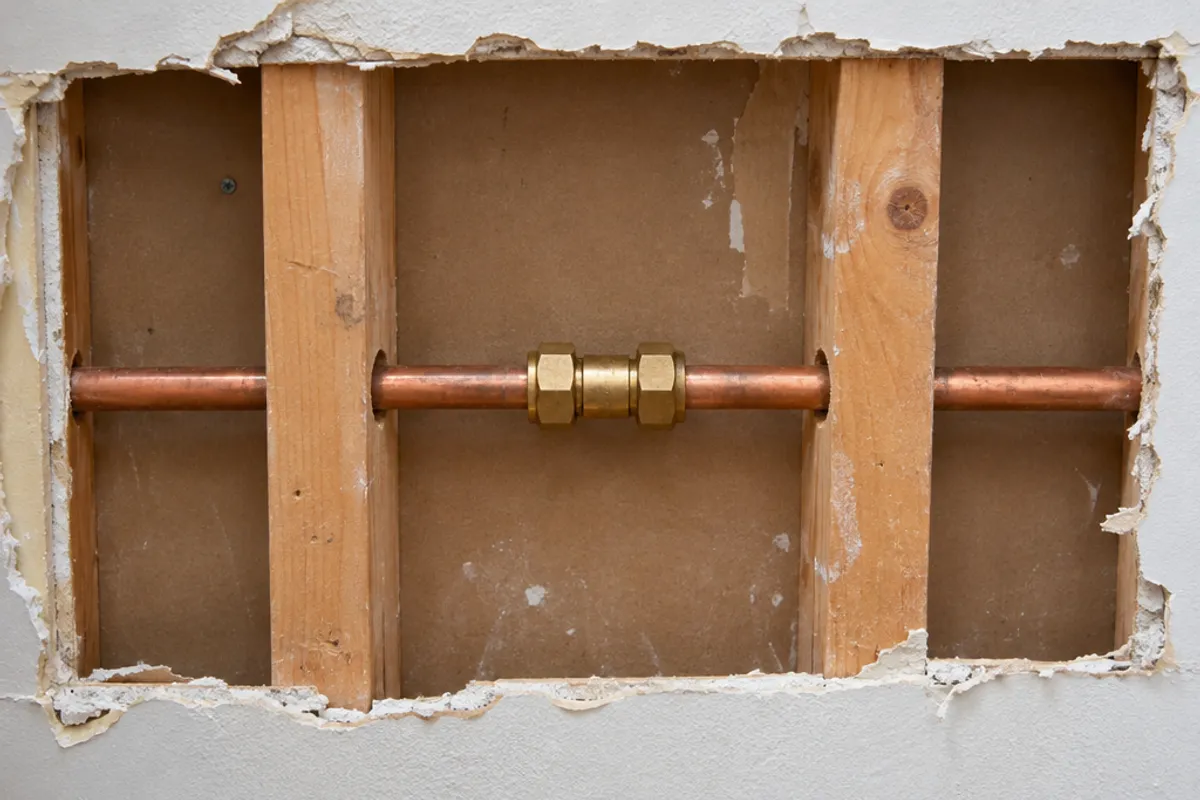
Can a compression fitting go behind a wall?
Not a supply stop or a connector, by one maker's sheets. The first maker's supply stop sheet, which covers its stops with compression inlets, carries the caution that they are for use with water in accessible locations only, and its connector kit carries the same line. A bilingual stop sheet sold in Canada says the same in English and French. The first maker's stand-alone sheet for compression fittings states no location limit, so for a coupling or tee, read the sheet for your fitting.
The same stop sheet limits its push-connect inlet to exposed locations only. A panel keeps a part reachable but doesn't turn a wall cavity into an open location, so keep that kind out of the wall.
Even where a sheet is silent, the cautions above are a good reason to keep a compression fitting reachable: no joint is a leak proof seal you can close in and forget, a leak can start long after installation, and the fix is often a little more tightening of the nut. Ask your local plumbing inspector before you close a wall over one.
What access panel fits over a concealed compression fitting?
Most stops sit in the open. A panel is for the compression fittings a remodel boxes in: a stop or a coupling on a repaired pipe behind a new wall, or a tee feeding a refrigerator line. Put the opening on the dry side, such as a closet, never inside a shower or a tub's splash area, and leave room for two wrenches. If the refrigerator line starts at a clamp-on saddle valve instead, see why inspectors flag it.
- A connection you check yearly: PAD0808 hinged door: maximum service opening 6.35 × 6.35 in, overall 8 × 8 in
- A connection you rarely touch: SAP0808 spring-loaded panel: fits 6 × 6 to 8 × 8 in openings, overall 10 × 10 in
Our plastic access panels and doors are not fire-rated, and we publish no water-resistance rating for them, so don't fit one in a fire separation, such as the wall between a house and an attached garage.
More options are on the plumbing access panel page. If a stop drips, see shut-off valve leaking when closed.
Measure before you order: our guide on how to measure for an access panel shows how, and the access panel size chart compares every opening and cover. How to install an access panel in drywall covers fitting it.