
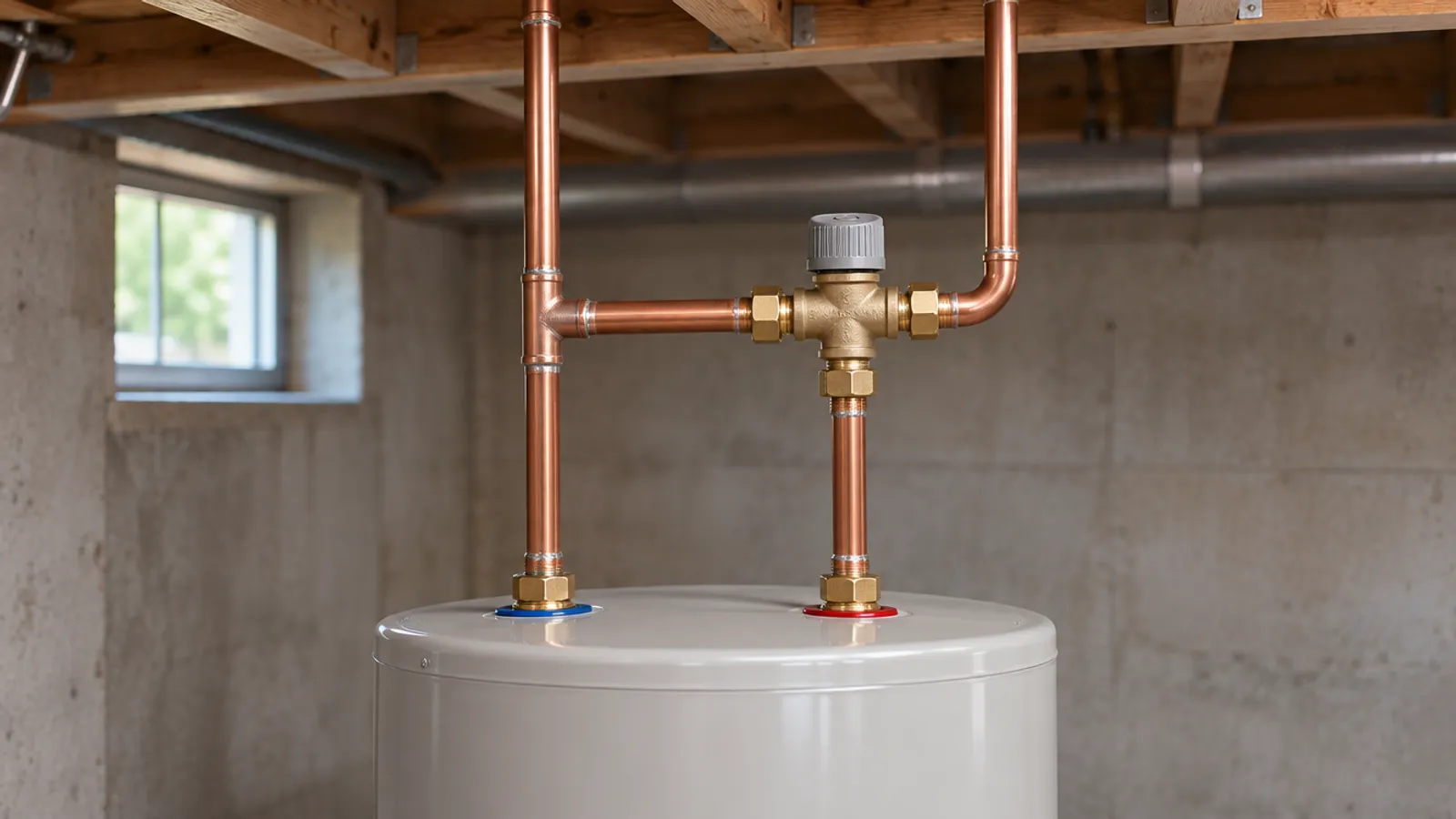
A thermostatic mixing valve (TMV) blends hot and cold water to a set outlet temperature and holds it there as supply temperatures and pressures change. A heat-sensitive element inside adjusts the mix. Fitted at a water heater or near a sink, tub or shower, it delivers tempered water and helps prevent scalding.
Its cartridge, screens and check valves need cleaning now and then, so a mixing valve closed into a wall or ceiling needs a way back in.
How does a thermostatic mixing valve work?
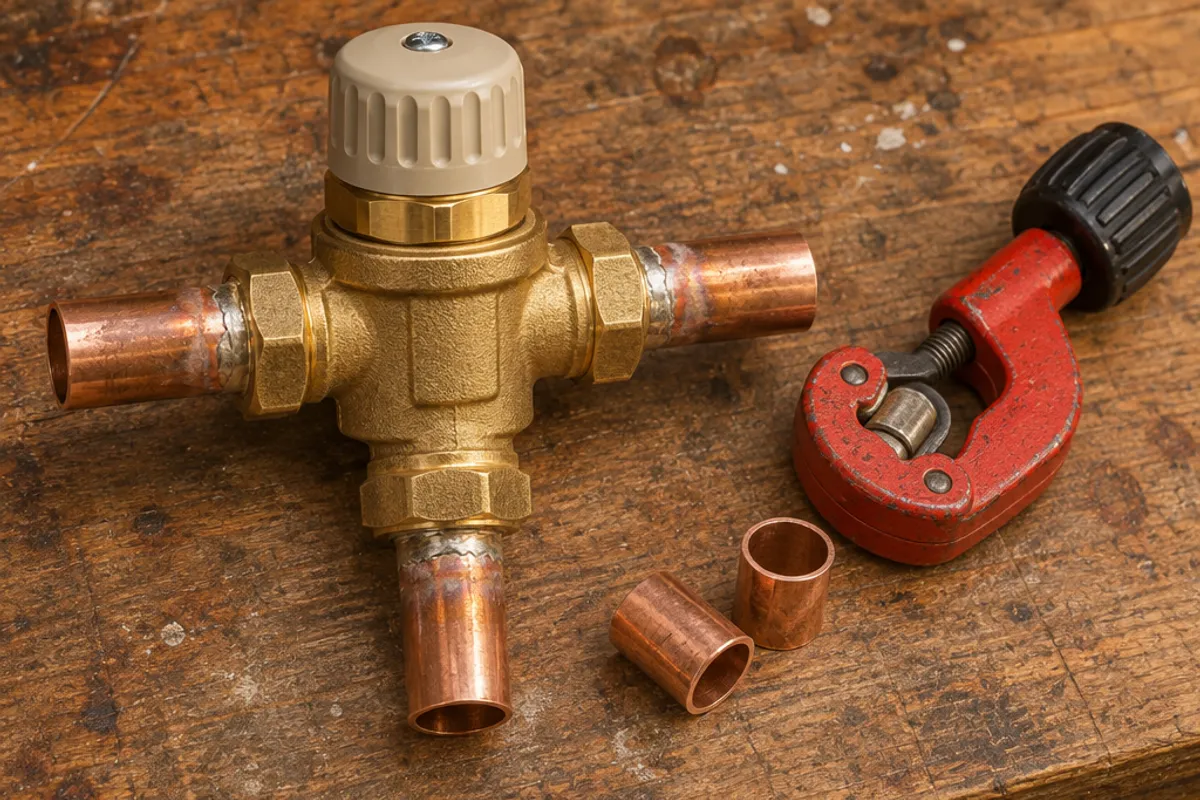
A thermostatic mixing valve has three connections: a hot water inlet, a cold water inlet and a mixed water outlet. Inside, a thermostatic element sits in the outgoing flow. On many valves it is a wax-filled capsule that expands as it warms and contracts as it cools, sliding a piston or shuttle that opens one inlet while it closes the other.
If the outlet water temperature climbs too high, the element cuts back the hot side and opens the cold water inlet a little more. If it runs cool, it does the reverse. That is how TMVs work: they react to the temperature of the water delivered, not to the position of a handle, so you keep a consistent water temperature when someone flushes a toilet or the water heater cycles. A knob or cap sets the outlet temperature within the range the maker gives.
A plain mixing valve without a thermostat holds a fixed blend, so its outlet changes whenever the hot or cold water supply changes. What a thermostatic valve does if the cold water supply fails depends on the type. Valves listed to ASSE 1069, used for gang showers, can sharply cut the outlet flow in that case; for any other valve, read the maker's specifications.
Thermostatic mixing valves turn up in plumbing systems of every size, from one bathroom to a hospital:
| Type | Where it goes | What it serves |
|---|---|---|
| Heat source valve | At the water heater or boiler outlet | The whole hot water distribution system |
| Point-of-use valve | Beside one fixture, often in a vanity | A single faucet, lavatory or tub |
| High-flow or central valve | A mechanical room, wall or ceiling | Groups of fixtures and high demand in larger buildings |
| Electronic (digital) valve | Usually a mechanical room | Larger systems; sensors control the mix |
| Three-way mixing valve | On boilers and radiant heating loops | Heating water, not drinking water |
Why put a thermostatic mixing valve on a water heater?
A thermostatic mixing valve for a water heater sits at or near the tank's hot water outlet, the heat source, and tempers all the hot water sent through the house. A whole house water filter goes on the cold side instead, before the heater. ASSE International's guidelines for temperature control devices describe these valves, listed to the ASSE 1017 standard, as giving a relatively uniform temperature to the hot water distribution system. As a side benefit, they let the tank store water at a higher temperature, which extends the hot water available and reduces the chance of Legionella, the harmful bacteria behind Legionnaires' disease.
Does a mixing valve give you more hot water?
In effect, yes. Water stored at a higher temperature than you use at the faucet is blended with cold, so each gallon in the tank goes further. That extra capacity is one of the main benefits in a house with high demand. A hotter tank also loses more energy as it sits, which costs efficiency, so weigh both, and ask the water heater's maker or your plumber what setting suits your tank before you turn up its thermostat. ASSE also says these valves must be sized to the flow of the system, in gallons per minute.
Water stored at a high enough temperature to stretch the tank is a scald hazard at any fixture it reaches without mixing. The U.S. Consumer Product Safety Commission's safety alert on tap water scalds urges users to lower water heaters to 120°F (49°C) and gives these exposure times for third-degree burns in most adults:
| Water temperature | Exposure for a third-degree burn |
|---|---|
| 150°F | Two seconds |
| 140°F | Six seconds |
| 130°F | Thirty seconds |
| 120°F | Five minutes |
In larger buildings with a water management program, the CDC's Legionella control toolkit for potable water systems says to store hot water above 140°F (60°C), keep circulating hot water from falling below 120°F (49°C), and install thermostatic mixing valves as close as possible to fixtures to prevent scalding.
One limit matters most: ASSE says a valve at the heater, used alone, provides neither adequate scald protection nor thermal shock protection. It is not a substitute for anti-scald devices at the point of use.
What does an anti-scald mixing valve do?
An anti-scald mixing valve caps the hottest water a fixture can deliver. ASSE's guidelines describe water temperature limiting devices (ASSE 1070, also issued as ASME A112.1070 and, in Canada, CSA B125.70) for sinks, lavatories, bidets and bathtubs. Their setting is fixed, or locked, or needs a tool to change, and the user control allows a maximum outlet temperature of 120°F (49°C).
Scald protection vs. thermal shock
Scalding is a burn from water hot enough for long enough. Thermal shock is a sudden swing from cold to hot, or hot to hotter, that makes a bather jump and can cause a slip and fall. A device can guard against one without the other:
| Device | Where it goes | Protects against |
|---|---|---|
| Heat source mixing valve (ASSE 1017) | At or near the water heater outlet only | Neither, used alone; it sets the supply temperature |
| Temperature limiting device (ASSE 1070, CSA B125.70) | At or in a lavatory, bidet or tub fitting | Scalding only |
| Tempered water valve (ASSE 1069) | Fixtures fed only tempered water, as the final control | Scalding and thermal shock |
| Shower mixing valve (ASSE 1016, CSA B125.16) | In the wall, one per shower or tub-and-shower | Scalding and thermal shock |
Is a shower valve a mixing valve?
Yes. A pressure balancing or thermostatic shower valve mixes hot and cold water at the fixture itself, with the user's control on the wall. See what a shower valve is for the types and their cartridges.
Where should a thermostatic mixing valve be installed?
Where it goes depends on its job, so pick a valve listed for its intended application and follow the maker's installation instructions:
- At the water heater or boiler. Installed only at or near the outlet of the heat source. ASSE recommends adding check valves where the valve has none built in, to stop hot or cold water crossing through it.
- Under a sink. A point-of-use valve typically sits between the hot stop valve and the faucet, with its own cold feed. In the cabinet it is easy to reach.
- In a wall or ceiling. A valve feeding a tub or a row of lavatories is sometimes installed in a wall cavity or above a ceiling, close to the point of use, as the CDC advises for building water systems. That spot needs a way back in.
Wherever it goes, insulate the hot and cold pipes to maintain water temperatures and keep the system efficient; the CDC's toolkit recommends pipe insulation for building water systems.
Thermostatic mixing valves in healthcare facilities
Hospitals and care homes put scald safety first because they serve the people most at risk: the CPSC says the majority of tap water scald injuries and deaths are to the elderly and to children under five. ASSE's guidelines work through hospital examples, such as surgical scrub sinks and sitz baths, and name the device each one needs.
In cold regions such as Alberta, Quebec or the Maritimes, keep the valve and its piping out of exterior walls, the same as any water line.
How do you maintain a thermostatic mixing valve?
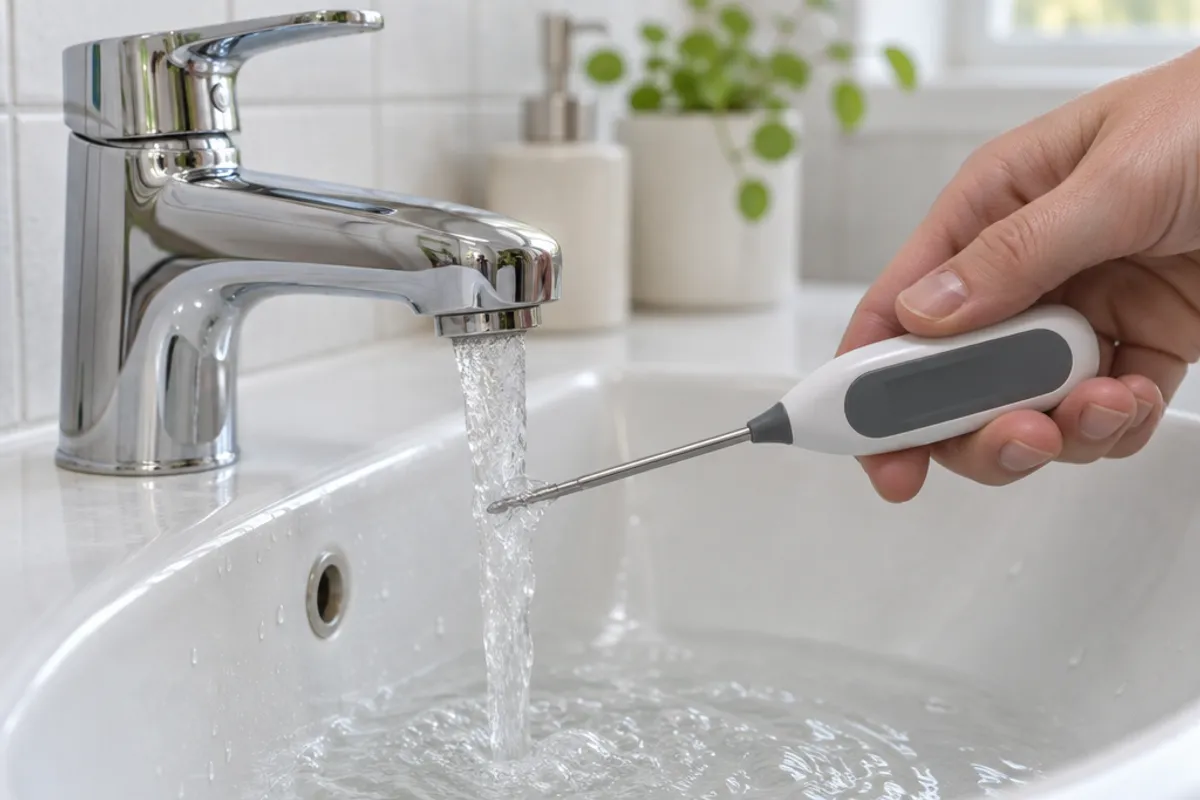
Mineral deposits, sediment and scale build up on the element, screens and check valves, corrosion can stiffen moving parts, and a valve can drift from its setting without anyone noticing. The CDC's building toolkit lists thermostatic mixing valves among the parts to clean and maintain regularly, so plan maintenance into the year. For proper operation, test yours from time to time: run the fixture it serves and hold a thermometer in the stream to read the water temperature delivered. The CPSC suggests a candy or meat thermometer for checking water temperature at the faucet.
Cleaning the cartridge and check valves
If the reading is off, or the flow has dropped:
- Shut off the water to the valve, at its isolation valves or the main water shut-off valve, and open a faucet downstream to relieve the pressure.
- Reach the valve: at the heater, under the vanity, or through the access door in the wall.
- Take out the cap and cartridge as the maker's instructions describe, noting how they came apart.
- Clean the screens, the cartridge and the check valves following those instructions, clearing any mineral deposits, and replace worn parts or the whole cartridge if it no longer holds temperature.
- Reassemble, turn the water back on slowly and check every joint for drips.
- Set the temperature as the maker says, then test the water temperature again with the thermometer.
Adding or moving a mixing valve usually means cutting and soldering pipe next to a gas or electric water heater. Use a licensed plumber where your area requires one.
Why does a mixing valve in a wall need an access door?
A valve that needs regular cleaning and testing is no use sealed behind drywall. Plan the opening while the wall is open, on the side where it will be least seen, such as a closet behind the tub, and keep it out of the spray.
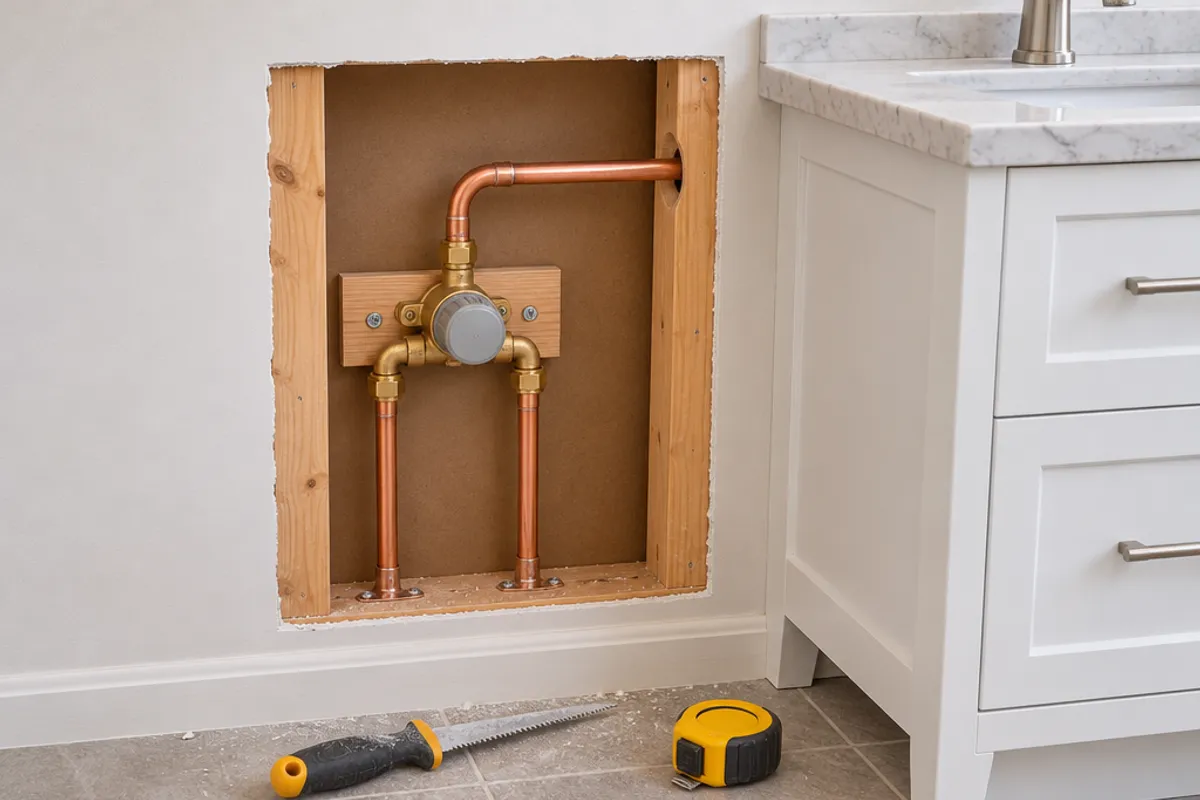
Measure across the valve, its unions and check valves, plus space for a wrench (see how to measure for an access panel). Then choose a hinged access door:
- The PAD0808 is 8 × 8 in overall, with a 6.35 × 6.35 in service opening and cut-out with rounded corners. That suits a compact valve you reach with one hand.
- The PAD1212 is 12 × 12 in overall, with a 10.35 × 10.35 in (estimated) service opening and cut-out, for both hands and a wrench.
Each door's product page has a 1:1 cut-out template, the frame screws on over the opening, and the screws come with the door. Neither door is fire-rated or water-resistance-rated. Compare hinged access doors and plumbing access panels, or read spring-loaded panel vs hinged access door.
Rules for anti-scald devices differ in many jurisdictions, so check compliance with your local building or plumbing inspector before you install or replace one.
Next, read what an access panel is, and compare every opening on the access panel size chart.