
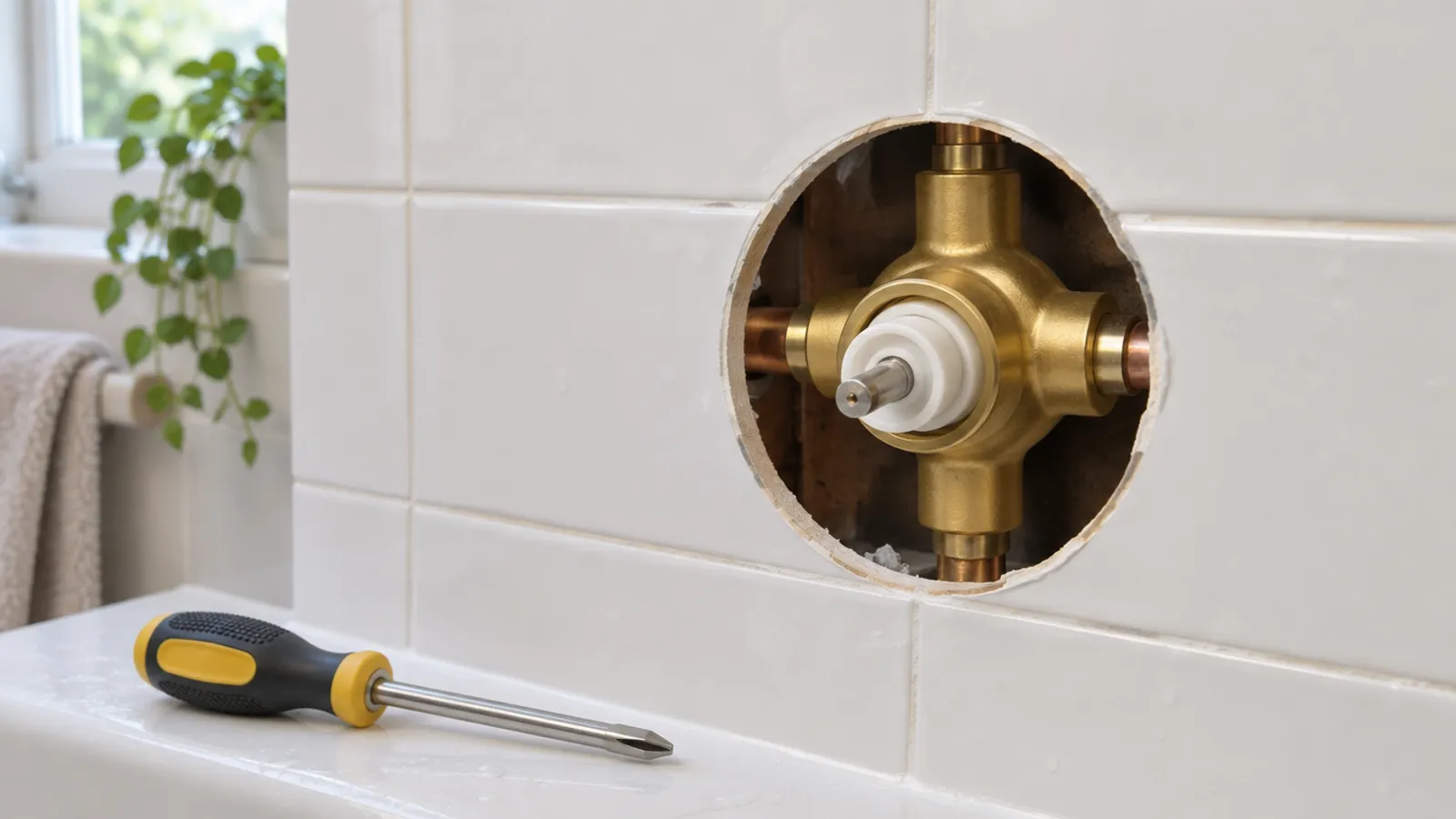
Most shower valves outlast their cartridges. The brass valve body behind the tile usually stays in service until it cracks, corrodes or a remodel replaces it, while the cartridge and its rubber seals wear out with use and hard water. No maker's page we read gives a set number of years, so watch for the signs, not the calendar.
Most repairs mean replacing the cartridge from the bathroom side. A cracked or leaking body is repaired from the room on the other side, which saves the tile.
What is the shower valve life expectancy?
Makers publish terms, not a lifespan. One large maker's lifetime limited warranty says its faucets stay leak- and drip-free during normal use while the original buyer owns the home, and its support page says that covers many of its showers. Another maker's terms cover faucet parts on the same basis. Both cover only recent products and exclude normal wear and tear, which is how a shower faucet cartridge fails, so neither is a promise about service life.
Here is what wears and what lasts:
| Part | What wears it | What to expect | Reached from |
|---|---|---|---|
| Cartridge (or stems on older valves) | Daily use, hard water, mineral buildup, grit from the water supply | The usual first failure | The bathroom side |
| Rubber seals and O-rings | Age, scale, harsh cleaners | Wear with the cartridge | The bathroom side |
| Valve body | Freezing, corrosion, a leaking joint | Usually outlasts the cartridge | The room behind |
| Handle and plate | Cleaners on the surfaces, knocks | Finish wear, a loose handle | The bathroom side |
Do shower valves last as long as bathroom faucets?
Inside, they wear the same way: bathroom faucets on sinks and bathtubs use the same kinds of cartridges and seals. The difference is access. A sink faucet sits in the open, like most fixtures; a shower valve is installed behind tile.
How long do shower cartridges last?
Water quality and use make a big difference, more than age. Hard water leaves mineral buildup that stiffens the internal parts and scores the rubber seals. Plumbing sites quote lifespan ranges in years, but none of the makers' pages we read does, so treat age as a reason to check, not a replacement date.
Replacing a faucet cartridge is usually a straightforward swap from the front, and it restores the valve without cutting anything. Material quality matters here: a replacement cartridge of poor quality, or one made for a different model, can fail early.
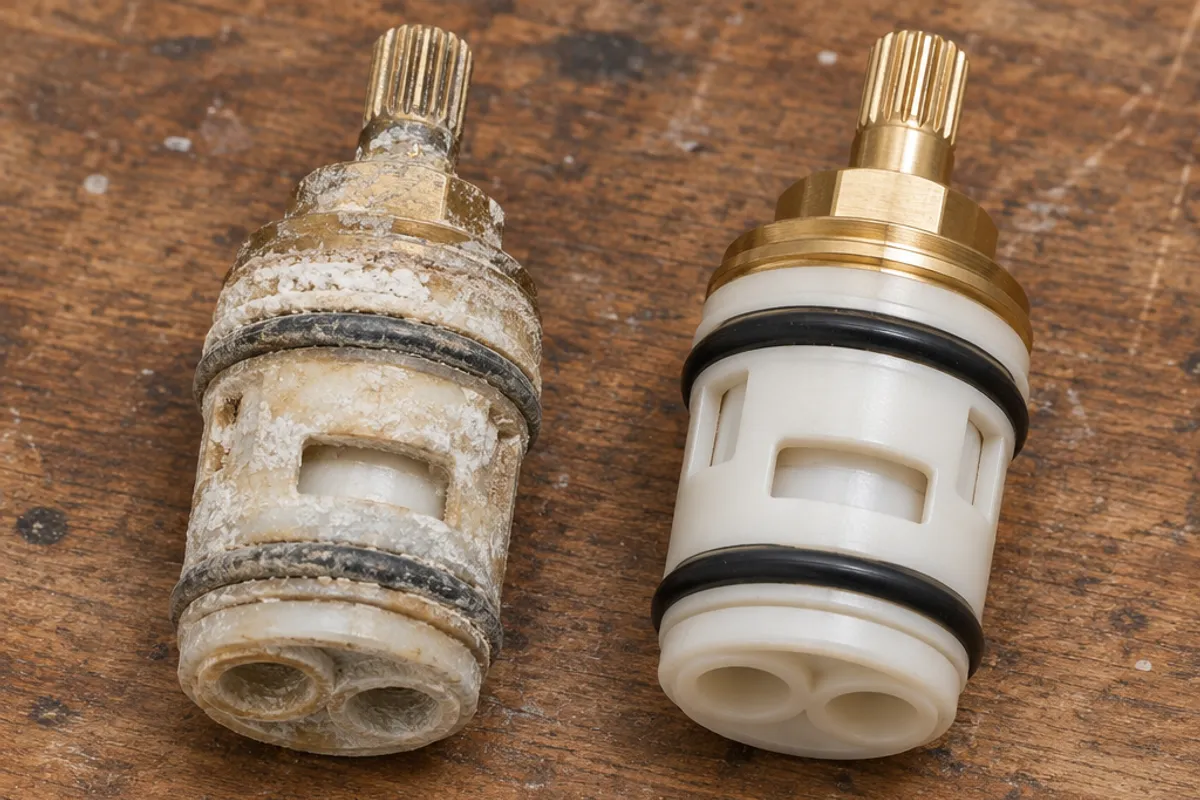
Does a pressure balance valve need its own cartridge?
Yes. On many pressure balance valves the cartridge holds the balancing parts that keep a flushing toilet from swinging the water temperature hot or cold, so the new one must match the faucet's maker and model. If the shower still swings when a toilet flushes, those parts are worn. Take the old cartridge with you when you buy.
What are the signs of a bad shower valve?
Most point to the cartridge, the faucet's main wear part, but rule out the simple causes before replacing anything. After that, one maker's support pages on leaks, water that isn't hot enough and low flow for its shower valves point to these parts:
| Symptom | Simple causes to rule out | What the maker's pages point to |
|---|---|---|
| Drips or runs after you shut it off | A handle not fully closed | Replace the cartridge |
| Water temperature not hot enough | A closed stop, the hot water off, the handle's limit stop | Replace the cartridge, then flush the valve |
| Pressure drops as you turn toward hot | A partly closed stop | Replace the cartridge |
| Weak water flow at the spout and shower head | A partly closed stop | Replace the cartridge |
| Weak water flow at the shower head only | A clogged head: take it off and test the arm | Clean or replace the shower head |
| Water behind the wall or around the handle | A loose cartridge retaining nut | Check the valve connections behind the wall |
A failing shower valve that leaks inside the wall can do significant damage before it shows as a stain on the far side; see leak behind a shower wall for the tests.
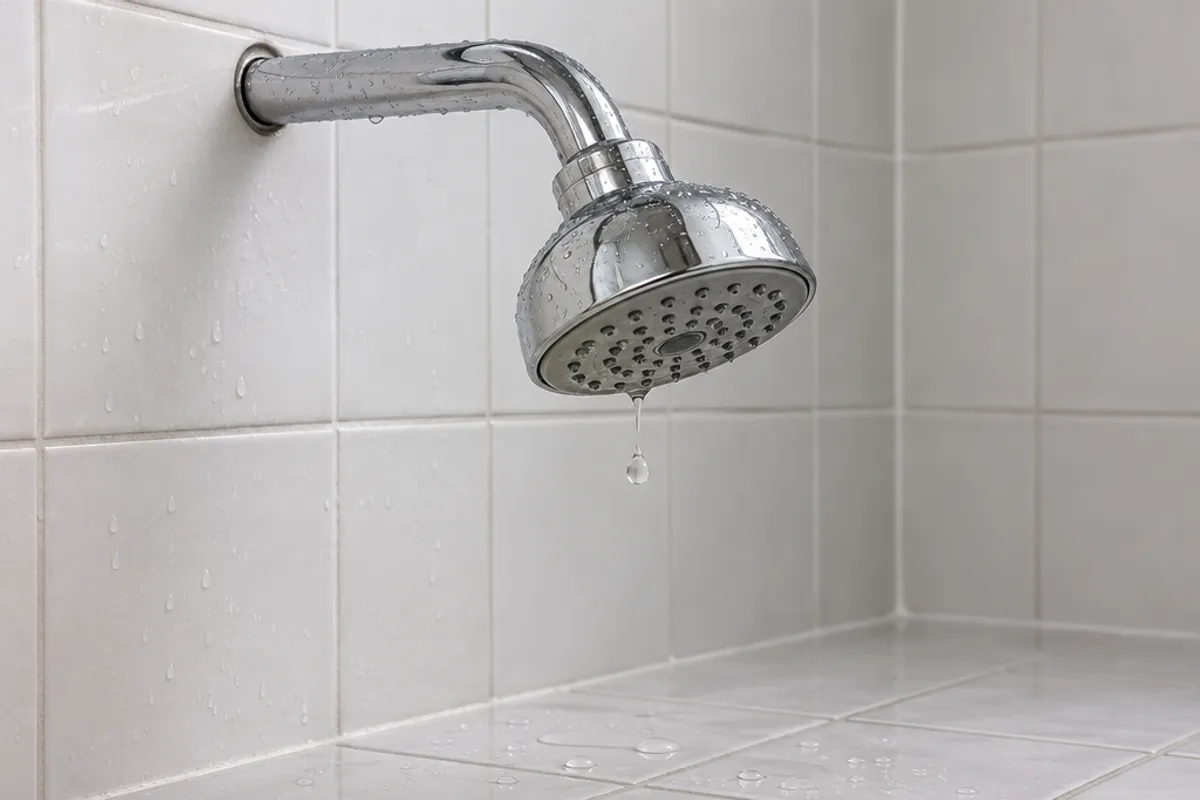
Is a stiff handle a sign of a failing shower valve?
Often. Scale on the cartridge makes the handle stiff and the temperature hard to set, and forcing it can break the stem. A new cartridge usually brings back smooth operation.
Is low water pressure the valve or the shower head?
If only the head runs weak, clean it. Low water pressure at the tub spout too points to the cartridge or a stop that isn't fully open.
Could the cause be elsewhere in the plumbing system?
Yes. A water heater that can't keep up, high pressure across the house or a failing pressure regulator shows up at other fixtures as well as the shower, because the whole plumbing system feeds them. The same maker notes that groundwater temperature changes through the year, so winter showers can feel cooler. If every fixture in the house acts the same way, the shower valve isn't the problem.
When is replacing the cartridge enough?
When the body is sound. Shut the water off at the stops or the main shut-off, open a tap to drain the lines, remove the faucet handle, trim plate and retaining clip, pull the old cartridge, and fit the new one following the maker's installation instructions. A stuck diverter is a similar job: see how to fix a shower diverter in the wall.
Frequent repairs are the warning sign. If replacing the cartridge doesn't stop the leaks, or the old one won't come out of corroded threads, suspect the body.
When does the valve body need work from behind?
Repair or replace the whole valve from behind when:
- a joint in the stud bay leaks: one maker's leak guide sends you to the valve connections behind the wall once tightening the retaining nut fails;
- it cracked after freezing, or corrosion has eaten the threads;
- no replacement parts exist for an old valve;
- a bathroom remodel changes the valve type.
Replacing the valve itself is a bigger service job than any cartridge: the new one must sit at the depth the old one was installed at, so it lines up with the existing tile opening and handle plate. Follow its installation instructions, and see standard shower valve height and what a shower valve is.
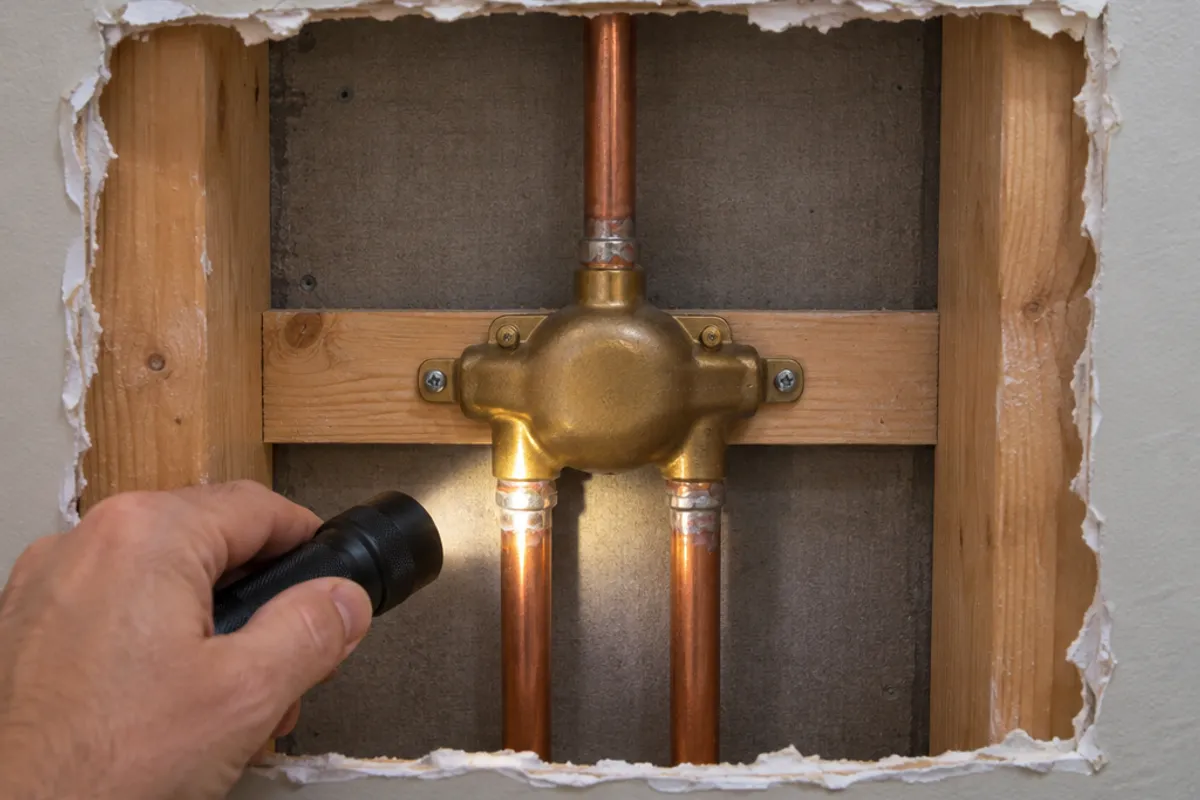
A new valve means cutting and joining pipe, often with a torch near wood framing. Use a licensed plumber where your area requires one, and ask your local building department whether the job needs a permit. Shut off the water before anyone opens it up.
How do you reach the valve body without cutting tile?
From the room behind. If the shower backs onto a closet, hallway or bedroom, open the drywall there between the studs, centered on the valve. Drywall is quick to cut and close; tile is not. Close the opening with a removable cover, so the next service visit takes minutes:
- Over a single valve: SAP1414 spring-loaded panel: fits 10 × 10 to 14 × 14 in openings, overall 16 × 16 in. The cover lifts off for a full view of the joints.
- If you want it to latch: PAD1212 hinged door: maximum service opening 10.35 × 10.35 in (estimated), overall 12 × 12 in.
Keep it on the dry side, never inside the shower. In an exterior wall, or with tile on both sides, there may be no room behind; plan the access at the next remodel. See shower access panels for more options.
Our plastic access panels and doors are not fire-rated, and we publish no water-resistance rating for them, so don't fit one in a fire separation, such as the wall between a house and an attached garage.
How can maintenance make a shower valve last longer?
Regular maintenance is simple:
- Follow the maker's faucet care and cleaning instructions; one maker excludes damage from ignoring them.
- Use genuine replacement parts; one maker's terms don't cover damage from others.
- Treat hard water if scale builds up on your fixtures, and fix a drip early, before grit scores the seals.
- In cold regions such as Alberta, Quebec and the Maritimes, keep valves out of exterior walls; see how to thaw frozen pipes in a wall.
That maintenance extends the lifespan of the cartridge and seals. For the valve itself, plan a way in before you need one, and size the opening to the valve and your hands.
Measure before you order: our guide on how to measure for an access panel shows how, and the access panel size chart compares every opening and cover. How to install an access panel in drywall covers fitting it.