
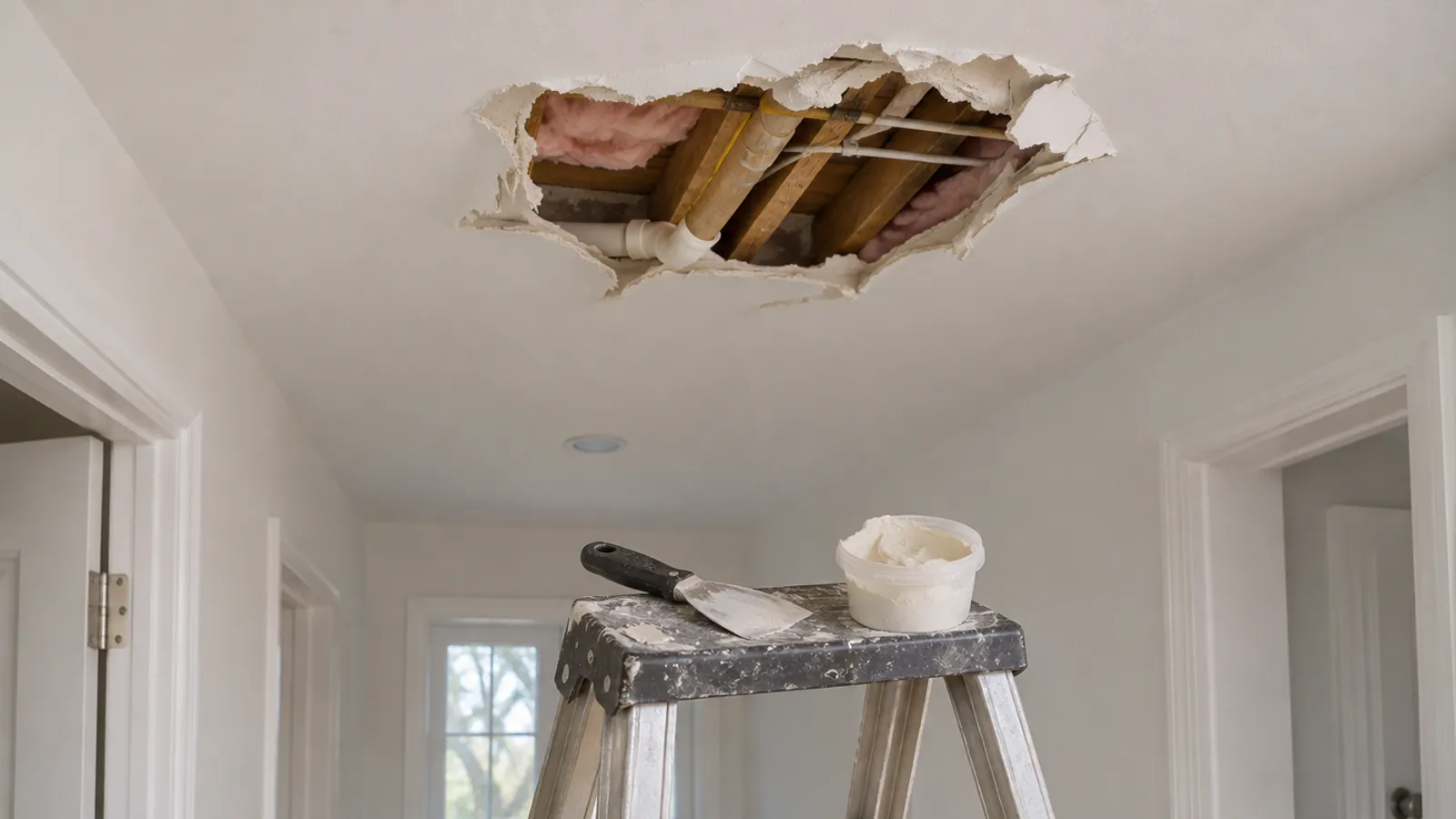
To fix a hole in the ceiling, match the repair to its size: spackle for nail pops and small holes, a mesh patch for medium holes, and new drywall on backing for large ones. Finish with thin coats of joint compound, then sand, prime and paint. Holes cut to service pipes or wiring get a removable panel instead.
This guide is about ceilings: working overhead, joists and backing, water damage, and openings cut for plumbing or wiring. For walls, see how to patch a hole in drywall.
How to fix a hole in the ceiling: which repair does your hole need?
Start by knowing what made the hole and what is above it. Ceiling holes come from nail pops, a foot through the attic floor, a leak, a removed light, or a tradesperson who needed to get above the drywall. The cause decides the repair as much as the size does. These are the common types of damage:
| Hole or damage | Repair |
|---|---|
| Nail pops, screw holes, small dents | Spackle or a little joint compound |
| Small to medium hole | A self-adhesive mesh patch, or a backed patch for larger ones |
| Large hole | Cut to a rectangle, add backing, screw in new drywall |
| Water damage | Fix the leak, let it dry, cut out soft drywall, then repair |
| Opening cut for plumbing or wiring | A removable access panel, if anyone will need to get back in |
| Round hole from a light or fan | A patch, or a round panel once the wiring is dealt with |
Determine the ceiling type too. The steps below are for drywall (gypsum board) on wood joists, the usual ceiling in newer houses. Plaster needs a different approach, explained at the end, and a suspended ceiling only needs a new tile.
What tools and materials do you need for ceiling repair?
Most ceiling repair jobs use the same small kit of tools and materials, and a DIY repair needs no professional tools. Gather everything before you climb the ladder.
Tools: a stable stepladder, safety glasses and a dust mask, a putty knife and a wider taping knife, a utility knife and a drywall jab saw, a carpenter's square and pencil to mark cuts, a drill with a screwdriver bit, a stud finder to help you find joists, a sanding sponge, a drop cloth and a flashlight.
Materials: lightweight spackle, joint compound (ready-mixed, or a setting-type powder you mix), self-adhesive mesh patches, mesh or paper joint tape, a drywall scrap the same thickness as your ceiling, drywall screws, wood strips for backing, primer (stain-blocking over water stains) and ceiling paint.
How do you work safely overhead?
Take care with the ladder: set it so the whole repair area is within reach, and move it rather than leaning out. Wear eye protection for every step, because cutting, applying compound and sanding all drop debris toward your face. Ceiling dust falls on everything, so keep the floor and furniture covered. If the hole is near a light, fan or smoke alarm, switch that circuit off at the breaker before you cut, and get help with any piece of drywall you have to hold over your head.
How do you fix nail pops and small holes in a ceiling?
Small holes are the easiest ceiling repair, and the only one that needs no patch. Look for more nail pops nearby: they often run in a row along one joist.
- For a nail pop, drive a drywall screw into the joist a short way from the popped nail so it pulls the board tight, then tap the nail just below the surface. Set the drill's clutch low, so it clicks before the screw head tears the paper.
- Clean loose paper and crumbs out of the hole with the putty knife.
- Press spackle or joint compound into the hole and scrape it flat in one pass.
- Let it dry, then add a second thin layer if it shrank.
- Sand lightly, wipe off the dust, spot-prime and paint.
How do you patch a medium hole in a drywall ceiling?
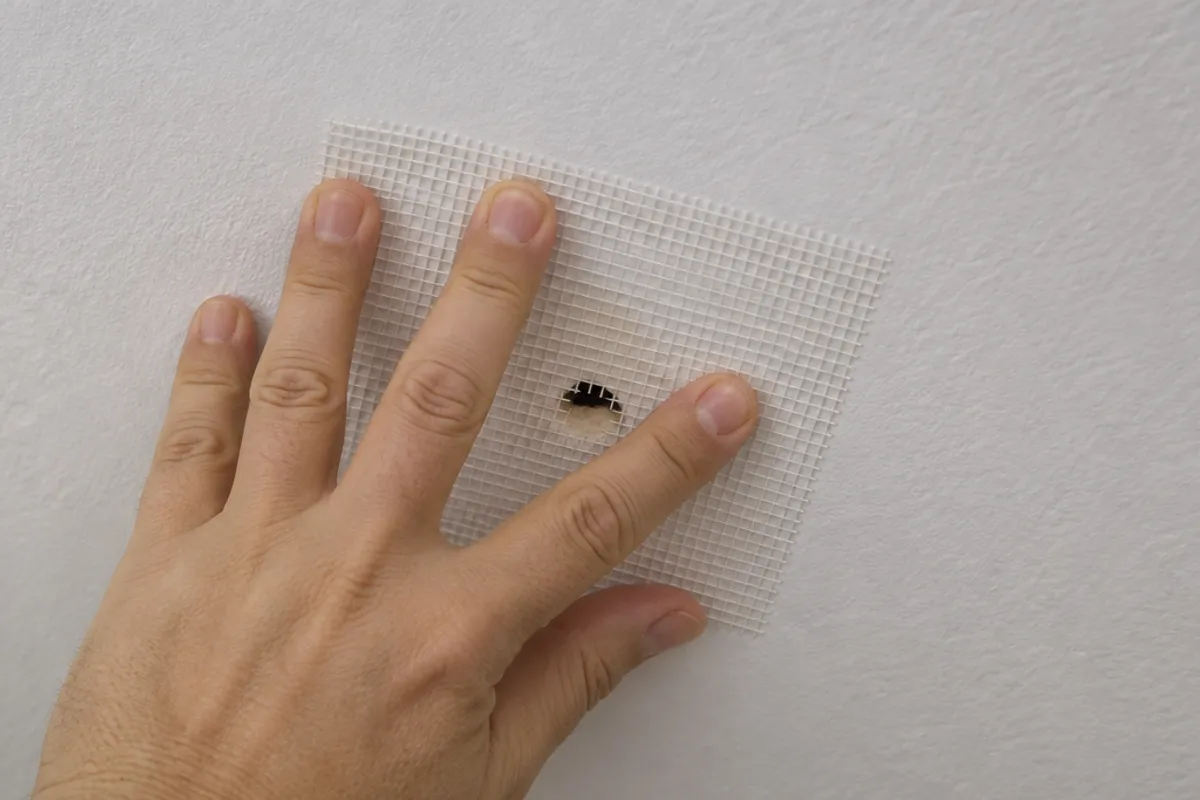
A self-adhesive mesh patch is the quickest fix for a hole too big for spackle but small enough to bridge.
- Trim torn paper and loose gypsum from the hole with a utility knife.
- Center the mesh patch over the hole, overlapping sound drywall on every side, and press it flat from the middle out.
- Apply joint compound over it, as in the steps below.
For a hole too big for mesh, use a backed patch. Cut the hole to a square, slip a thin wood strip through it, and drive a screw through the ceiling into each end of the strip to hold it in place. Screw a piece of drywall cut to fit onto the strip, then tape and finish the seams. If a patch flexes when you press it, it needs more backing.
How do you apply joint compound to a ceiling patch?
How you apply joint compound decides whether the repair shows. Overhead, thin coats matter even more than on a wall, and they are easier to sand.
- Load a bit of compound on the putty knife or taping knife and spread a thin first coat over the patch or tape, pressing it into the mesh.
- Feather the edges: press harder on the outer side of the knife, so the coat thins to nothing on the old ceiling.
- Let it dry completely before the next step. Drying time varies, so follow the directions on the package.
- Apply a second coat a bit wider than the first, and a third if the patch still shows.
- Sand only where ridges stand up between coats, then sand the final coat smooth with a sanding sponge.
Check the repair with a good flashlight held flat against the ceiling: the low light shows ridges and dips you cannot see from the floor. When the patch looks flat from every angle, it is ready to prime.
How do you fix a large hole in the ceiling, step by step?
A hole too big for a patch needs a new piece of drywall. Cut out all the damaged drywall, not just the hole, so the new piece sits against sound board. It has to hold itself up, so it needs solid support on every side.
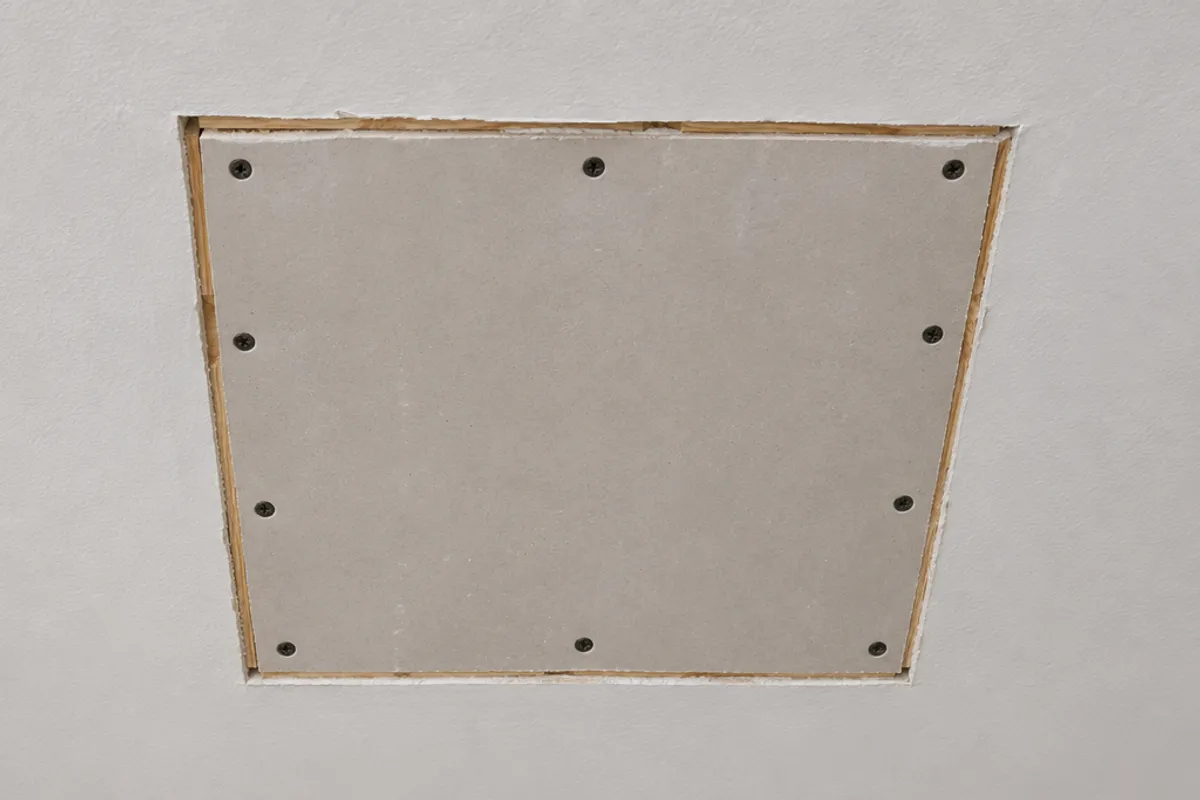
- Before starting, look inside with a flashlight and switch off nearby circuits. Determine where the joists, wires and pipes are before you cut.
- Mark a rectangle around the damaged area with the carpenter's square. If a joist is close, extend the rectangle to its center line, so that side lands on solid framing.
- Score the lines with the utility knife and cut along them with the jab saw, taking care to hold the piece so it does not fall.
- Where a side does not land on a joist, screw a wood backing strip in place on the back of the old ceiling along that side, half of it showing in the opening.
- Cut a new piece of drywall the same thickness, test the fit, and screw it to the joists and strips, setting each screw just below the surface.
- Tape the seams and apply the compound in two or more thin coats, feathering each one wider than the last.
- Sand, prime the whole patch, and paint once the primer is dry.
Get help holding the new piece in place while you drive the first screws, or prop it with a T-shaped brace cut from scrap lumber. Light from the windows rakes across a ceiling and shows a patch more than on a wall, so where a spot of new paint will not blend in, paint the whole ceiling. A flat ceiling paint hides small flaws better than one with a sheen.
How do you repair water damage in a ceiling?
Water damage is the one ceiling repair where the hole is not the first step. If you patch before the leak is fixed and the drywall is dry, the stain and the soft spot come back.
If the ceiling is sagging with water, or water is coming through near a light fixture, switch off the power to that area at the breaker before you touch it, keep out from under the bulge, and put a bucket under it. If you don't know which circuit feeds it, call a licensed electrician.
- Find and fix the leak. A stain under a bathroom often points to the shower: see how to find a leak behind a shower wall and how to replace a shower drain. To stop the water first, here is where to find the water shut-off valve.
- Let the area dry fully. Fans and a dehumidifier help, and a moisture meter tells you when the board is dry.
- Press the drywall around the stain. Mark all the damage, anything soft, sagging or crumbling, and cut the damaged drywall back to sound, dry board.
- Check the joists and any insulation above for wet spots and mold. Replace wet insulation and other soaked materials, and call a professional if you found mold over a large area.
- Repair the hole with the large-hole steps, then seal the remaining stain with a stain-blocking primer before you paint, or it can bleed through.
Damage often spreads further above the drywall than the stain shows, so look from above to know how far it went. In cold regions such as Alberta, Quebec, the Maritimes and the northern US states, a stain that shows up after a cold snap can come from a pipe that froze in an attic or an outside wall, or from an ice dam on the roof. Find which one it is before starting the ceiling repair.
When should you close a ceiling hole with an access panel instead?
When a plumber or electrician opened the ceiling to get to a shower drain, a trap, a shut-off valve or a junction box, a patch seals that part away, and the next repair means cutting the same ceiling again. If what is above will need service, close the hole with a removable panel instead.
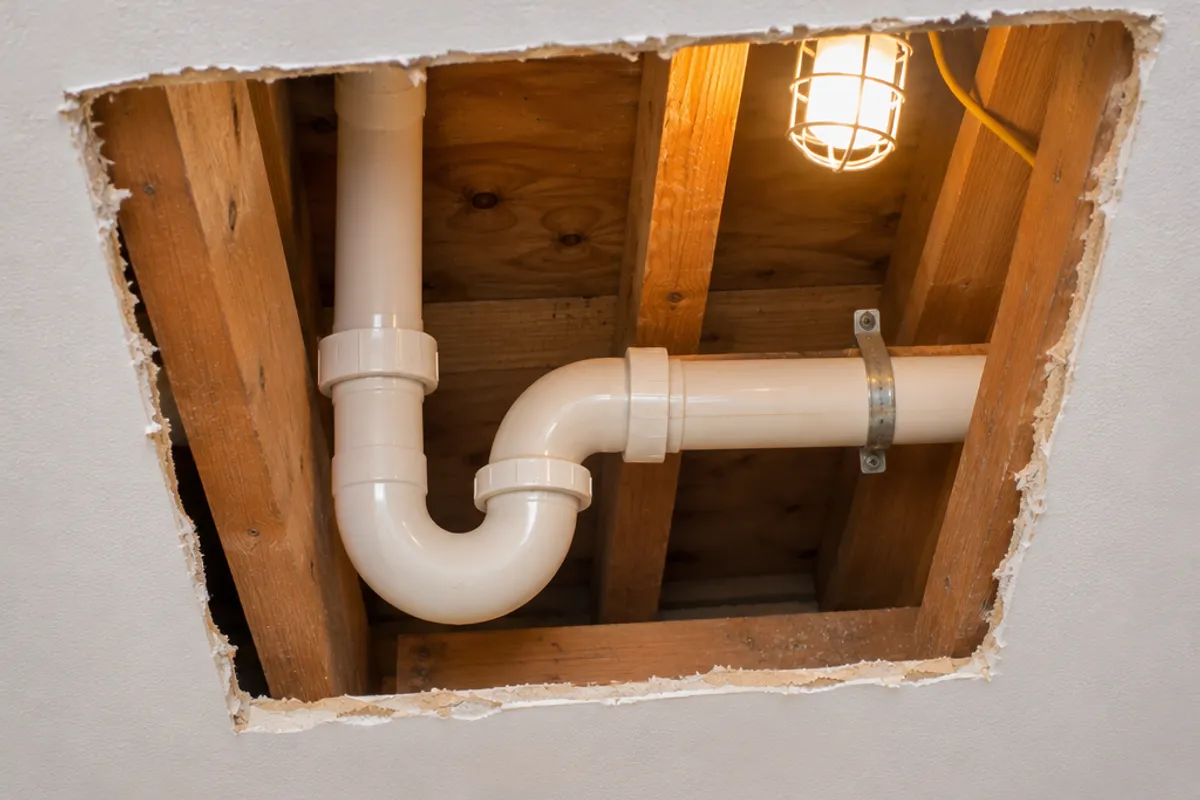
Next step: square the opening up between the joists and choose a panel that fits it.
| Model | Type | Opening | Overall size |
|---|---|---|---|
| SAP1414 | spring-loaded panel | Fits 10 × 10 to 14 × 14 in openings | 16 × 16 in |
| PAD1212 | hinged door | Maximum service opening 10.35 × 10.35 in (estimated) | 12 × 12 in |
| SAP10R | round cover | Fits 6–9 in round openings | 10 in diameter |
The PAD1212's frame sits on the ceiling and is screwed on, the screws come with the door, and its page has a 1:1 cut-out template. A hinged door is easier overhead if you open it often; a removable panel gives the whole opening. A plumber's opening is often bigger than a panel's range: patch part of it back with new drywall, then cut the rest to fit. Our guide to installing an access panel in a ceiling explains cutting and fitting overhead, and the ceiling access panels page compares the options.
How do you cover a hole in the ceiling where a light was?
The first step is to turn off the power at the breaker and test the wires. If an electrician has removed the box and the wiring, repair the hole like any other, or fit the SAP10R from the table. Check the size with our guide to measuring a round opening, and see every round model on the round access panels page.
If the box stays and still has wires in it, don't hide it behind a panel or under drywall. It has to stay accessible with a proper box cover: see can you drywall over a junction box.
Disconnecting a fixture, capping wires and closing up boxes is electrical work. Use a licensed electrician where your jurisdiction requires one, and check whether a permit applies.
Can you fix a hole in the ceiling yourself, or should you call a professional?
Most small and medium holes in a drywall ceiling are a good DIY job: the tools are basic, and the skill is mostly patience with thin coats. Call a professional when:
- the ceiling is sagging or wet, or the damage spreads over a large area
- a textured ceiling in an older home might contain asbestos: have it tested before you sand or cut it
- the ceiling is a required fire separation, such as some ceilings next to an attached garage: ask your building department what its repair needs. No fire rating is claimed for our panels or doors.
- the repair involves wiring, gas or plumbing
What if the ceiling is plaster?
Older houses often have plaster over wood lath or a gypsum base, and plaster ceiling repair is a different job. Small holes can be filled with patching plaster or joint compound. Larger holes need the loose plaster cut back to a firm edge and the lath checked. Plaster that sags or sounds hollow has come loose, so ask a plastering professional before you cut a large area.
Measure before you order: our guide on how to measure for an access panel shows how, and the access panel size chart compares every opening and cover.